I could live in Spanish Wells

You know the game you play, where you get to choose which famous person you’d most like to be shipwrecked with on a tropical island? (Or which ten books? Or which five foods?) Obviously you wouldn’t really want to be stuck on a deserted island with only that one person (Or ten books. Or five foods). You’d go crazy! But I honestly think I could live quite happily in Spanish Wells.
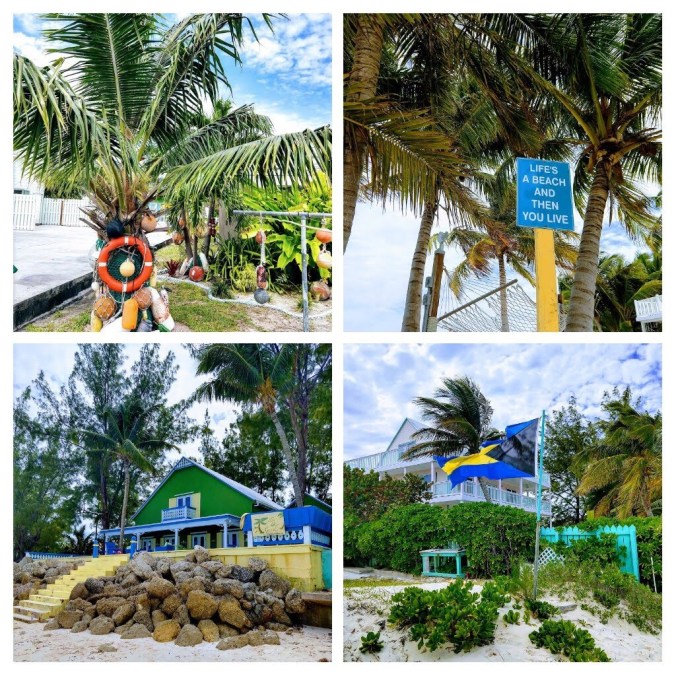
Spanish Wells is a small island off the coast of Eleuthera, and there’s been a community here since at least the 1700’s, when this town was founded by the loyalists. These were the folks who sided with the British, rather than the colonials, during the revolutionary war. Today, it is a prosperous fishing village made up of colorful houses with lovely tropical gardens. And the people we met here were the friendliest of our trip. We exchanged fish recipes in the local “everything” shop, and received waves or even offers of a ride from every car or golf cart that passed by. Now it is small, and everybody seems to be related (and named Pinder) so perhaps living here would get a little bit old. But I like to picture myself opening a beach bar, attending the local Independence Day festivities, and taking the water taxi to Eleuthera once a month for a big shopping trip.

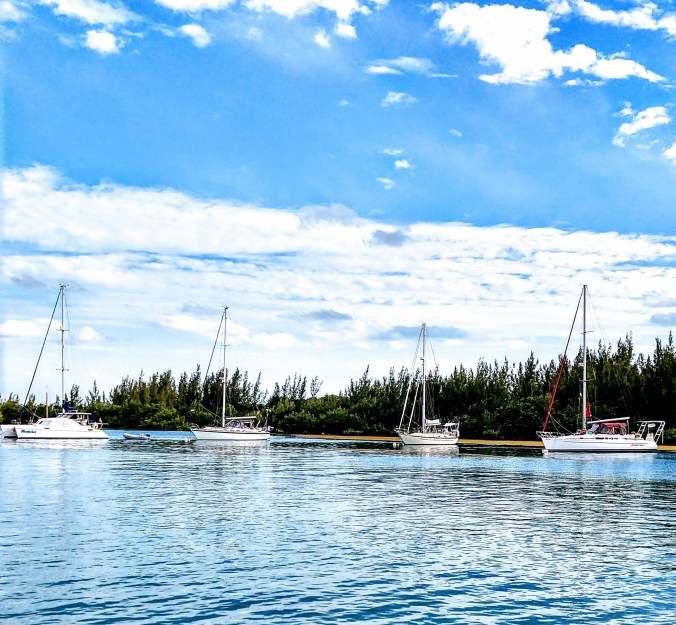
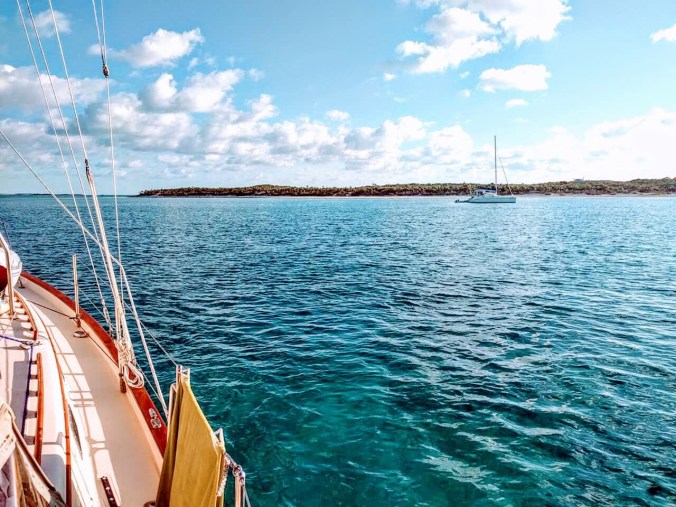
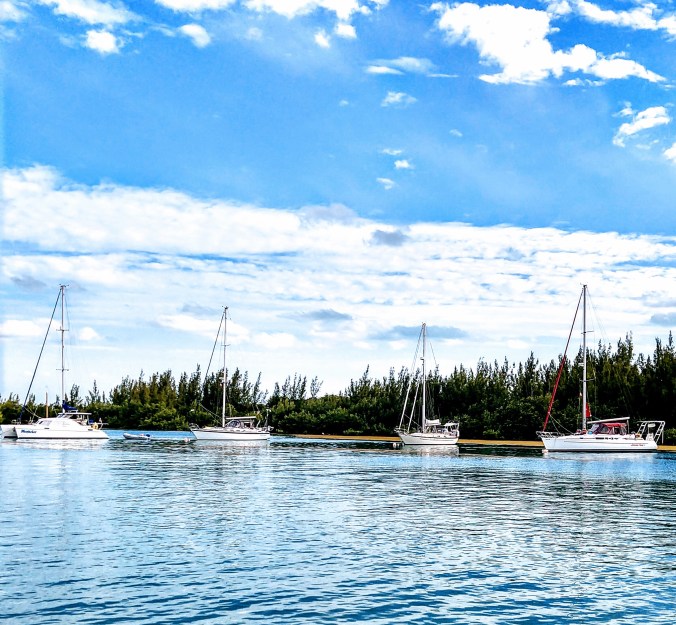
We stayed in the mooring field here, so that we were a short dinghy ride into town. But wow was this a tight field! Only eight balls, and the first time we cruised through, only one ball was open. I stood on the bow as we drifted toward it in slow motion and kept calling back, ” It looks shallow! It looks shallower.” Until, yes. We were aground again. This time, it was less dramatic because we were going so slowly, and the bottom was soft sand. Capt. Mike swung the boom way out to the side, over the water, and hung from the boom until Sanitas tilted slightly and slid off. We anchored outside the harbor that night, and tried again for a ball in a deeper section the next day!
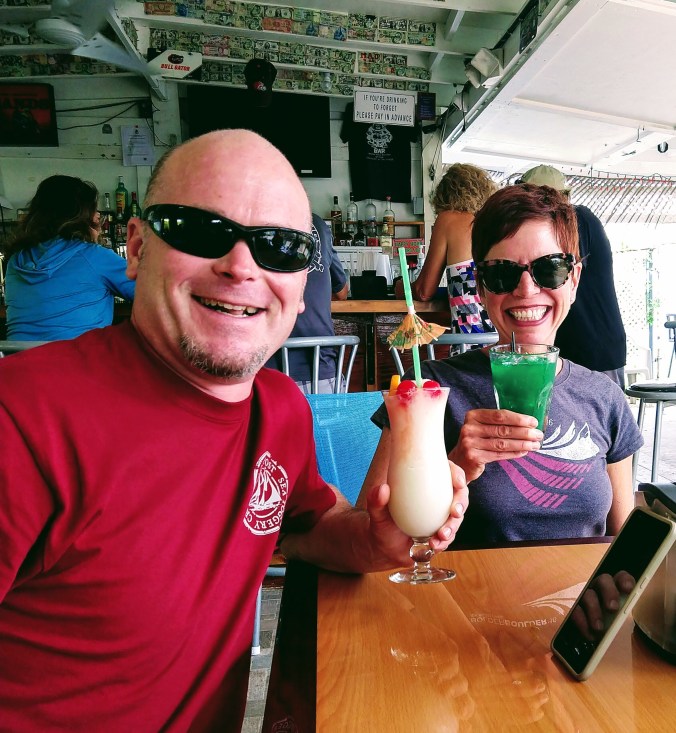
We explored the full length of both streets by foot, purchasing some supplies for boat projects, locally grown tomatoes (in March!), and an extra water bottle. Each day we were here, we spent some time at Buddha’s Snack Shack. Based out of a psychedelic school bus, Buddha and his wife and daughters run a funky little bar and restaurant serving creative burgers on homemade buns, delicious cracked conch, and stiff drinks. I ordered the signature “Dizzy Buddha” expecting an ordinary rum punch. But instead, it was bright green! I can’t tell you what it tasted like, or what it was made of, other than green. Glad I tried it!
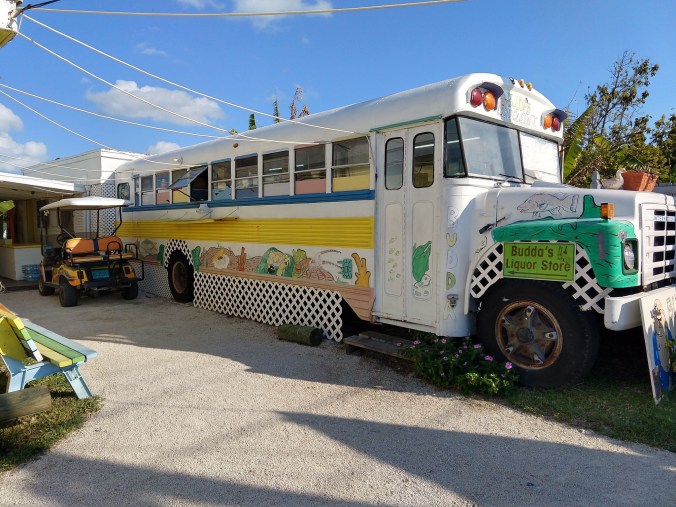
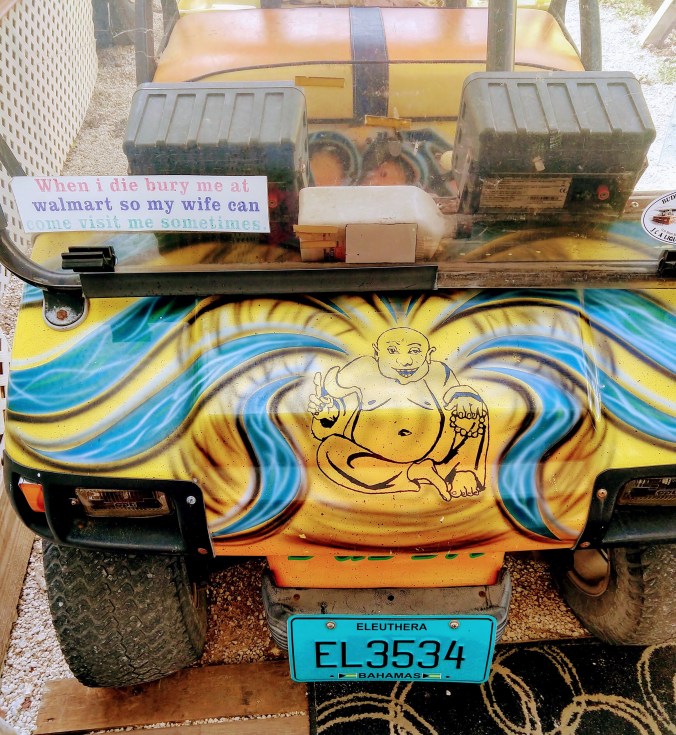
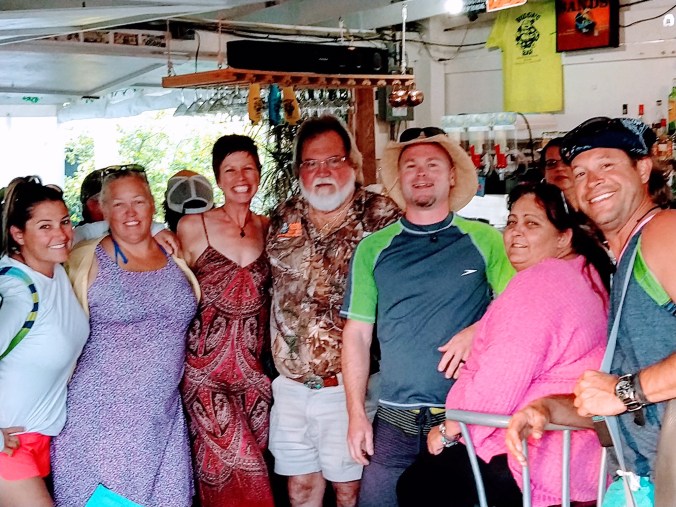
Got our photo taken with Buddha, himself!

Mike and I spent a day jogging the length of Spanish Wells, then crossing “our bridge” to Russell Island and back. It felt good to stretch our legs, and I made friends with the many goats we met along the way. Apparently, I speak excellent goat. “Mwaaaaaaaa…..”

I was only able to persuade Mike to run so far with the promise of a stop at SandBar. Good thing they posted a “Keep going. You’re almost there sign, right when we were about to give up.
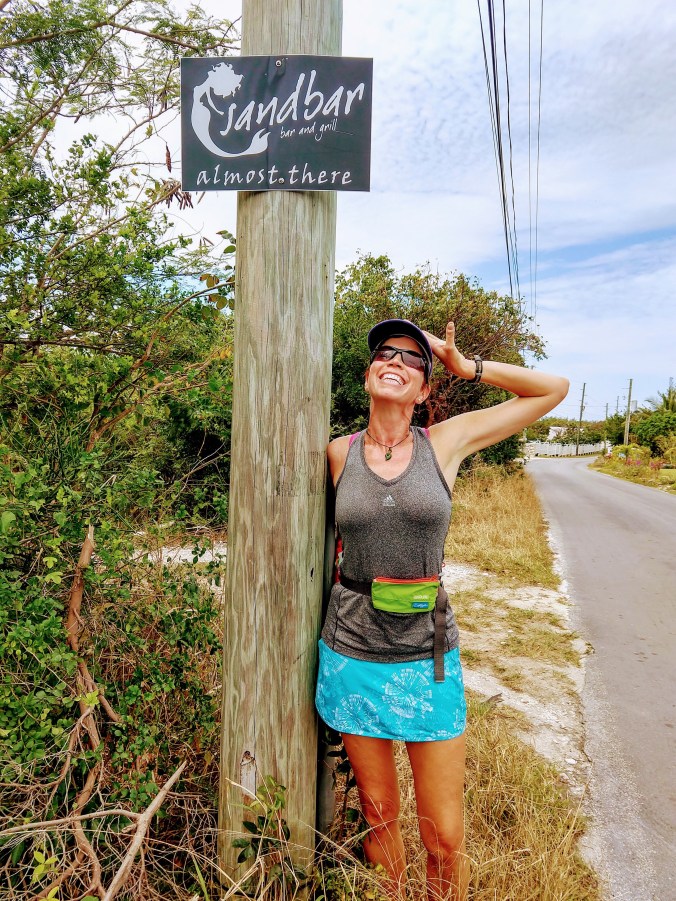
It was worth the long, hot trip to get here. A tiki hut, palapa roofs, and hammocks all facing a miniature sandy beach. We had the best blackened fish tacos we’ve found since leaving St Pete, and the Guava Lava cocktail wasn’t bad either.

Of course, tacos and cocktails made the return trip seem a lot longer and hotter. But our stop made for perfect timing to pass Bernie Sweetie’s fish dock. The boat was just drifting is as we jogged by, so we stopped to watch. No scale fish today, but some huge conch, and a bucket of live lobster. We’ll never be able to beat the price we paid for lobster back in tiny Foxtown, but here they were as fresh as can be. We watched the diver who had caught them chop their tails off right at the dock. The granddaddy 8-pound lobster looked at us quite sadly as he lost his tail. We bought a pound of lobster tails for $16 and grilled them for dinner.

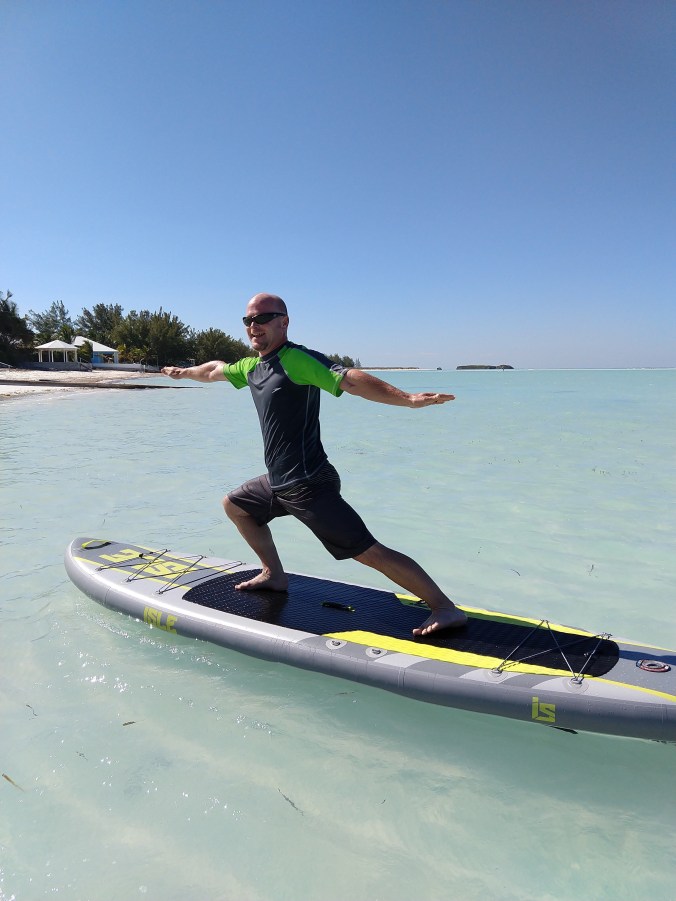
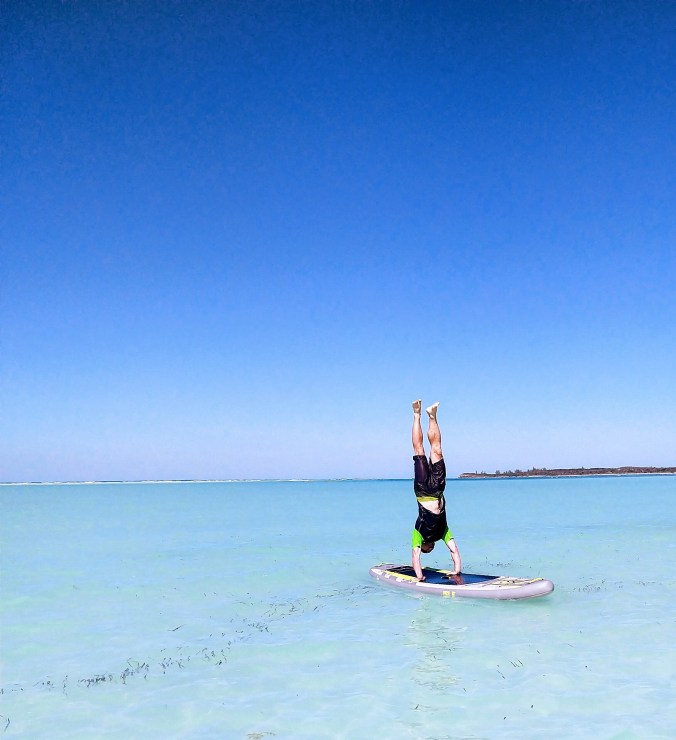
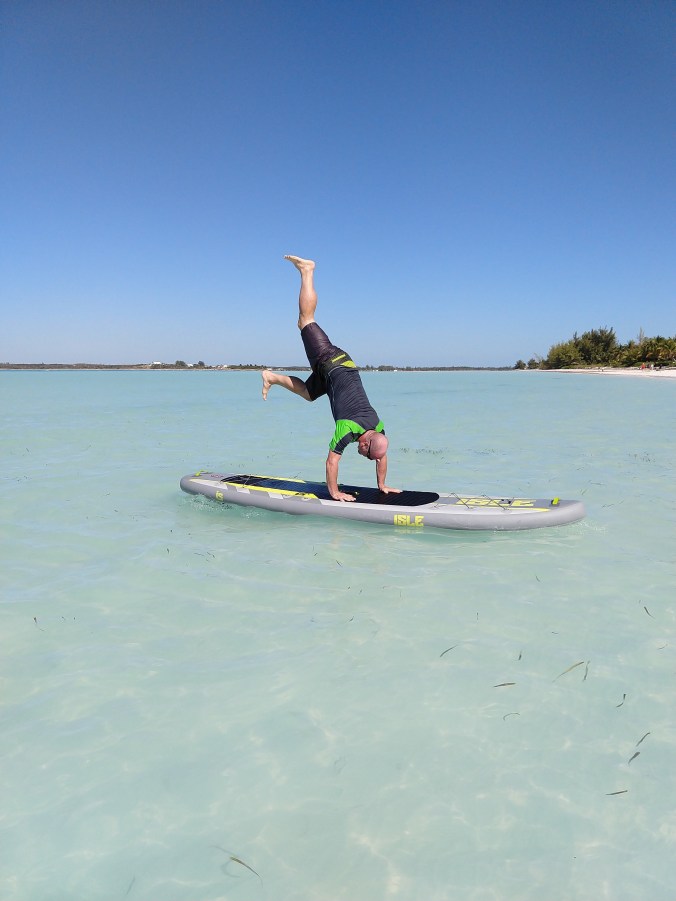
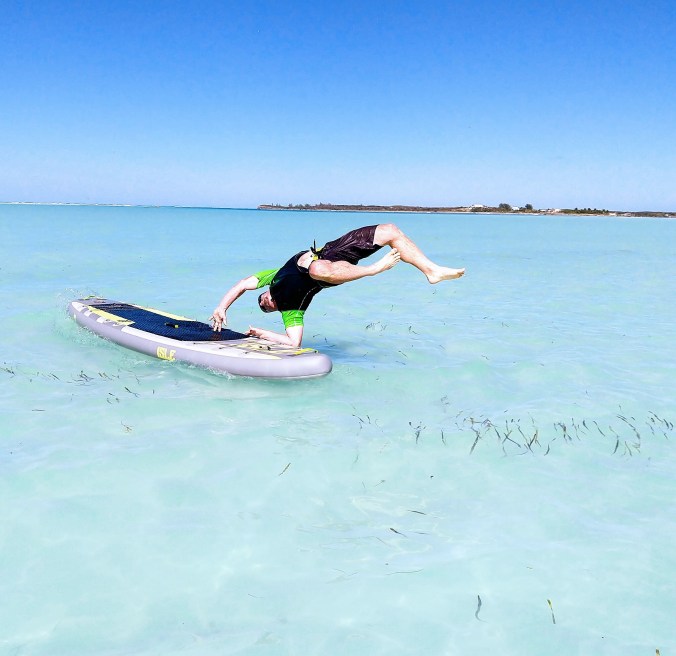
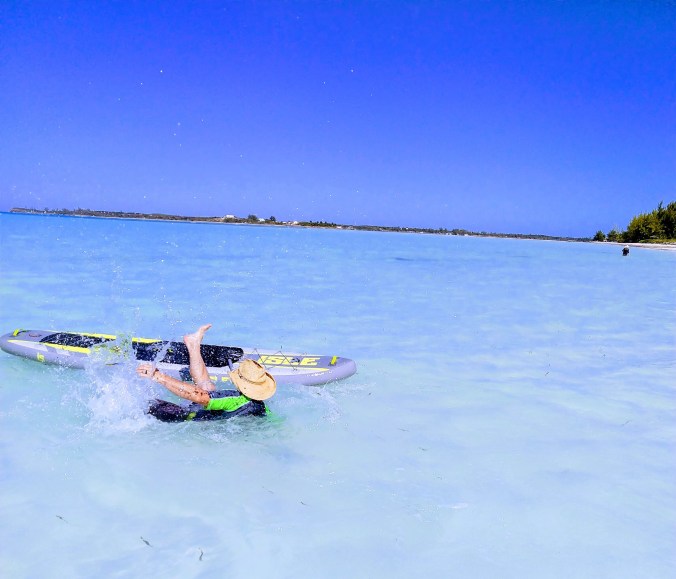
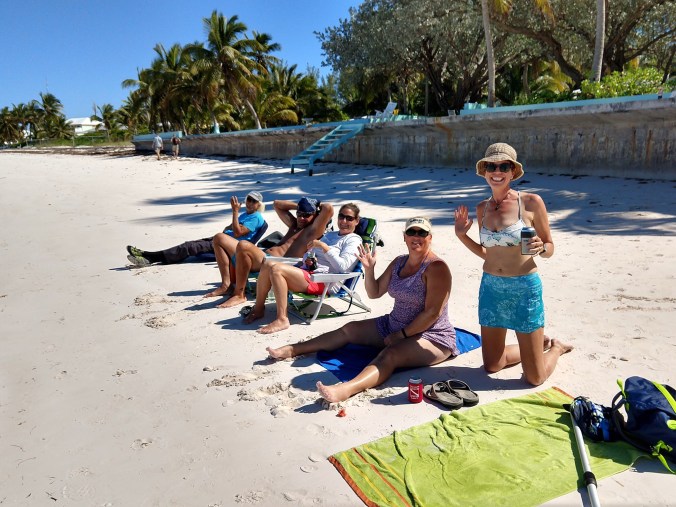
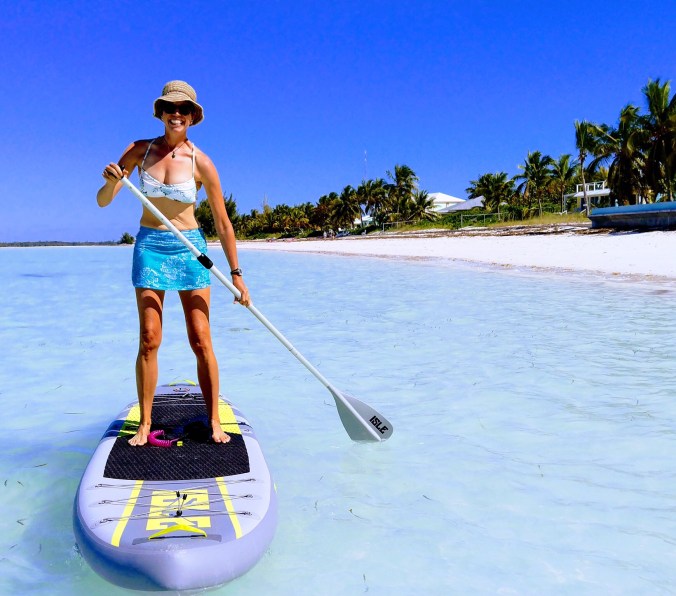
On our final day in Spanish Wells, we had a beach day on the long, pristine, sandy beach on the north side of the island. I broke out the Isle Explorer inflatable stand up paddle board that I got for Christmas, but hadn’t yet tried. This was a perfect place to test it out; calm, shallow waters, with stunning scenery to distract me just when I was starting to get the hang of it. Yep. I fell in a couple of times when I started getting too cocky. Mike took a turn and really showed me up. Just paddling around was way too easy for him, so he tried SUP yoga ( with Chris and Laura and I doing yoga poses on the beach to coach him) and then head stands. Believe me. I got some great shots of BOTH his successes and his failures. I definitely intend to return to this beautiful island someday!
Crossing the Coral Garden

Leaving Spanish Wells Harbor was a little bit more exciting than we had expected.

We’d spent three nights on one of Bandit’s mooring balls, but we had only paid for one night. It seemed bad karma, not to mention impolite to leaving without paying the rest. So we spoke to Mrs Bandit on the radio the night before leaving, and made a plan for him to pick up the money at 7:00 am – just before we headed out for the day’s sail. Apparently Mrs Bandit never told Mr Bandit the plan, because by the time we hailed him on the radio at 7:30, he was already two islands away. We tossed around some ideas of how to get him the money without too badly inconveniencing ourselves, and finally settled on giving the money to one of his friends at the fuel dock. So, we cruised ever so slowly past the dock and I shouted “Does anyone know Bandit?” When someone answered “Yes. I’ll make sure this gets to him” I leaned over and handed him an envelope filled with cash as we drifted by. Bandit, if you’re reading this, I hope you got your money. I handed it to the old fisherman with the beard. You guys know each other, right?

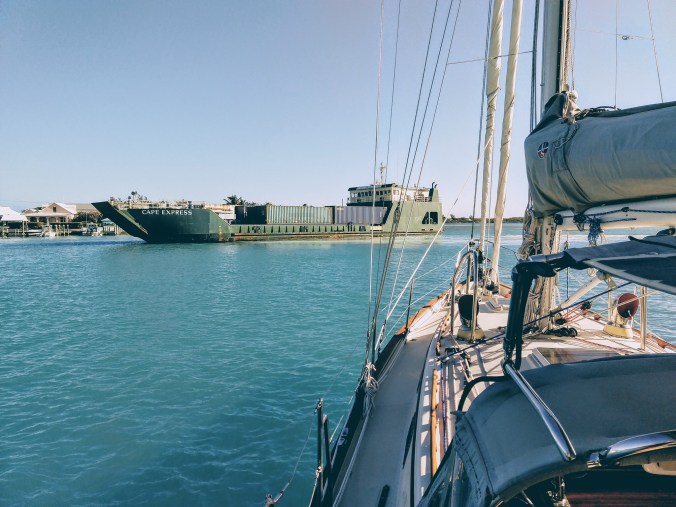
Then all of our comm systems suddenly blew up. I heard “Sanitas… Sanitas … Sanitas” on channel 71. Then a DSC direct call, which makes our VHF ring like an old-school telephone. Then my new-school cell phone started ringing (which happens so seldom, I don’t even recognize the ring tone). Our friends on Orion and Disorder were trying to alert us that a massive UFO-sized cargo ship had just entered the narrow Spanish Wells channel.

We were already trying to leave the harbor, and were pretty sure this channel wasn’t big enough for the both of us. So we did a little donut turn to slow down, and moved as far to starboard as we could while still staying in deep water. And I walked along the starboard deck of Sanitas fending off dock pilings with my bare hands. A crewman on the cargo ship waved at me. Now this all happened in fairly slow motion, so it might not have appeared at all dramatic to a bystander, but it was hair-curlingly nerve wracking to me and to Capt. Mike! Especially since I hadn’t had my morning coffee yet!

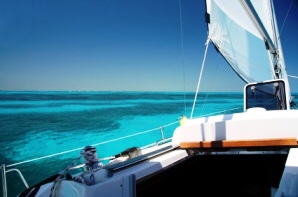
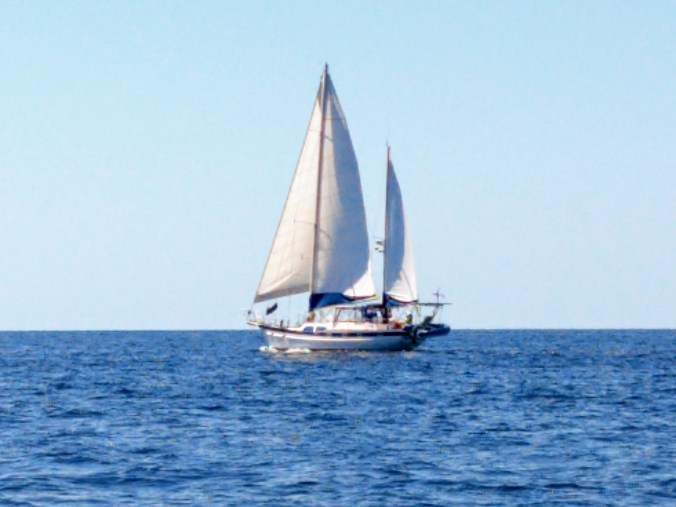
This was our easiest passage so far: smooth seas, light winds, no dramatic equipment failures. Crossing Fleeming Cut was a piece of cake. (Remember my goal for crossing cuts? No stories!) The trickiest part of this day was crossing the coral garden east of Nassau. The charts for this area are covered with plus symbols and warnings such as “Numerous Shallow Coral Heads”, “Unsurveyed Area”, and “Visual Piloting Rules apply”. We had downloaded a set of eight GPS waypoints from Drew on Z-Raye, and we used these points to guide us from Fleeming Cut down to the northern end of the Exuma Chain near Ship Channel. These waypoints helped immensely, but didn’t substitute for scanning the seas ahead, and adjusting course when needed.

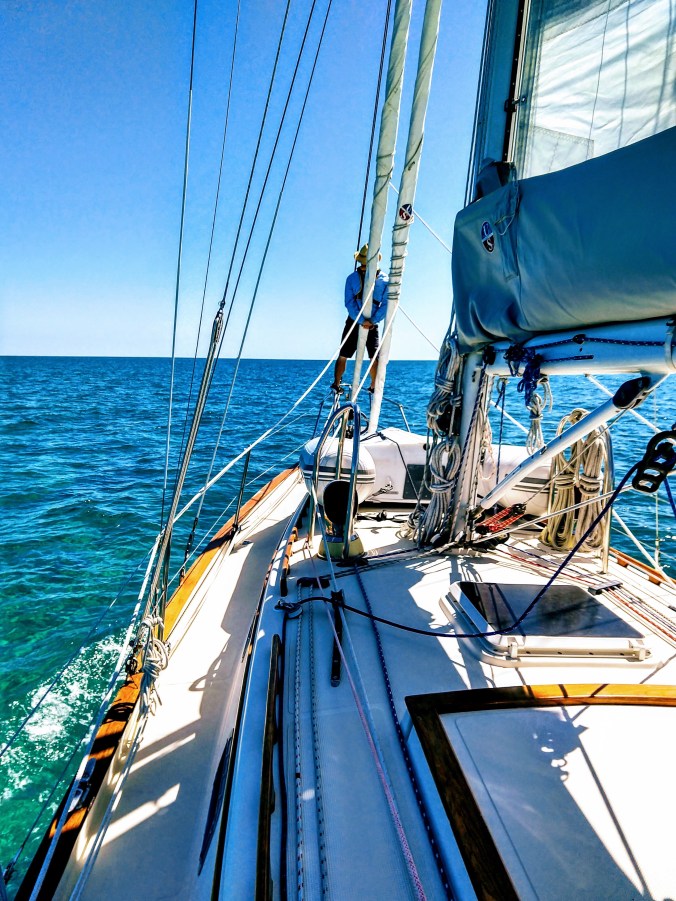
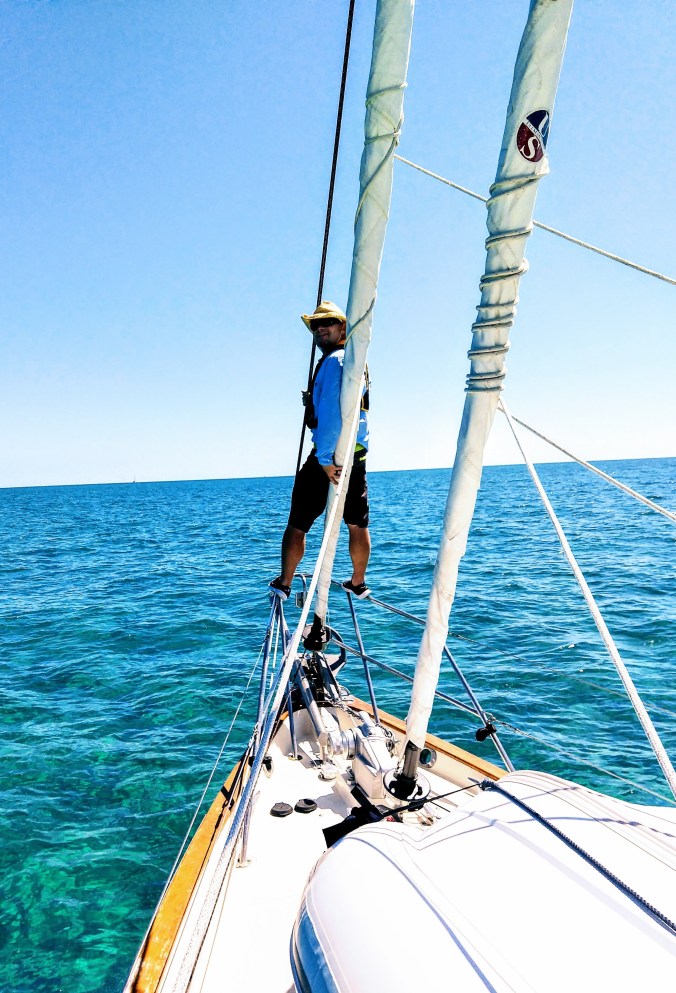
From about 1:30 in the afternoon to 4:30, Capt. Mike and I took turns standing on the bow of Sanitas, wearing polarized sunglasses, scanning the waters around us. We kept the autopilot navigating to the next waypoint, but when we’d spot a round, black coral head, the spotter on the bow would provide guidance to the person at the helm on how to avoid it. Things like, “Twenty degrees to starboard”, or ” hard to port”.

The coral was easier to spot than I had expected, and we usually saw them about a football field away. Still, it kept me on edge for the afternoon, especially when we were in the thick of it and there were coral heads to both sides and directly ahead of us. Once the sun got lower in the sky, it was harder to spot the contrast between the turquoise blue of the water and the black of the coral. I’m glad that by that point in the afternoon, we were through the thickest patch, and the need to frequently adjust course to avoid hitting the coral had diminished.

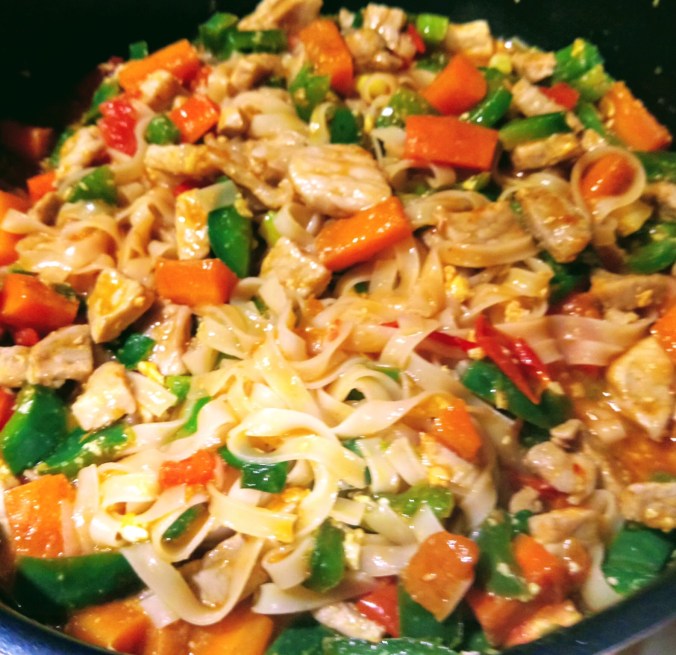
We pulled into the anchorage at Highborn Cay around 6:30 after about eleven hours of travel. Exactly one month after entering The Bahamas, we’d finally made it to the Exuma Islands! In addition to that milestone, we also celebrated six months since we left our jobs, AND Mike’s birthday. Fresh lime margaritas in the cockpit at sunset, using the last of our rapidly melting ice; homemade pad thai with ingredients from the tiny Asian market in Marsh Harbour, and gluten free brownies standing in for a birthday cake.

Now this is more like it!

Tool of the Day …. Pump Diaphragm

After the rough passage from The Abacos to Eleuthera all three boats in our little flotilla were bruised and battered. On Sanitas, the propane sensor was alarming and cutting off propane to the stove. This first occurred after the ingredients for dinner were chopped but before they were actually cooked. Doh! And more importantly, the bilge pump failed. Yes, that bilge pump. The one that drove Mike to stay up late every night in Marathon to ensure it was installed and working before we left Florida.

After pumping a 5-gallon bucket of dirty water out of the bilge by hand using a tiny portable pump (and dousing me with bilge water in the process) Mike started trouble shooting.

  • Sea grass clogging the input strainer? Nope.
  • Intake hoses clogged? Nope.
  • Output hoses clogged? Nope.
  • Thumb over the pump intake. Any suction? No suction.

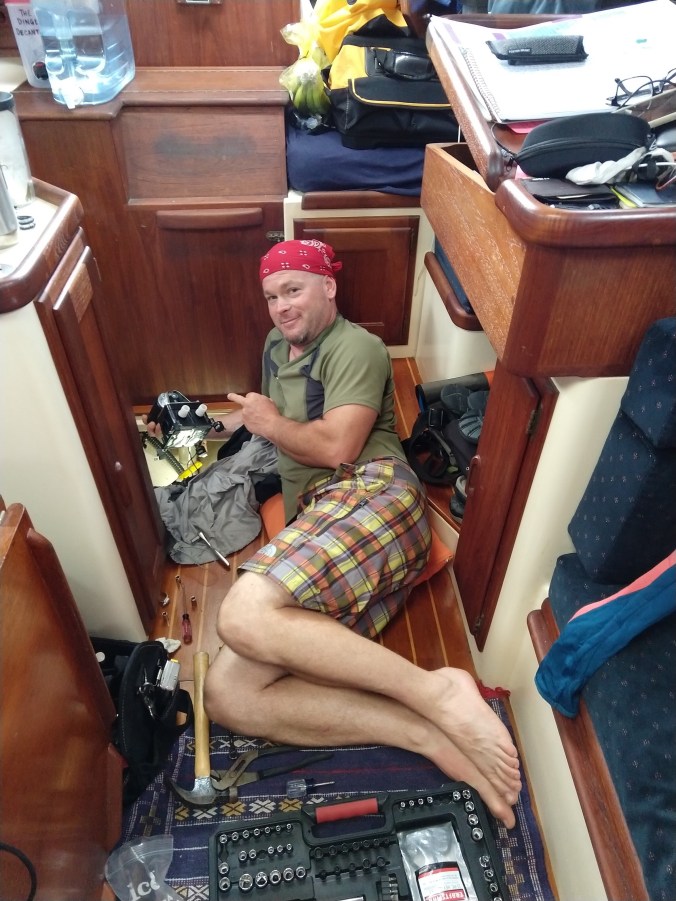
So we took the whole darn thing apart. I have a lot of photos from boat projects so far of Mike lying on the floor in this same place and in a similar measure of contortion.

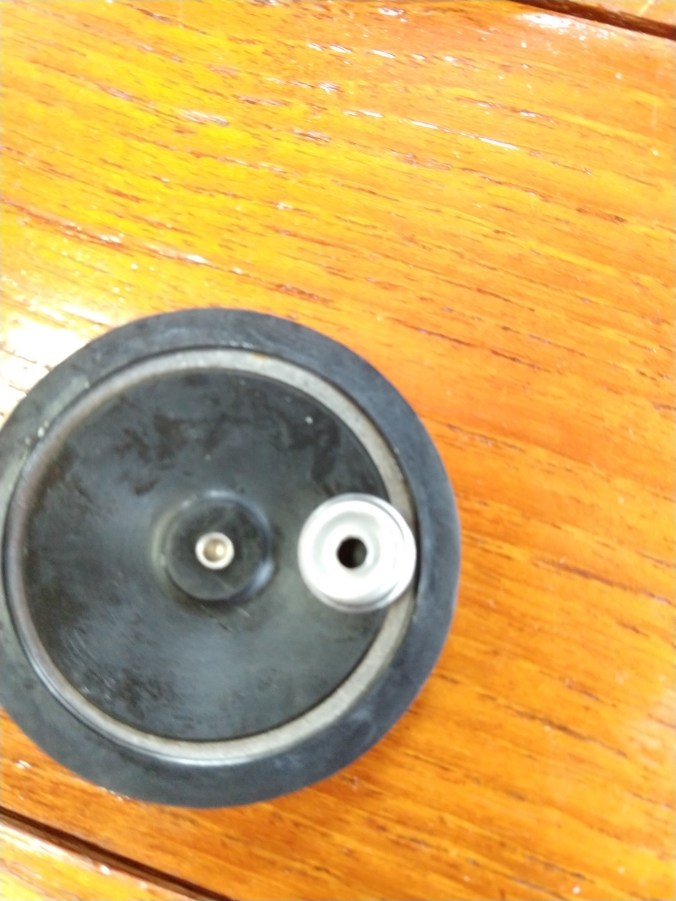
I am so impressed that Mike was able to find the source of the problem and to fix it! The diaphragm that performs the physical pumping is supposed to be held in place by a small metal cap. That cap had failed. Essentially this cap had bent in such a way that it no longer did its job of holding the diaphragm in place. But it was miraculously still sitting next to the diaphragm, instead of being lost somewhere in the dark corners of the bilge.

We jury-rigged a solution that should work until we can replace this specialized part. Mike re-flared the pin that holds the cap in place, using a #2 phillips head screwdriver bit. He pounded down on the head on the pin using a hammer onto the screwdriver bit until it was shaped more or less correctly and resumed its job of holding the diaphragm in place.

So far, so good! Of course while executing this project, we discovered that our back-up manual bilge pump doesn’t work. But rebuilding that pump will be another whole project for a later date.

It was supposed to be a smooth passage …

On March 10th, we finally headed south from the Sea of Abaco. After 10 days in Marsh Harbour, hiding from nor’easters, we had staged ourselves off Lynard Key, watched the weather, and listened to the cruisers net every morning to hear the status of the cuts. The cuts are gaps between Bahamian islands that allow you to pass from the protected waters of a sea or bank (such as the Sea of Abaco) into the open ocean. They can be tricky; narrow with rocks and reefs on either side, and a strong current either pulling you forward or fighting your progress. You need to time a cut passage properly, preferably at slack tide, when the wind is not working again the current and building up strong, high waves. I have a goal for cut passages, and that goal is “No stories.” There are many salty sailors who take pride in their horror stories, “I was passing through Whale Cut in northerly winds of 35 to 40 knots! The waves were as tall as houses! Only my arcane skills as a sailor and my brave heart enabled me to make it through unscathed!” Well personally, I prefer the uneventful, safe passage. Oh, and I passed through Whale Cut a few days ago. It was fine. Nothing happened. That makes for a boring blog post, I know. Sorry!

Anyway …. We had listened to the cruisers net hosted out of Hope Town every morning. The net coordinator shares a weather report from Barometer Bob, and invites folks to describe the conditions they are observing in the cuts. We decided to head south when the Little Harbor Cut transitioned from a “bouncy 3 out of 5” to a “very passable 4 out of 5 and improving” We had mapped out a course of approximately 60 nautical miles to Spanish Wells at the northern tip of Eleuthera. The trip was supposed to be calm and uneventful. We might even need to motor if the winds were too light to sail. We departed the anchorage just at sunrise, giving us almost 12 hours of daylight to make the passage. I had a book ready.

And the weather man was wrong! Winds were as high as 25 knots. Seas were 6 feet in the wrong direction to the wind. On the positive side, we sure had enough wind to sail! We spent the day heeled over at 15 to 25 degrees and sailing at 5 to 6 knots (fast for Sanitas). The wind was on our bow, as it always seems to be, and the seas were on our beam, so it made for “uncomfortable” conditions. I claim that I don’t get seasick, but I put that claim to the test today! At one point, I built myself a little nest of pillows in a corner of the salon, and wedged myself into the small space to avoid being tossed around.

All three ships in our tiny flotilla were battered today. On SE of Disorder, a bail broke on their main, causing lots of noise, and tangling the main sheet in the rigging. On Sanitas, the bilge pump stopped working, and the propane sensor broke so that we couldn’t use our stove. But Orion had the worst luck of the passage. They had sailed all day, bearing west of our rhumb line because it provided a better angle to the wind for a close reach. We could just barely see them on the horizon when they started up the engine and planned to motor straight into the wind to reach our destination for the evening. Over the radio we heard “Orion is having a very bad day.” They were getting absolutely no thrust from their motor, and feared the prop was missing – the victim of a large patch of seaweed they’d sailed through ten hours earlier. Bob had to get in the water, in those high seas, out of sight of land to check on the prop. (There would have been a lot of tears shed if that happened on Sanitas) Bob diagnosed that the prop was there, but the prop key was missing, allowing the prop to spin freely. Essentially, Orion had no working motor, and could only proceed under sail. That meant they couldn’t make it to Royal Island which was directly into the wind, and couldn’t get to Egg Island Cut and the hopefully calmer waters on the other side. Instead, they sailed all night long in deep safe waters, until they saw the lights of Nassau, and headed back north to join us in daylight and under better wind conditions. Capt Mike and I felt terrible as we watched them sail further away from us, and we instead made our turn toward Royal Island. We knew they’d soon be out of radio range and on their own for the night. And I have never been happier to hear Bob’s voice than when he hailed us at 6:00 am the next morning, after making it safely through the night, and only about three miles from our anchorage!

We’ve nicknamed Disorder “Toolbox” because Stan, a retired fire fighter, has every tool and part and spare you could possibly need aboard. Between our three boats, we had everything Bob and Mike needed to replace the prop key with Orion in the water. Even a small dive tank to facilitate the underwater repairs. The trip that took 12 hours and 60 miles for Sanitas took 120 miles and 30 hours for Orion, but she was finally anchored, repaired, and safe. And her crew could get some much needed sleep.