Everybody Poops

Remember that composting toilet? I’ve gotten a few questions about how our toilet works, and if we are still happy with our decision to replace the traditional marine head with a composting toilet. So far, I think we are happy with it, although that may be easy for me to say, because Capt. Mike is in charge of emptying the compost. If this post is TMI, I won’t be offended if you skip on to the next one……

Our Nature’s Head toilet functions by separating the liquid and solid waste, therefore keeping the odor down. It works by desiccating, or drying, the solid waste, killing bacteria and resulting in material that is the color and consistency of potting soil. A small fan circulates air through the head at all times, requiring very little battery power. We do need to remember to close the toilet vent each time we are under sail, to avoid getting ocean water in the vent, and we also unplug the fan so that it doesn’t overheat. These steps; unplugging the fan and closing the vent; and opening the vent and plugging in the fan are now part of our regular sailing checklist.

Number One:

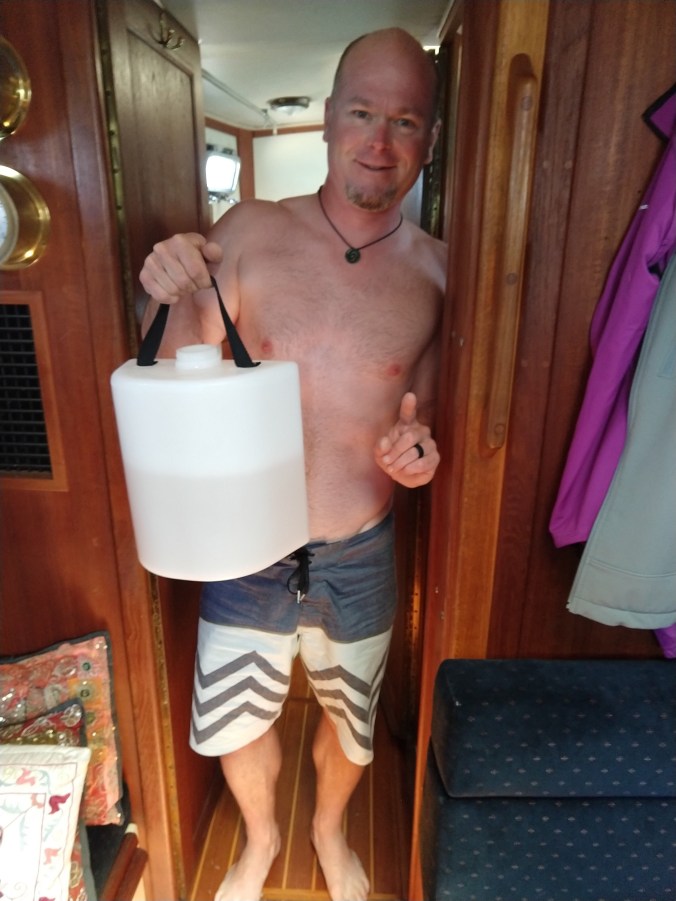
We empty the urine bottle every one to two days. This is the only part of the process that does have an odor. Not in the bathroom itself (the Nature’s Head design works really well to contain the liquid waste and accompanying odors) but when we remove the bottle and it isn’t capped. In a marina, we empty the bottle into a toilet. When we are three nautical miles out to sea, we empty it overboard. In a crowded anchorage, we wait for a better opportunity to empty it. We have a second, spare bottle to let us go longer between emptying in those situations. We rinse out the bottle each time, and put a few drops of dish detergent in the empty bottle.

Oh, and then there’s the “pee tack”. Based on the direction that the toilet is installed, Sanitas must be flat or heeled over to port for the toilet to function correctly to separate liquid and solid waste. That means that if I need to use the head while we are underway and on the wrong tack, I need to raise my hand like a school girl to ask permission. Then Capt. Mike steers into the wind briefly to flatten Sanitas out so that I can go in comfort. It’s my least favorite thing about the composting head, honestly. What does Capt. Mike do if he needs to go while we are underway? I’ll leave it up to your imagination. It’s so much easier being a man!
Number Two:

We know that it is time to change the compost, when the handle used to stir the mixture becomes difficult to turn. That indicates that the coconut coir composting medium has done its job, and has absorbed all the moisture that it can hold. No sense pushing it past that point! We tend to have another bag of coconut rehydrated, crumbled, ready, and waiting. So far, we have used three bricks of coconut since we left St Pete in January. We have five blocks left in our stores which should be sufficient to last until we return to the states to wait out hurricane season. If we were continuing south through the Caribbean, we might have to get creative and use a different composting medium, such as peat moss, sawdust, or wood pellets. We prefer coconut because it stores in a very small space, is an extremely renewable resource, and is less likely to contain dormant insects or eggs than other forms of compost.

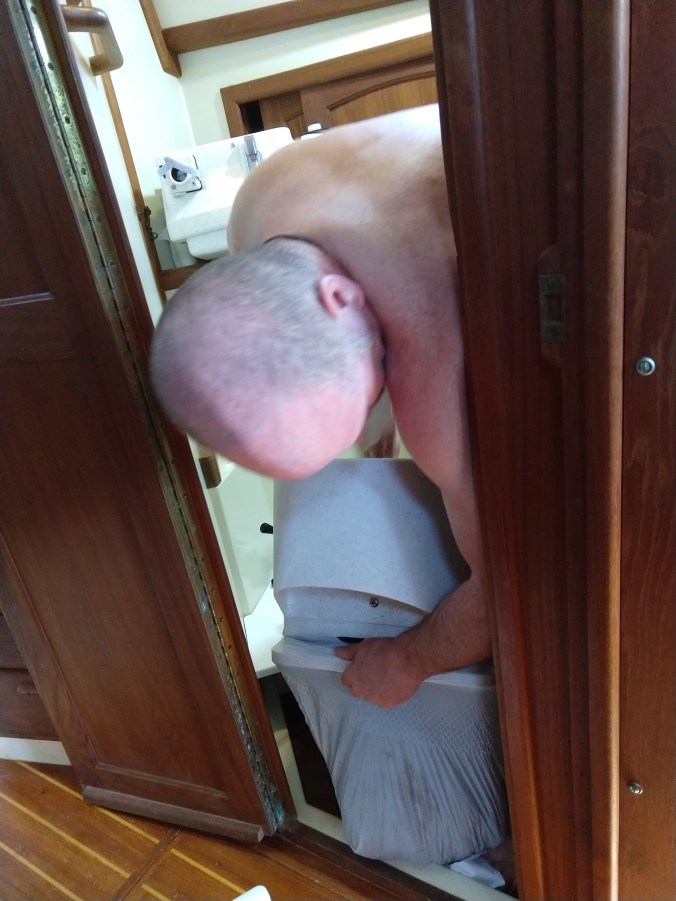
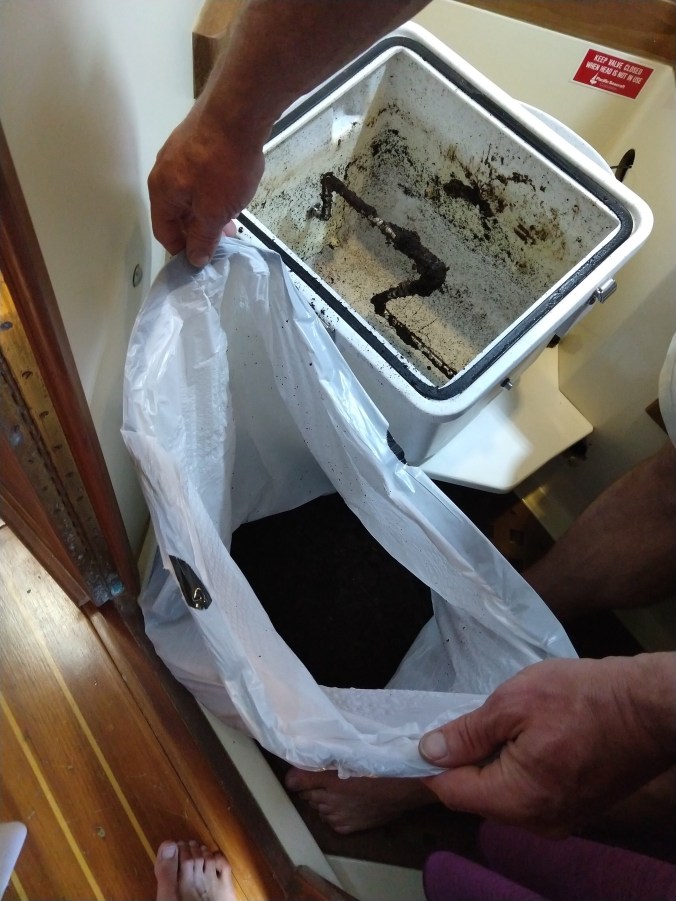
We simply take the lid off the toilet, and dump the solid waste into a garbage bag. I’ve included a few closeups. You’ll have to take my word for it, but I swear it does not stink! It smells like good garden dirt, but nothing worse than that. This part of the process would be a lot easier if we had more room to maneuver. We barely had the space to install the composting toilet in Sanitas’ head (and in fact, we had to remove some of the teak trim to make space) and there isn’t enough room to gracefully tilt the cover back like they show in the manual. Welcome to life on a small, narrow-beamed sailboat. Everything is just a little bit trickier than planned! We stored the used compost in a cockpit locker until the next opportunity to throw it away ashore.
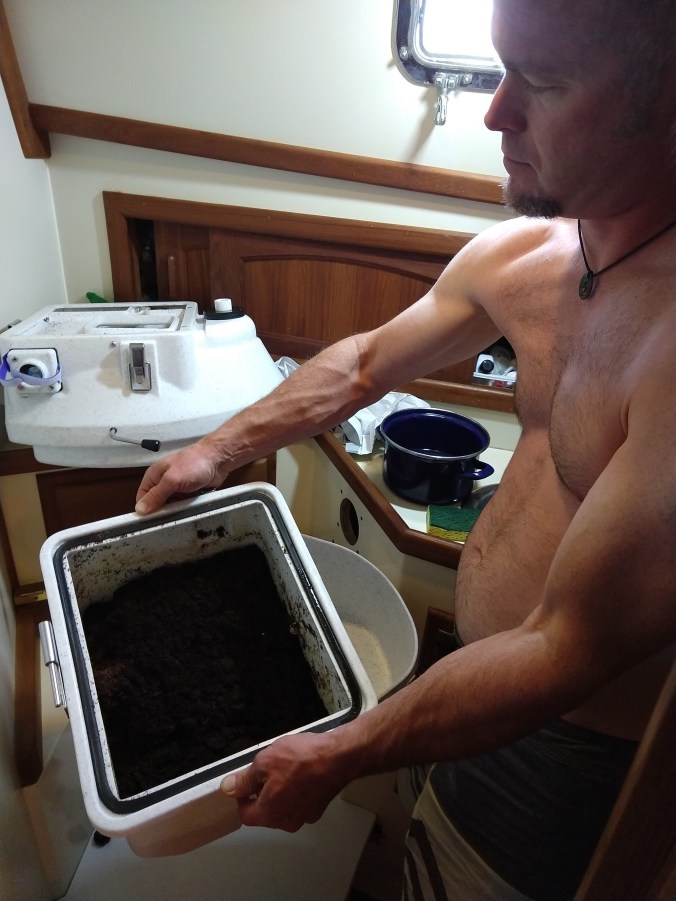
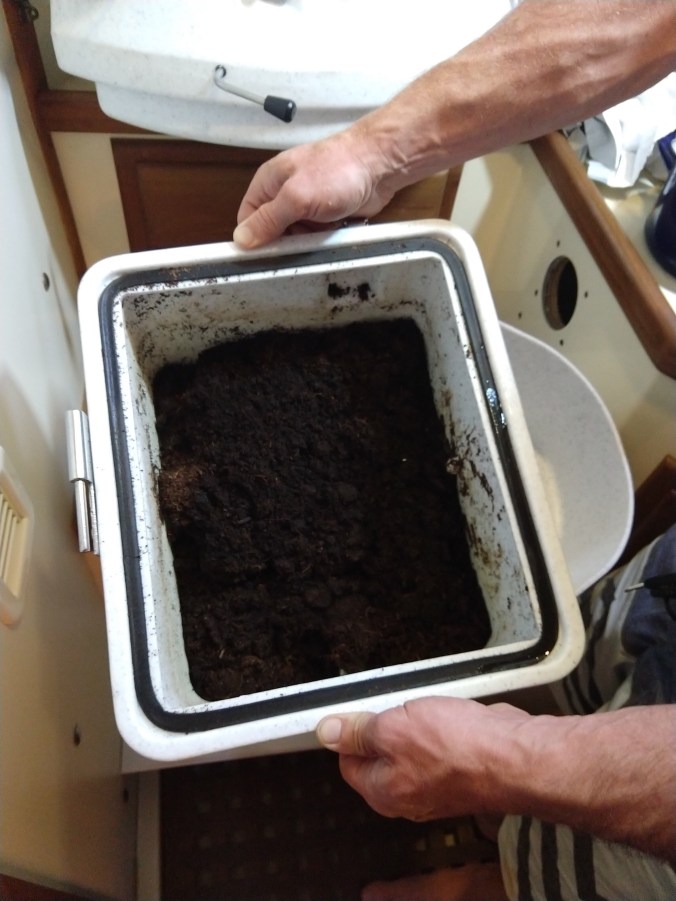
We use this opportunity to give the head a thorough cleaning, using bleach water to disinfect the toilet base, floor, and sink. But we don’t bleach or even wash the compost compartment of the toilet. Nature’s Head says that good bacteria develop and remain in the residue in the corners of the container, helping the coconut compost medium work better next time, and helping to break down waste more quickly.

We’ve been lucky so far, and have had no issues with flies or gnats in the compost. We do add septic tank additives and a bacteria marketed to remove gnats. Whether they really do any good, I can’t tell, but why mess with success? The best part about this head, is that we can pretty much plan to do the regular maintenance when it is convenient for us, and don’t have to deal with unexpected failures or really messy leaks and breaks. And we never have to search for or pay for a pump out. I’m sure it’s not for everyone, but along with our solar power, and water maker, the composting head helps keep us independent and off the grid.
Tool of the Day …. Pump Diaphragm

After the rough passage from The Abacos to Eleuthera all three boats in our little flotilla were bruised and battered. On Sanitas, the propane sensor was alarming and cutting off propane to the stove. This first occurred after the ingredients for dinner were chopped but before they were actually cooked. Doh! And more importantly, the bilge pump failed. Yes, that bilge pump. The one that drove Mike to stay up late every night in Marathon to ensure it was installed and working before we left Florida.

After pumping a 5-gallon bucket of dirty water out of the bilge by hand using a tiny portable pump (and dousing me with bilge water in the process) Mike started trouble shooting.

  • Sea grass clogging the input strainer? Nope.
  • Intake hoses clogged? Nope.
  • Output hoses clogged? Nope.
  • Thumb over the pump intake. Any suction? No suction.

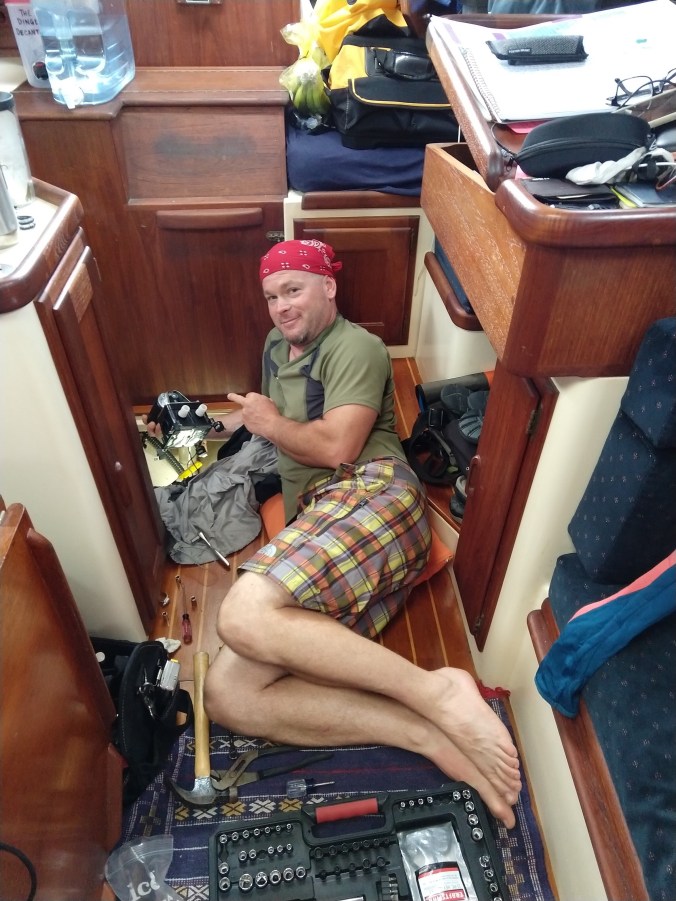
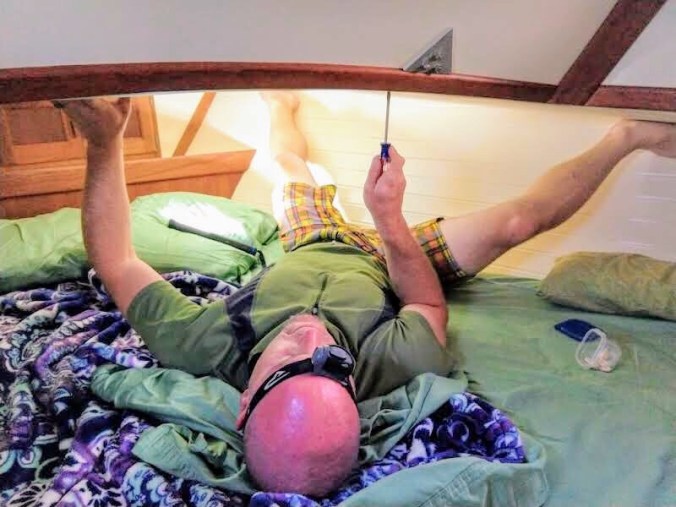
So we took the whole darn thing apart. I have a lot of photos from boat projects so far of Mike lying on the floor in this same place and in a similar measure of contortion.

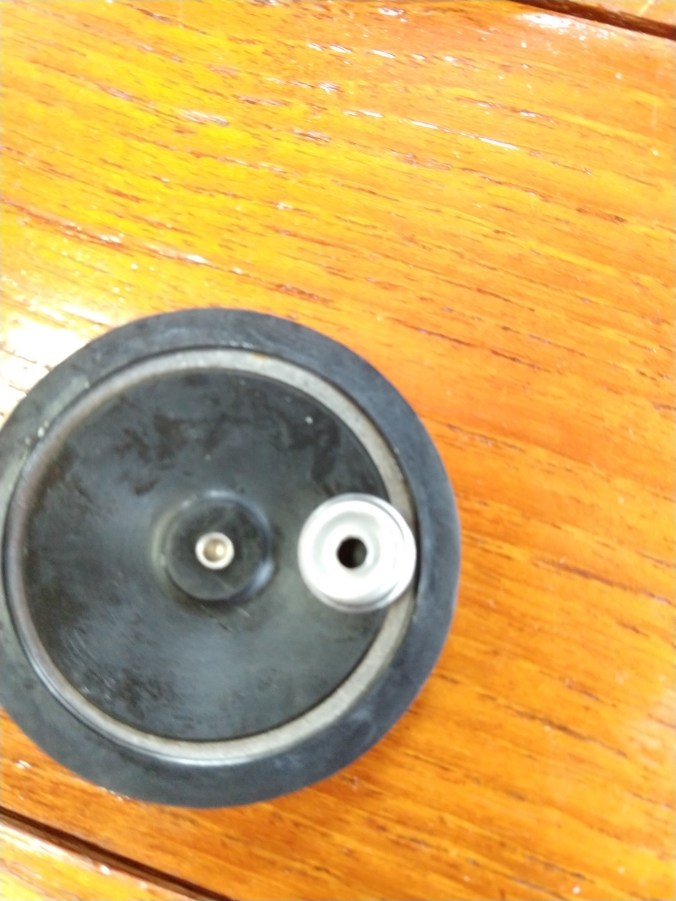
I am so impressed that Mike was able to find the source of the problem and to fix it! The diaphragm that performs the physical pumping is supposed to be held in place by a small metal cap. That cap had failed. Essentially this cap had bent in such a way that it no longer did its job of holding the diaphragm in place. But it was miraculously still sitting next to the diaphragm, instead of being lost somewhere in the dark corners of the bilge.

We jury-rigged a solution that should work until we can replace this specialized part. Mike re-flared the pin that holds the cap in place, using a #2 phillips head screwdriver bit. He pounded down on the head on the pin using a hammer onto the screwdriver bit until it was shaped more or less correctly and resumed its job of holding the diaphragm in place.

So far, so good! Of course while executing this project, we discovered that our back-up manual bilge pump doesn’t work. But rebuilding that pump will be another whole project for a later date.

Tool of the Day … Life Calk

In the latest episode of the quest to PLUG ALL THE LEAKS …. we had a carpenter / captain take a look at Sanitas in White Sound at Green Turtle Cay. He pointed out some small cracks in the teak toe rail on the bow, and suggested that they could be the source of the water intrusion into our forward cabin. You remember that “water intrusion”, aka leak, right? I now admit that we’ve been fighting this leak since the boat yard. So far we’ve:

  • Re-set the deck fitting for the head pump-out
  • Re-set the deck fitting for the foreword water tank input
  • Replaced the mattress and bought three different mattress pads
  • Side-tripped to Miami and re-glassed the anchor locker

Now we are trying again to get to the root cause and fix this dang leak once and for all by repairing the connection between the wooden toe rail and the fiberglass deck.

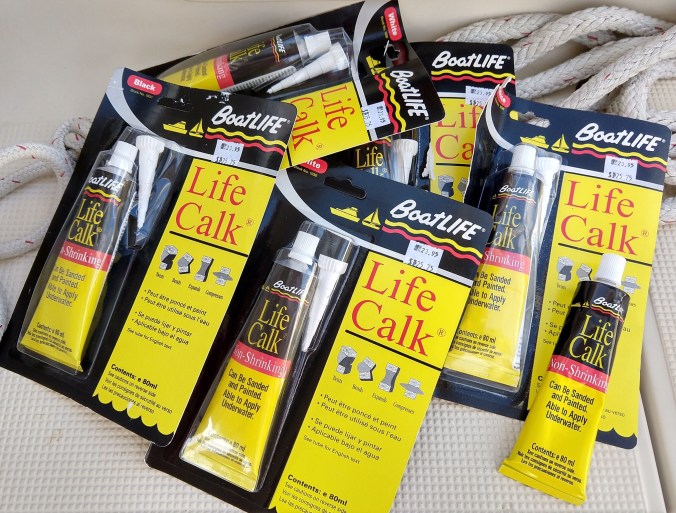
We grabbed a slip at the Conch Inn Marina in Marsh Harbour so that we’d have a safe and secure place to work, protected by wind and waves. Then I made the trip the Island Boy’s Tackle and bought them out of Life Calk tubes.

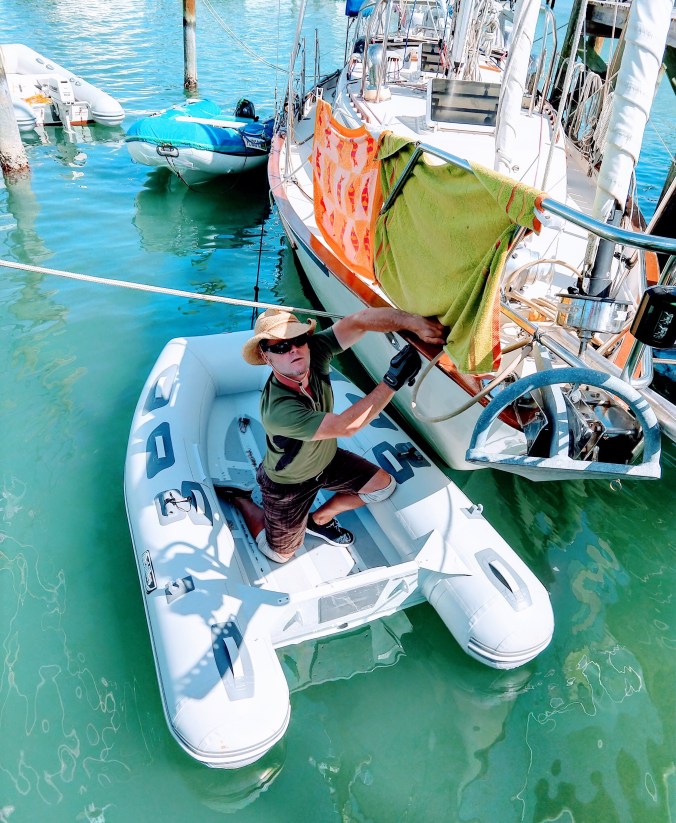
The material supposedly stays slightly flexible when dry, so it should work for the necessary flexing of the bow when we sail into waves. But it should also be well waterproof, and fill any existing cracks in the decking. Mike spent one entire day standing in the dinghy, tied to Sanitas, scraping old adhesive from beneath the toe rail, all the way from the bow to the beam. He did find several spots where the old adhesive was black and rotten – a good sign that this could be the culprit in our leaks. The black spots did roughly correspond with the places we see water trickle down the walls of the cabin too. Another good sign!

The second day, Mike spent back in that dinghy (core and balance workout?) filling the seam with a new bead of Life Caulk. We let her dry for 48 hours in the sun, and hoped for the best.

I really hope this does the trick. It would be great to be able to leave the mattress in the cabin while we sail. Lately, we’ve been folding the mattress in half, pulling out all of the pillow and blankets, stuffing chamois into the “ceiling” when the water comes in, and laying beach towels along the hull. Oh, and the headliner has been sitting in the salon on the floor leaning against the settee, so that it does not continue to get wet. It will be great to get back to normal, and clear up some of the chaos on Little Sanitas!

Here’s Mike putting the headliner back in place …

Tool of the Day … Prop Anode

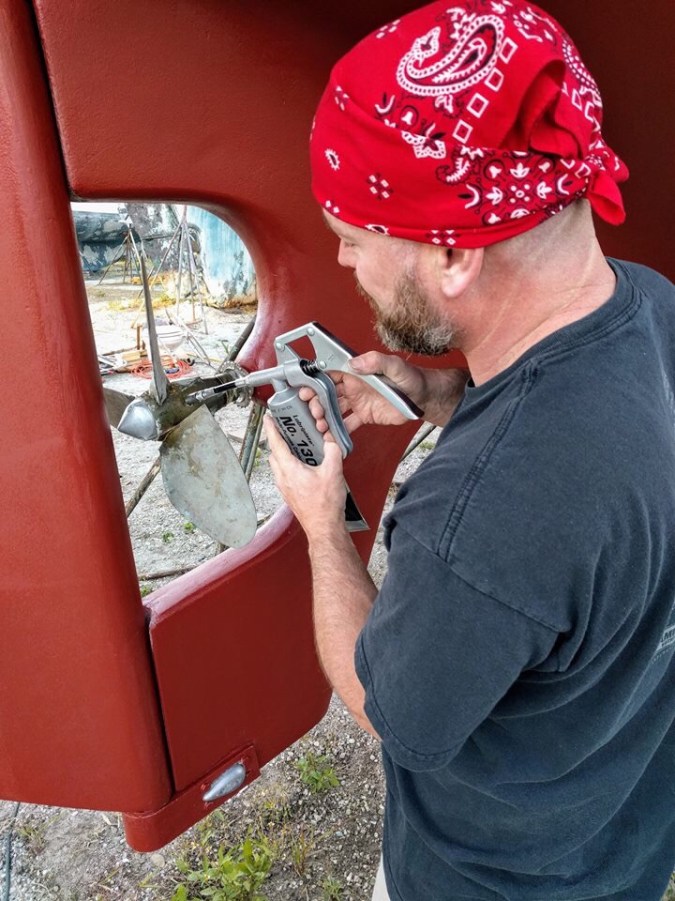
When metals are placed in a conductive liquid, such as salt water, they create a battery. Current flows between the metals in the process of electrolysis and essentially eats away at one of the metals. The goal is to set things up so that electrolysis eats away at a piece of metal that we don’t really need, and doesn’t destroy the prop or the hull or the motor. So sailboats have small pieces of zinc on the hull and on the prop that are designed to crumble and fall apart over time keeping the important bits intact. One of the last things we did before putting our boat back in the water was to replace these zincs or sacrificial anodes. While we were at it, we greased the prop as well.

See how crumbly the old zincs are?

And a nice clean new one!

Mike loves his grease gun.