Tropical Shipping Blues

When we first started talking about buying a new boat, I concocted a little fantasy in my head…. We’d buy a new boat in Grenada and we’d sell Sanitas in Grenada, so we’d put our two boats right next to each other on a dock. We’d simply carry armloads of belongings from one boat to the other, de-cluttering and donating as we went. But when we found our perfect boat in Florida, that little fantasy went “poof”!

So I toyed with the idea of Japanese minimalism. You know, “it’s all just stuff” and “everything is replaceable”  and we would just bring what we could fit into checked luggage. Until Capt Mike loaded just a fraction of his tools into a suitcase and immediately exceeded the 50 pound limit. Sure, everything IS replaceable, but how much did I want to spend to buy everything all over again? It takes A LOT of tools to keep a sailboat running and happy.

So we decided to use Tropical Shipping to ship a “Less Than Container” or LCL load from Grenada to Florida. That’s more difficult than it sounds – everybody wants to ship goods from the USA to Grenada, but who wants to ship things BACK to the land of plenty? Apparently we were lucky. We learned that sometimes people wait weeks or even months for enough containers to fill a ship heading west.  We called Tropical on a Thursday afternoon and learned there was a ship leaving the next week. Great news! Little did we know how much red tape and bureaucracy we were going to fit into that week….

Step 1: Find a container

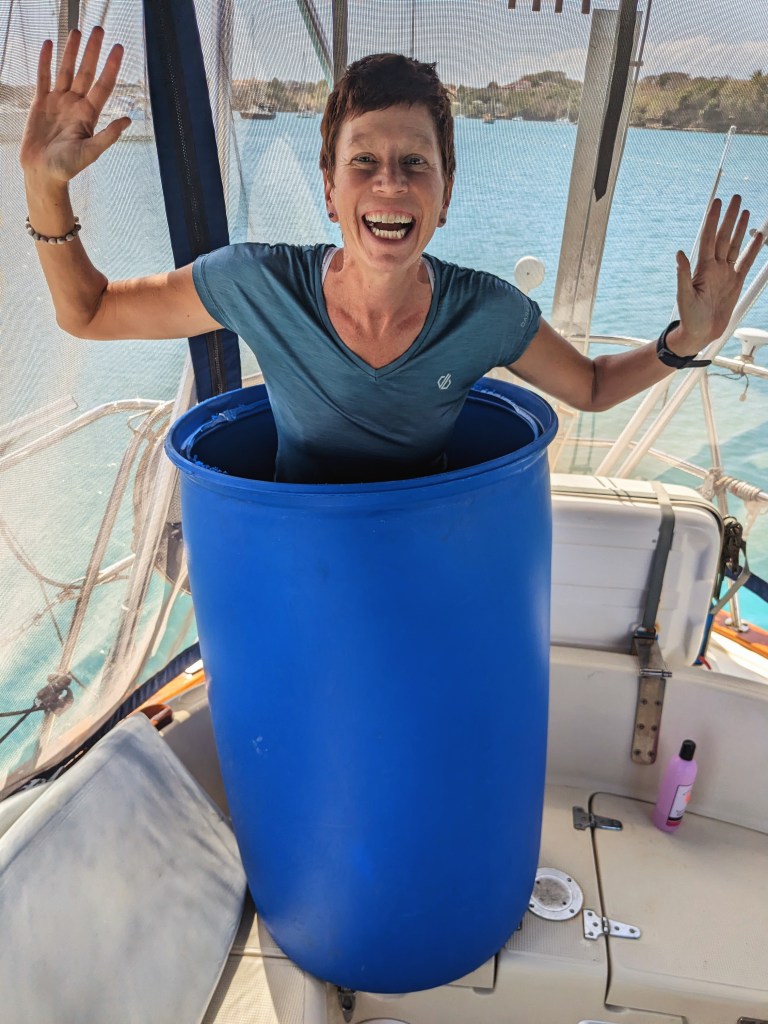
Apparently, when you are shipping “less than container” loads, you need to bring your own container. Who knew? And for some reason, the shipping companies don’t sell containers. Neither do the hardware stores, boat supply stores, home goods stores… And although you’ll see shipping barrels by the side of the road all over the islands, often doubling as garbage cans, they never have lids, so they are useless to us. Finally, I turned to the internet and found two big blue plastic shipping barrels (WITH lids) on Facebook marketplace for about $20 each and sent Mike out into Friday night traffic to collect them.
Step 2: Paperwork. A lot of paperwork

I naively believe Tropical Shipping would handle all the paperwork as part of the fee we were paying them. Nope! The customer service agent rattled off a list of forms and a deadline – our shipment would need to be delivered to the port in Grenada by 3:00 Tuesday to make the Thursday departure. Oh, and we’d need to hire a local broker to process our customs forms on the Grenada side. AND we’d need to hire a US broker to process things on that side. The deadline was already feeling tight! After getting a few price quotes, we chose Lund & Pullera and they were excellent! Stacy really helped me through the US Customs process. We hired Alana from Phenomenal Brokerage in Grenada who was also very responsive. But all together I probably spent 10 hours on the laptop tracking down forms and trying to figure out how to complete them. In addition to my part-time job as a boat broker, I’m now working as a customs broker, lol. I need to print new business cards.

Step 3: Pack the barrels

A big blue shipping barrel can swallow up a LOT of stuff. So after Mike packed his tools, we still had a lot of space to pack my favorite pots and pans, snorkel gear, clothes, and even some packaged gluten free food. I admit, we hit the point that everybody gets to eventually when moving house – that point when you just start shoving in whatever you can reach, and you’ll worry about whether you really need it or not on the other side. Then we realized our next problem. A full shipping barrel weighs over 400 pounds. So how were we going to get it out of the boat and to the port?

Step 4: Unpack the barrel you just packed

So we took everything out of the barrel, loaded it all into tote bags and shopping bags, made multiple dinghy trips from the boat to shore, and loaded all that stuff into a rental car.
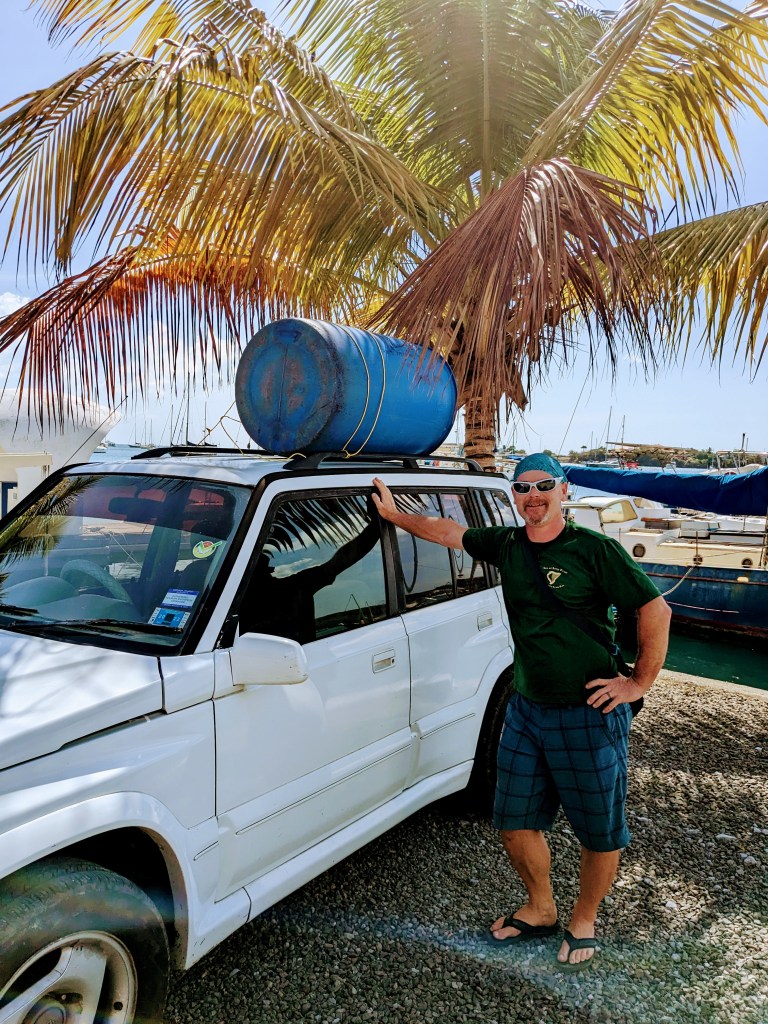
Step 5: Repeat pack and unpack steps for Barrel #2

By this point, I’m pretty sure we’ve touched everything on the boat, and moved it around, at least five times.

Step 6: Keep calling Tropical until they finally break down and let us deliver the barrels

We worked hard all weekend, and by Monday morning we were ready to deliver our barrels to the port in St George’s. And then we got stuck. We couldn’t do anything until Tropical approved our paperwork, assigned us a container scheduled for that ship, and arranged for someone to meet us at the port. We waited… And waited.. and started calling them about every three hours. Nothing happened on Monday. Or on Tuesday morning. Remember we’d been given a 3pm Tuesday deadline? Finally we called Alana at Phenomenal and she called Tropical and finally we could proceed

We hopped in the rental car and drove into downtown St George’s to the Tropical office to get a car pass for the port. The customer service agent asked Mike for a hardcopy form that Alana processed for us. Uh oh. We couldn’t find it. Must have left it back on the boat. So we hopped back in the car and drove like a bat out of hell back to the dinghy dock, plus a long dinghy ride back to the boat, found the form, and did it all again in reverse. Phew! Got our car pass and headed to the port. It’s now 2:30pm.

Step 7: Deliver the barrels to the port

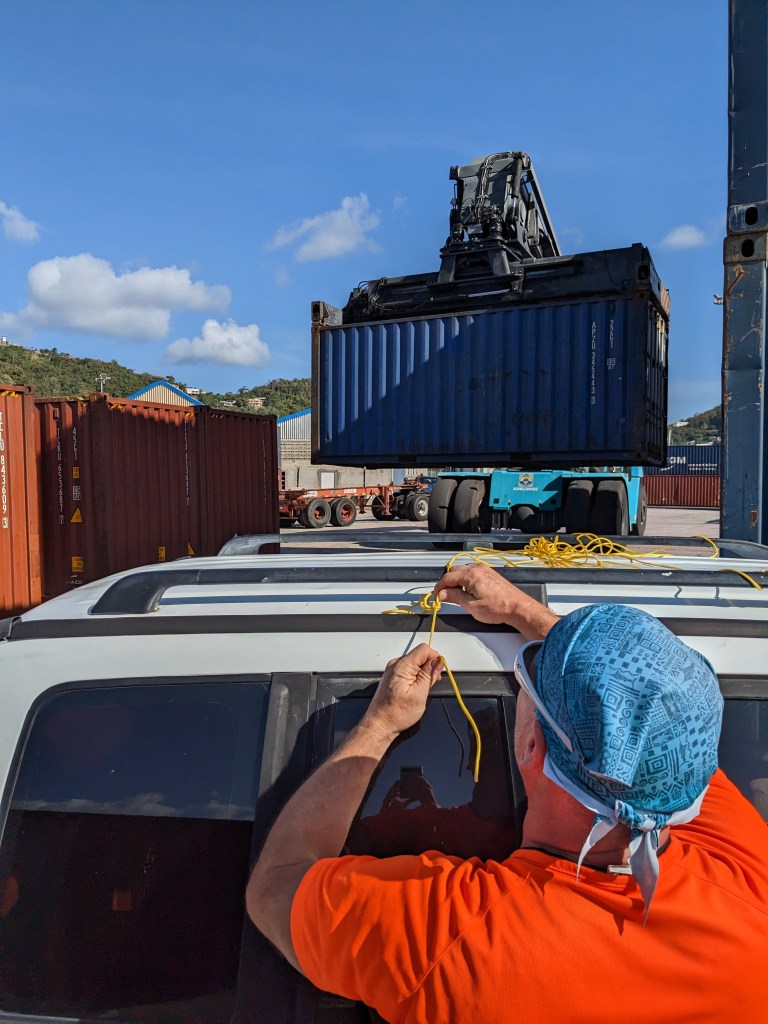
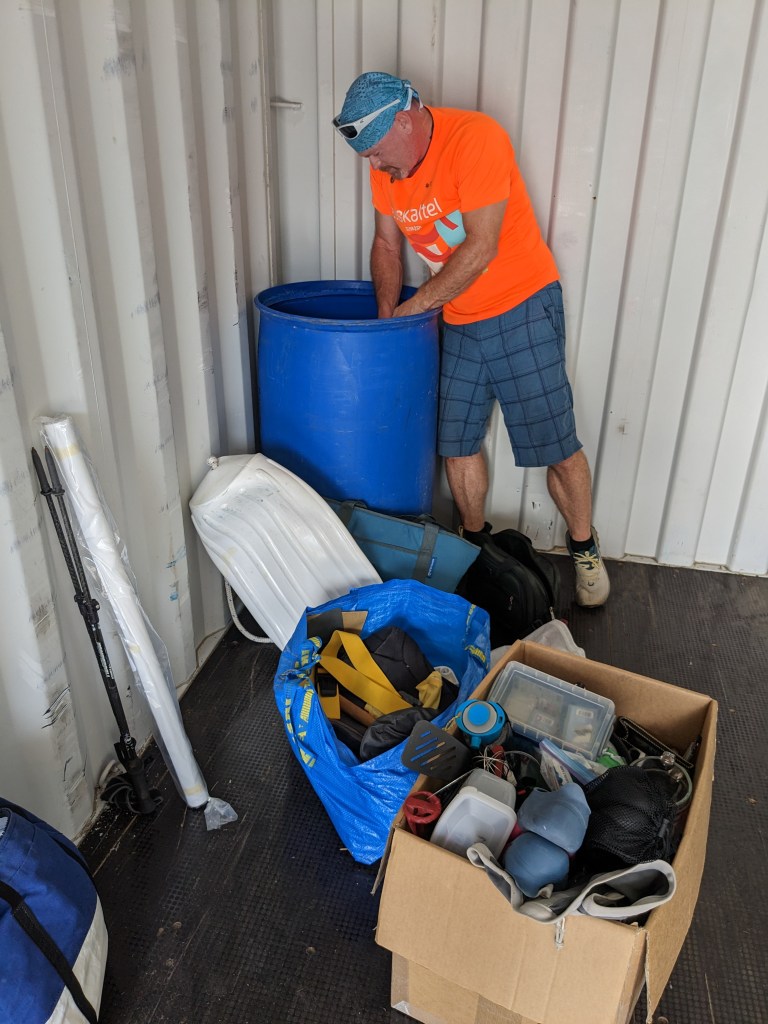
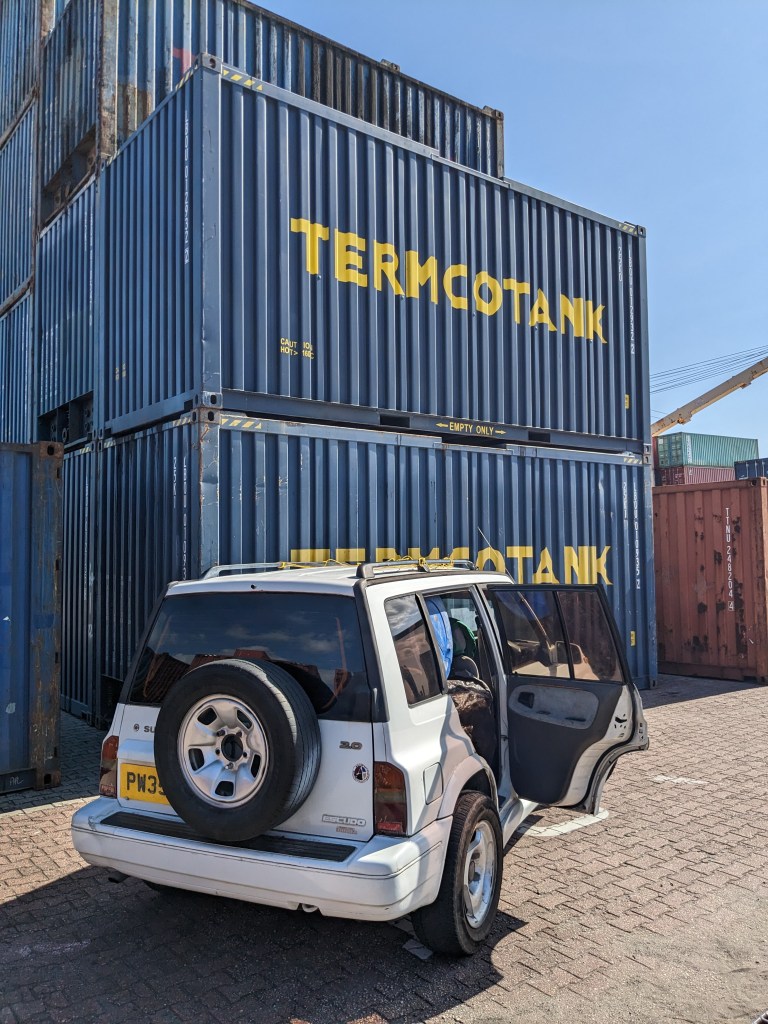
We donned our close-toed shoes and hi-vis shirts and rushed to the port. A very pleasant young man named Kelwin met us there and showed us to an empty container. Capt Mike set to work. Remember how we couldn’t carry a full barrel? That means we showed up at the port with two empty barrels tied to the roof of the car, with the car itself overflowing with all the stuff we hoped to fit inside them. Kelwin helped me carry bag after bag into the extremely hot shipping container while Mike worked his packing magic. Somehow, miraculously, it all fit. We were asked if Alana had “processed the customs form.” I assumed so, but when we called to find out, she said she’d come down to the port now to do it if, and we weren’t allowed to actually make our official delivery until the US Customs agent filed an ISF form but… the computer was down. We made a bunch of calls and I bit my nails, and eventually it all got done. We closed the lids on the barrels, sealed with a lot of duct tape, tipped Kelwin for his help, and left the port around 4:15. I guess we were on-time when you take into account the concept of “Island Time” We went home and as Mike was unpacking his bag, out fell the paperwork that we drove all the way back to the boat to collect. No one had asked for it again. And even as I am writing this week’s later from the US, no one has ever asked for it. Sheesh.
Panorama – Steel Pan Paradise

After visiting Trinidad for Carnival, I am officially a Steel Pan snob. From now on, I’m not going to be completely happy until I’m dancing along to 100 drums along with fireworks, Moko jumbies, and dance routines. Oh boy, is this a fun time!

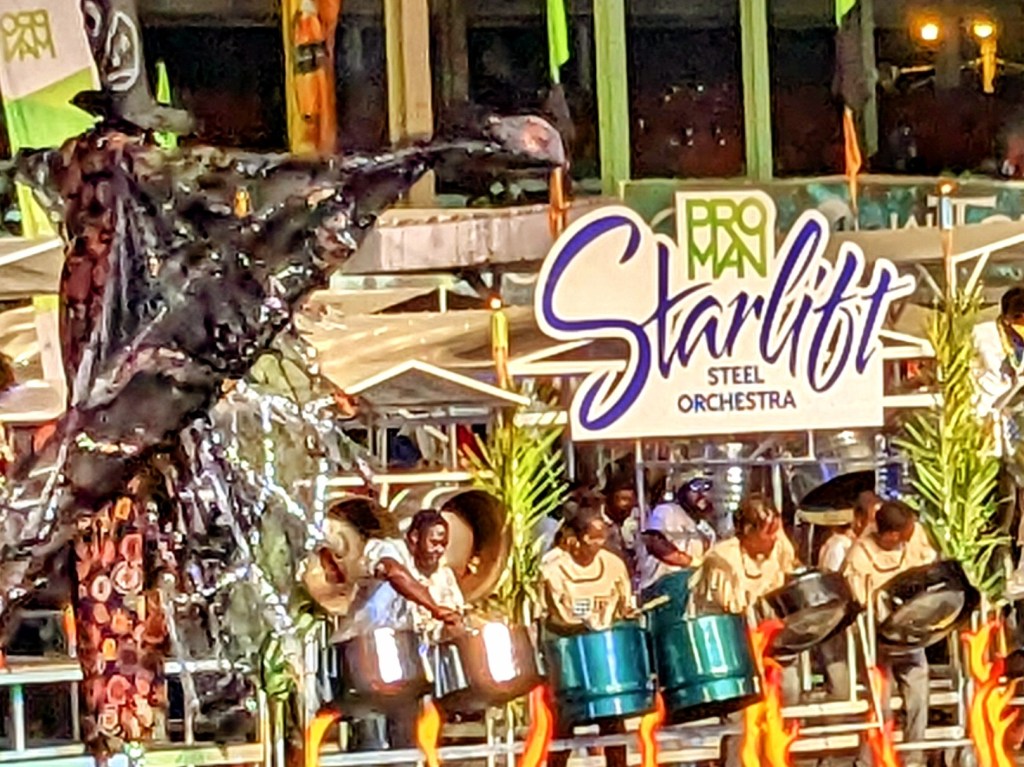
I have to admit, it wasn’t until I was standing in line, waiting to get into the Large Band Finals that I realized the name “Panorama” doesn’t refer to a lovely scenic view, but to a celebration of Steel Pan 🤣 Large bands have between 90 and 120 musicians – can you believe it?!? Most musicians play a single drum, but some of the bass and percussion players play 6 or 8 drums. It’s amazing!

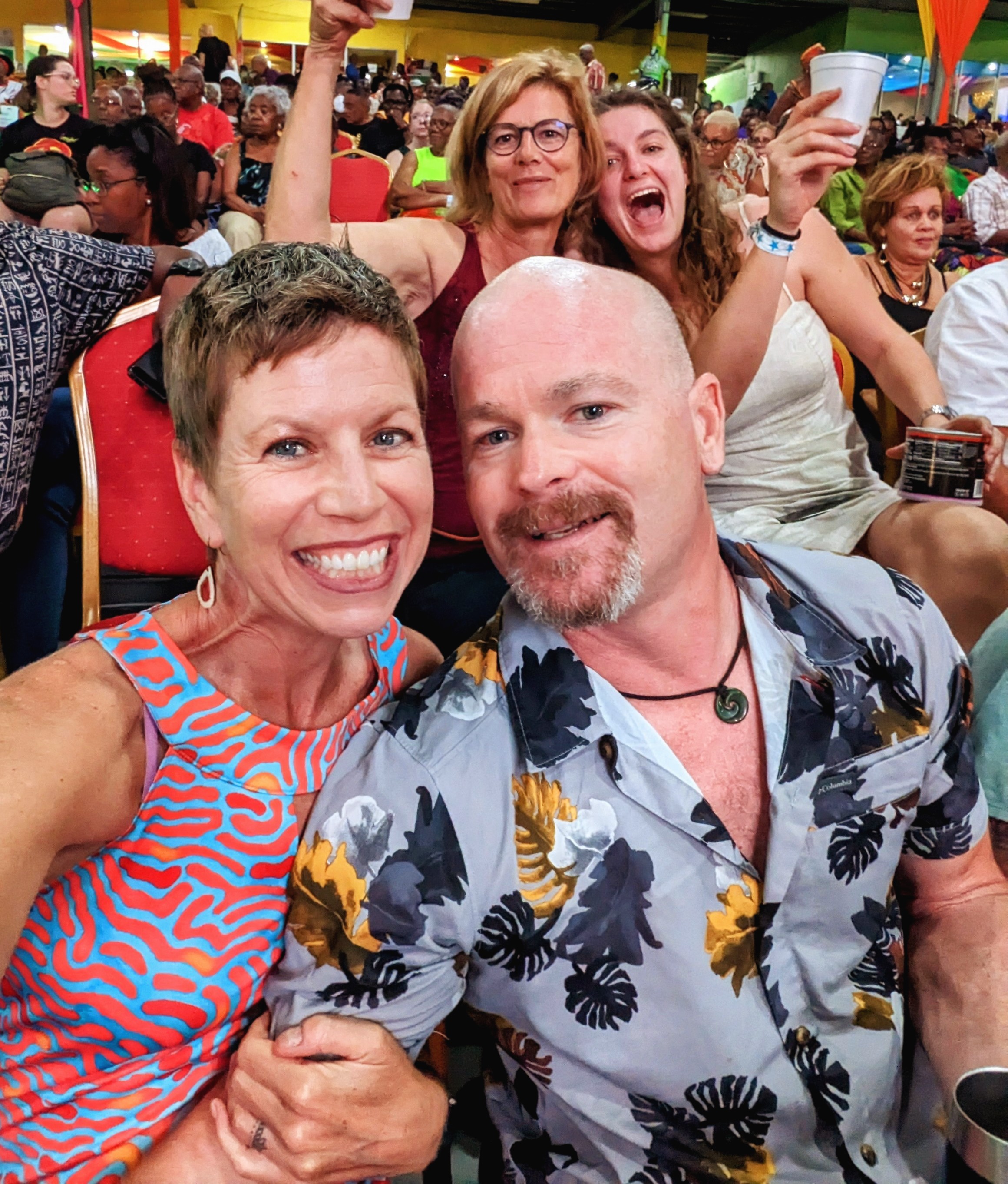
Each band has their fans and supporters who cheer them just like a sports team. The week before the competition, we visited several of the pan yards on a Friday night to check out the practice. It’s fun to watch the players in a more casual atmosphere, and food trucks and pop-up bars surround the yard. It’s a local and inexpensive way to get a taste of steel pan by hanging out with the locals. And it’s a chance to pick the band you’re going to cheer for at the finals. Capt. Mike is a Renegades supporter. Me, I love Phase II. They actually write a new song for each Carnival season, rather than covering a classic, and I can’t get this year’s “We come out to party … Everybody happy” out of my head 🎵🎶🎼

It’s also fascinating to see how the bands perform on the big stage. The steel pans are loaded onto metal trailers with roofs. The roof protects the pannists when they are playing outdoors in the sun or rain, and they also make for better acoustics by bouncing the sound toward the audience. All the trailers are staged in a field outside the stadium, and when it’s a band’s turn, they have a strict time limit to move all of those trailers and musicians and support staff onto the stage. Each band only plays one song – one! But they put their all into it, matching costumes, dancing, decorations, and sometimes pyrotechnics. Then they have a strict time allowed to leave the stage before a literal SWAT team crosses the stage in body armor shoulder to shoulder walking any stragglers off the stage. A crew with brooms sweeps all the confetti and other potentially slippery stuff off the stage. And it starts all over again for the next band. Does this all sound very time consuming? Well we caught our bus from the boatyard at 4pm, and we got home around 3:00 in the morning. This so so not our usual cruiser schedule!

Parade Day at Carnival

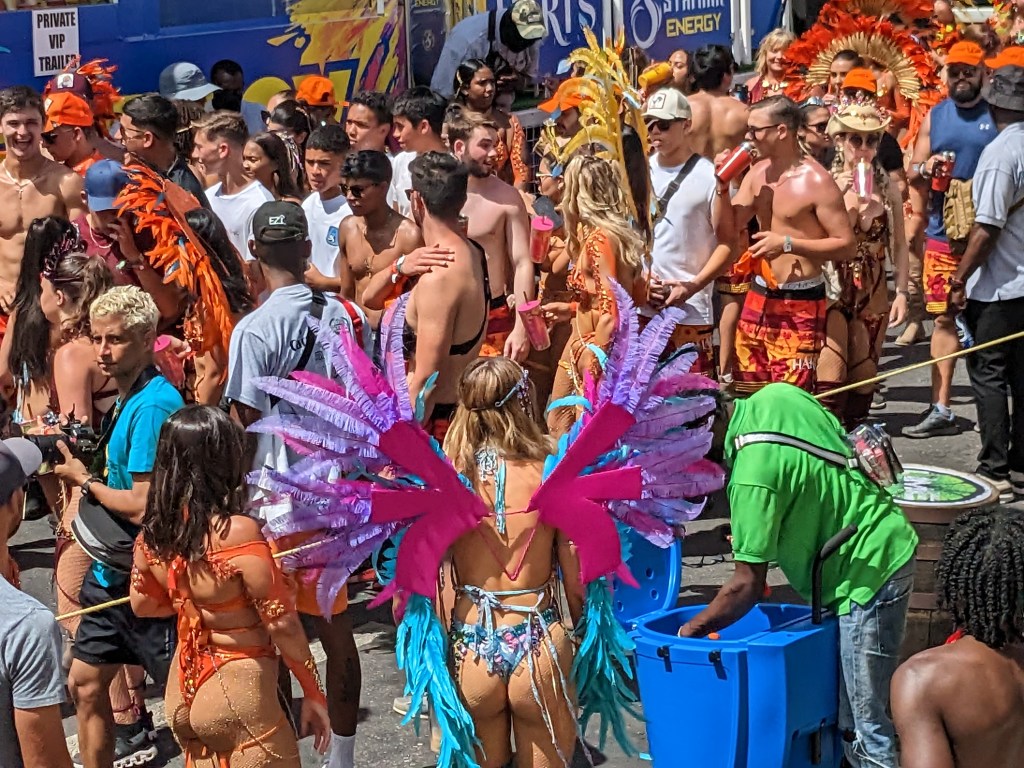
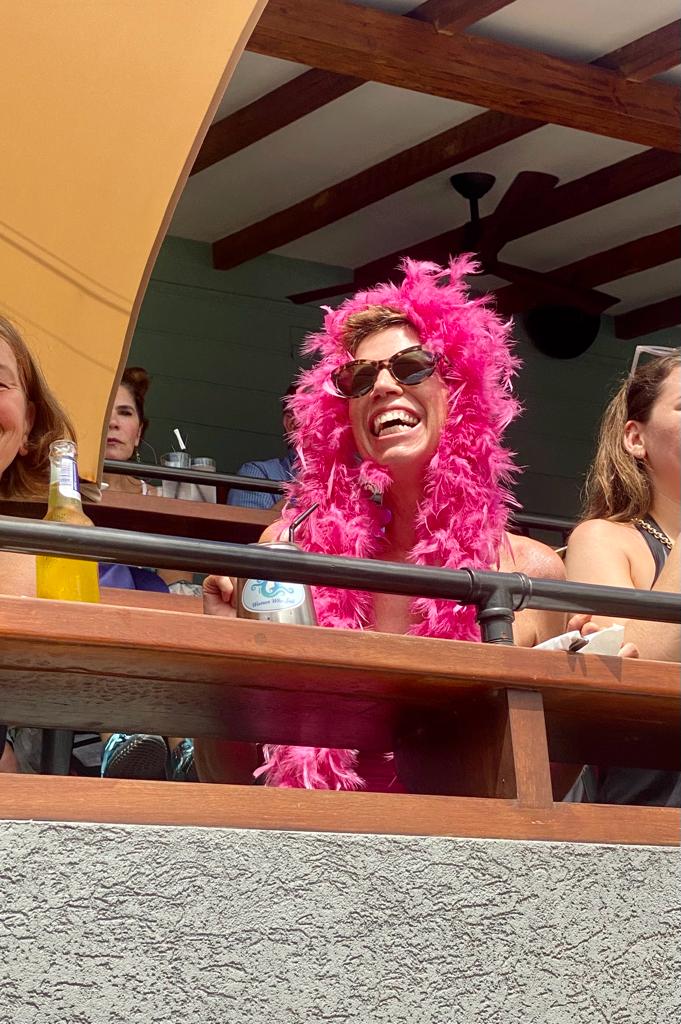
When we first started thinking about going to Carnival in Trinidad, I seriously considered joining one of the big masquerade bands. Even contemplated squeezing my middle-aged white bum into one of those sequinced and feathery bikini costumes. But then I did a little bit of research and learned that it costs around $1,000 usd to join a band. More if you want feathers. Yikes! So instead, we joined a few friends and bought tickets at a restaurant on “The Avenue” where we could watch the parades from comfort and it was perfect!

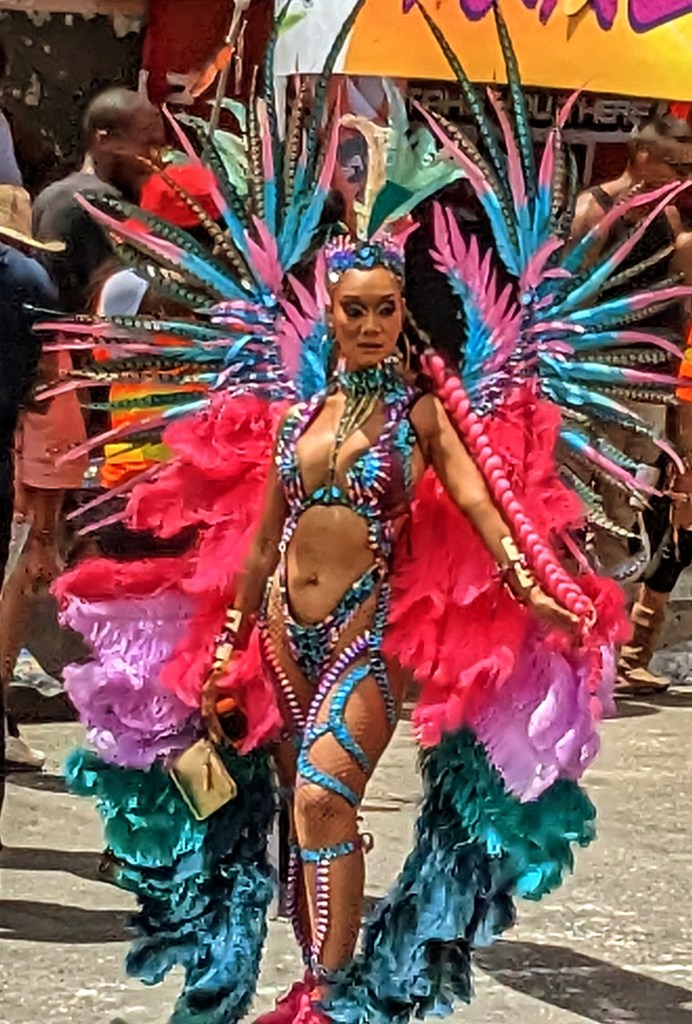
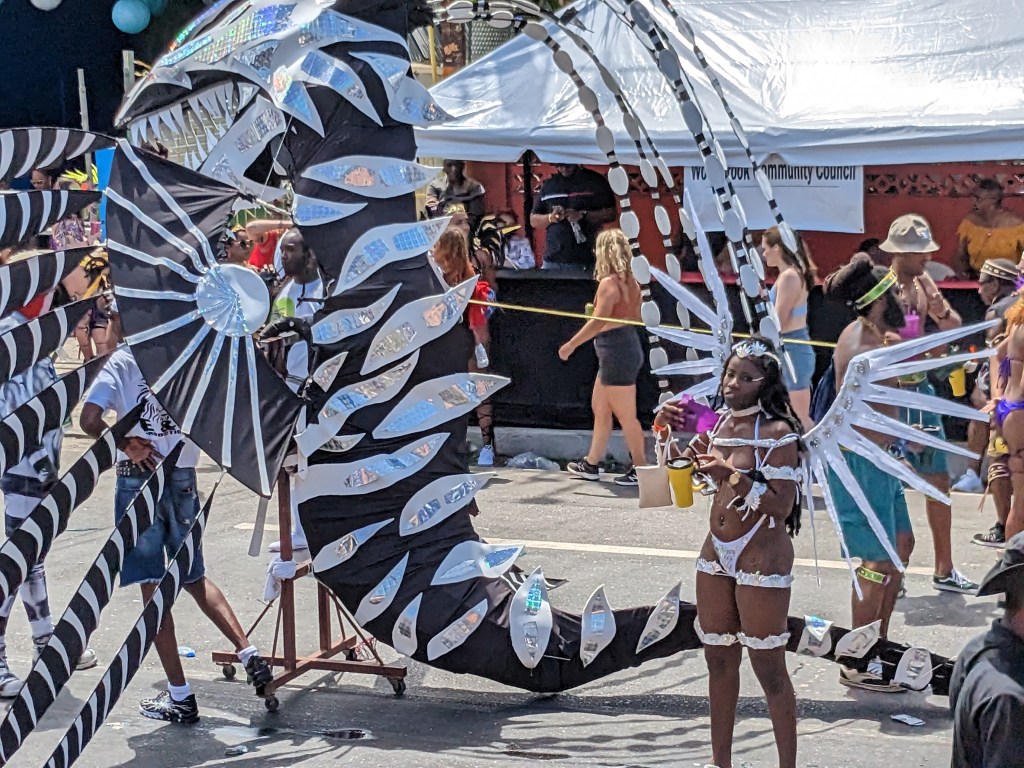
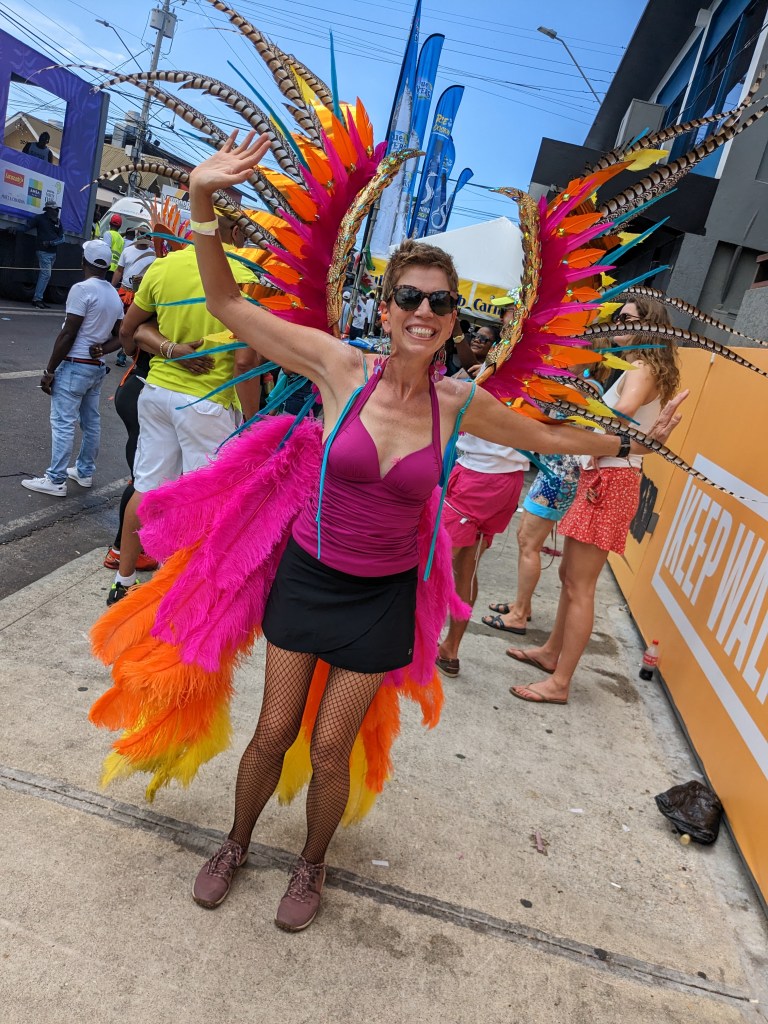
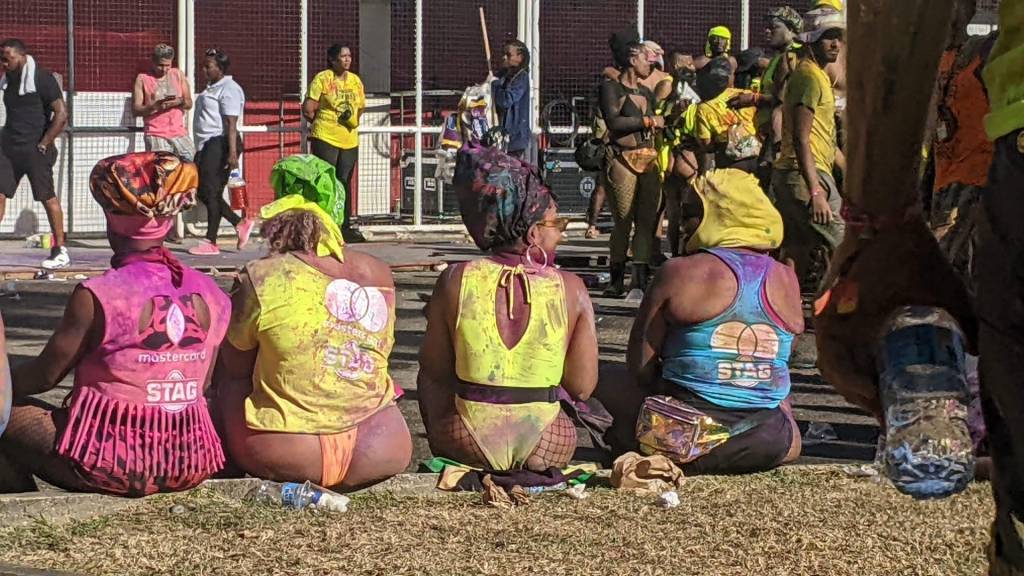
As opposed to the “Dutty Mas” of J’ouvert, Tuesday’s parades are “Pretty Mas or Bikini Mas” Folks choose a band to join and choose the simple “Backline” costume or more elaborate “Frontline” costume. It’s called “Playing Mas” (short for masquerade) In addition to the standard costume, many women buy colorful sneakers or boots, and wear elaborate sparkly makeup. Add a backpack of feathers and maybe a headpiece and it makes for a colorful joyous spectacle.

If you’re gonna play mas in Trinidad, you’d better have some stamina! Bands “chip” and “wine” their way through downtown Port of Spain all day long, dancing and bouncing to soca. The parades are fueled by local rum and local delicacies such as doubles and shark and bakes. I’m not sure how they manage to keep up the energy in the hot tropical sun!

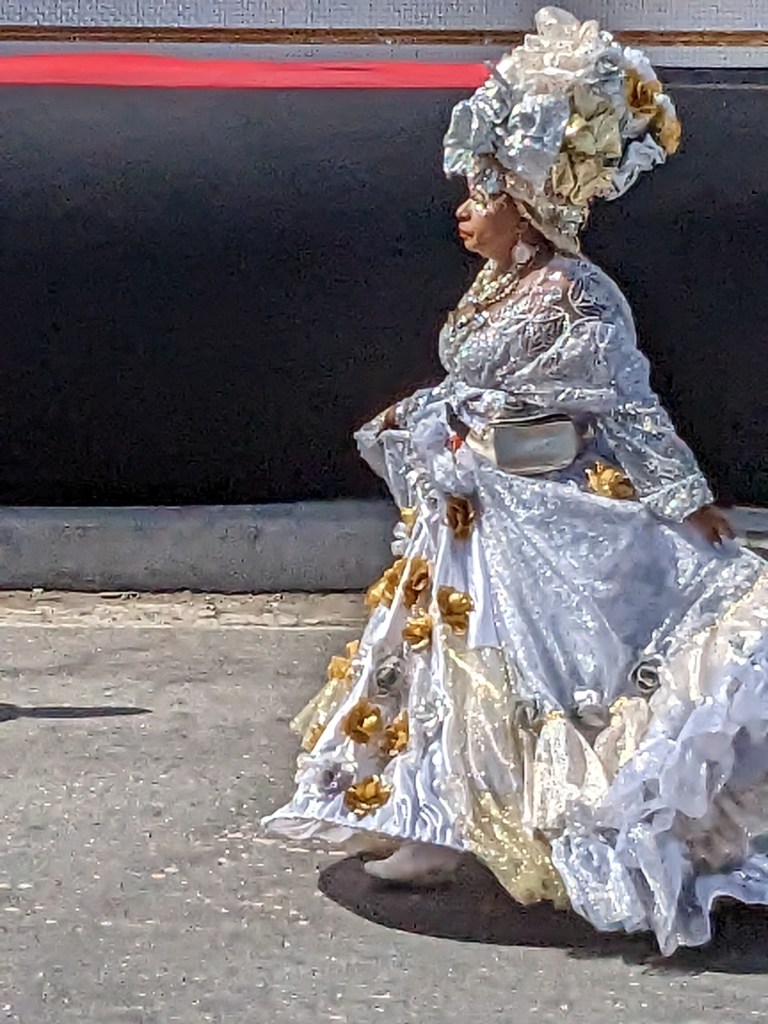
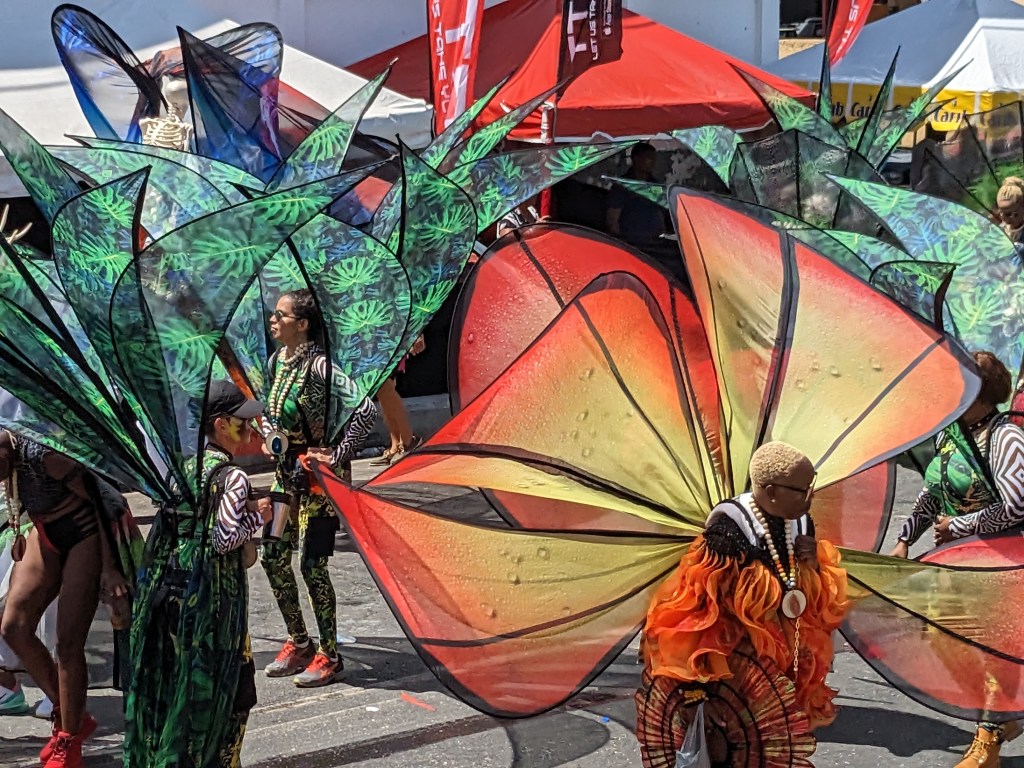
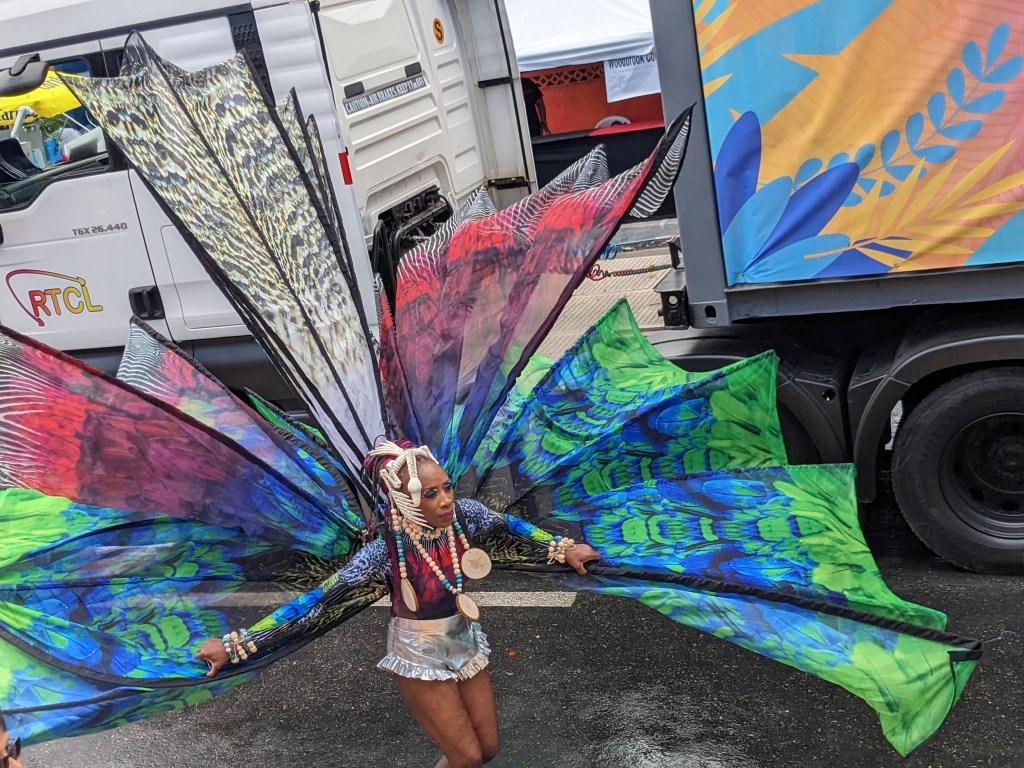
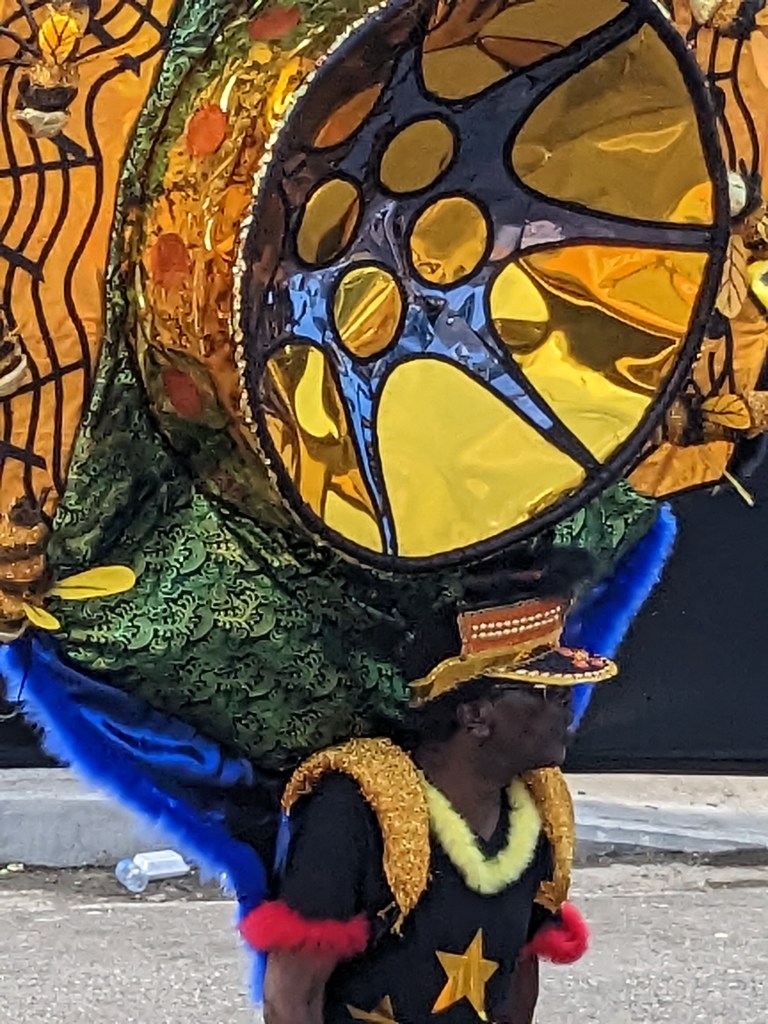
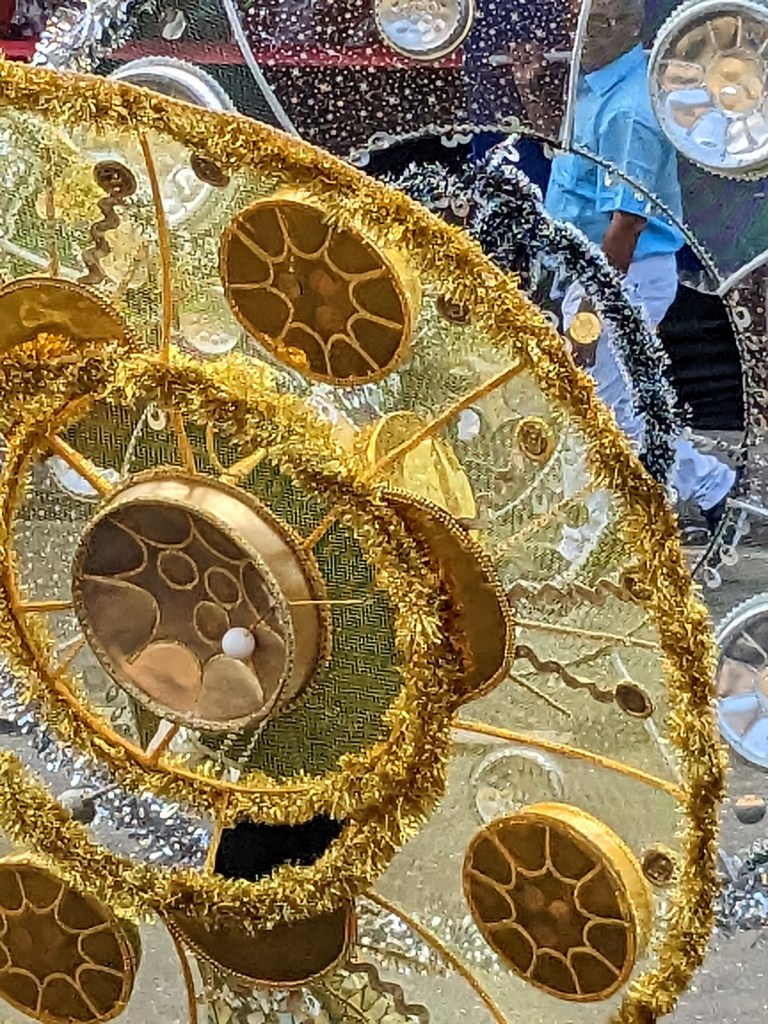
Some bands avoid bikini mas, and instead wear elaborate costumes that tell a story or depict some of the history of Carnival. The larger, grander costumes are feats of engineering and take the entire year to design and create. It’s really pretty amazing to be there in person to see them “on da road”.

By the afternoon, some partyers get tired of their heavy costumes and leave them behind. Our gain! We had a lot of fun trying on the castoffs!

There’s a competition for the Road March – the most popular and most frequently played soca song in the parades. Our favorite “Come Home to Me” came in third place. We were robbed!

Celebrating freedom at J’ouvert

The festival of J’ouvert kicks off the final two days of Carnival in Trinidad and Tobago, and if you’re doing it right you won’t get much sleep!

J’ouvert (the creole version of the French words for day break) has its roots in the history of slavery and emancipation in Trinidad. During colonial times, enslaved peoples created their own versions of the carnival celebrations of the French. And after emancipation in 1834 the celebrations came out into the open and took on a greater and more powerful significance. Well before sunrise, parades start winding their way through Port of Spain. The darkness itself masks revelers’ identities, allowing everyone to behave a little bit crazy and act not at all like their usual non-Carnival selves. The disguise gets even better when paint (and mud, colored powder, even oil) starts flying. Everybody dances and chips to the latest soca tunes following a band truck. And these days, probably a bar truck as well 🍻 Finally, at sunrise, folks wave the flag of Trinidad to welcome carnival Monday.

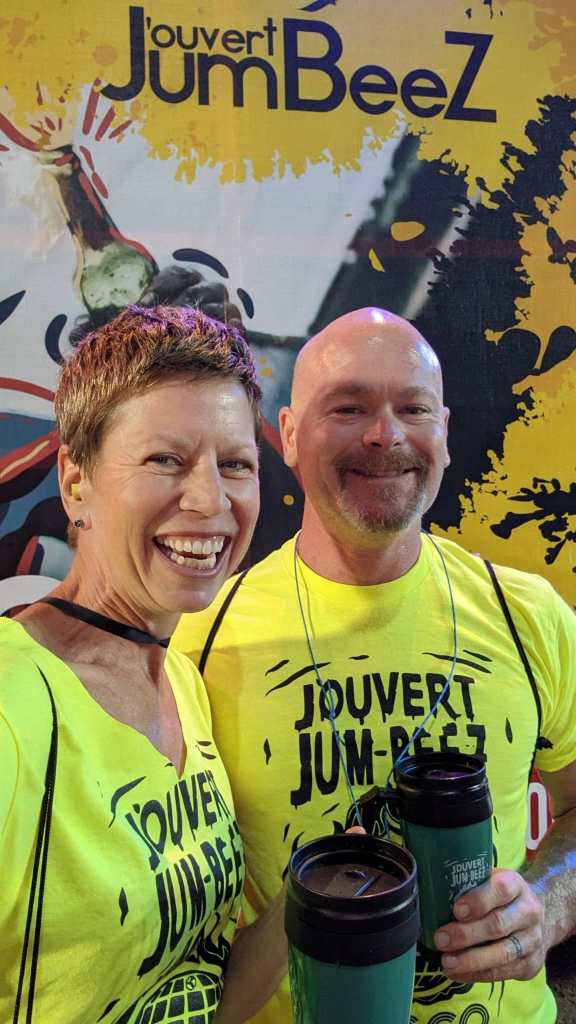
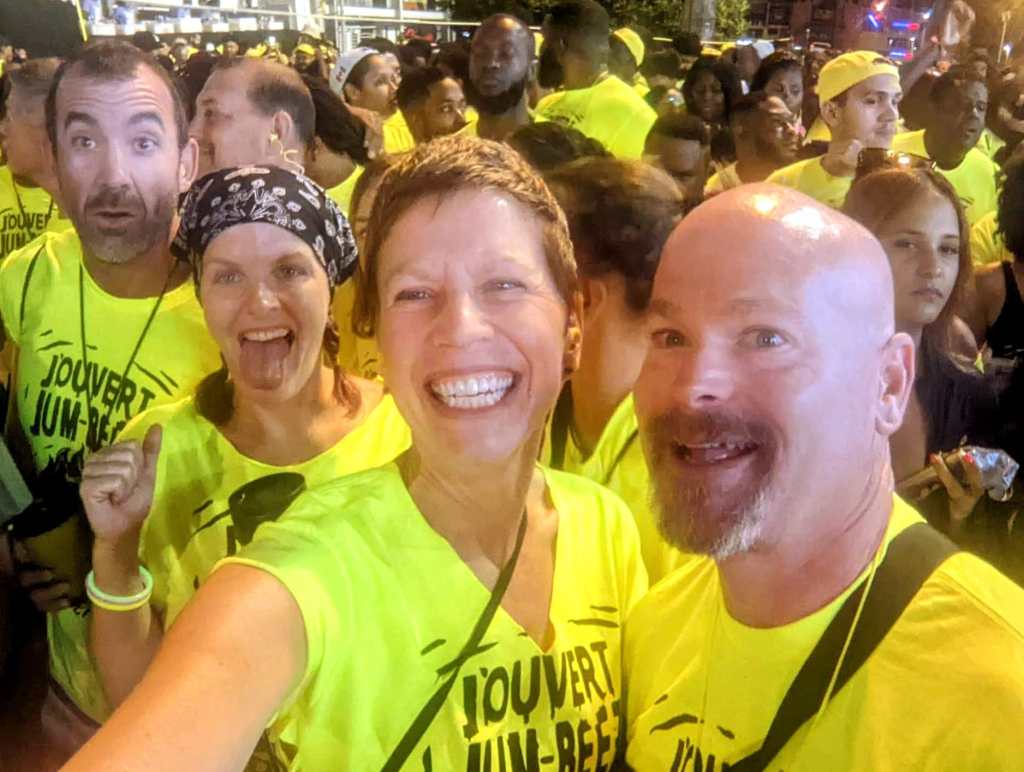
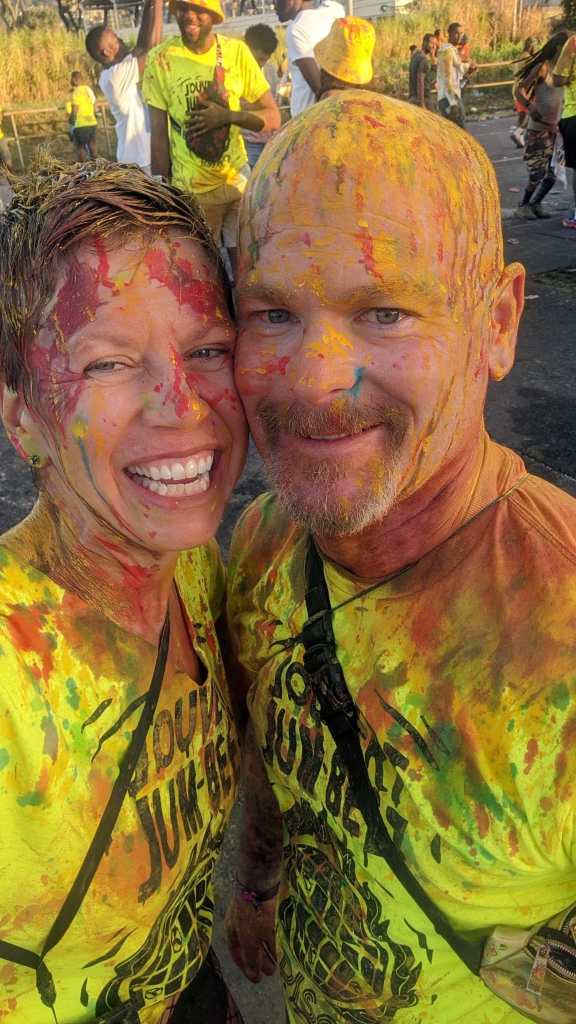
We met Jesse James’ bus at 2:00 am to ride from Chagaramas boatyards into town with a small crowd of fellow cruisers. We were all playing J’ourvet with the “J’ouvert Jumbeez” – a band of 3000 people, 3 DJ trucks, and 3 bar trucks. We had picked up our swag bags several days in advance and all the ladies had spent an afternoon of arts and crafts customizing our ugly yellow men’s t-shirts into something slightly cuter and more personalized. (None of us had paid extra for the sexy black “monokinis” that the more body-confident Trini ladies were rocking.) I had planned ahead and made coffee the night before in the hopes of finding some kind of energy in the middle of the night!

The bar opened at 3:00am (yes, I know this sounds completely and totally nuts) so we had time for a run and club soda in our matching insulated mugs to calm the nerves before the start of the parade. Good thing we packed ear plugs, because the soca music pounded so loud Capt Mike and I had to shout directly in each other’s ears to make our plans to stick together. We’d been listening to the DJ Private Ryan Soca 2023 playlist on Spotify for at least a month, so we knew all the songs and were definitely ready to “jump up” and put our hands in the air just like the Trinis (I’ve still got the song “Come Home to Me” by Nailah Blackman and Skinny Fabulous in my head – it just might be stuck there until next Carnival!)

The gates opened around 4:30am, and we slowly followed the trucks out onto the streets of Port of Spain. Mike and I made a pact to stick together and to watch our footing in the dark. Security staff held long ropes on either side of the street, so as long as you followed a truck and stayed between the ropes, it was impossible to get lost. Wow, there was a ton of energy! We didn’t really march, we pretty much bounced our way through town.

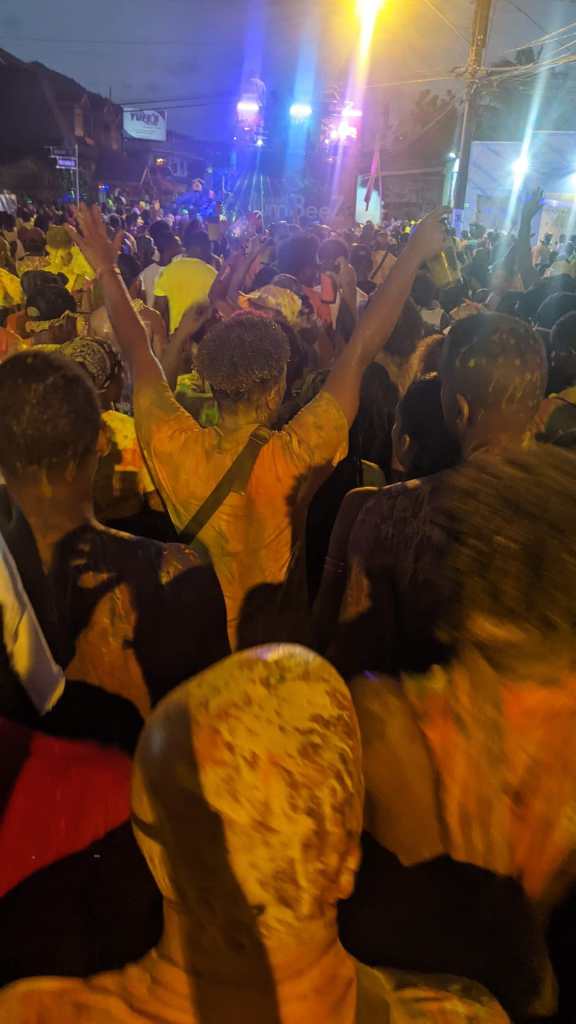
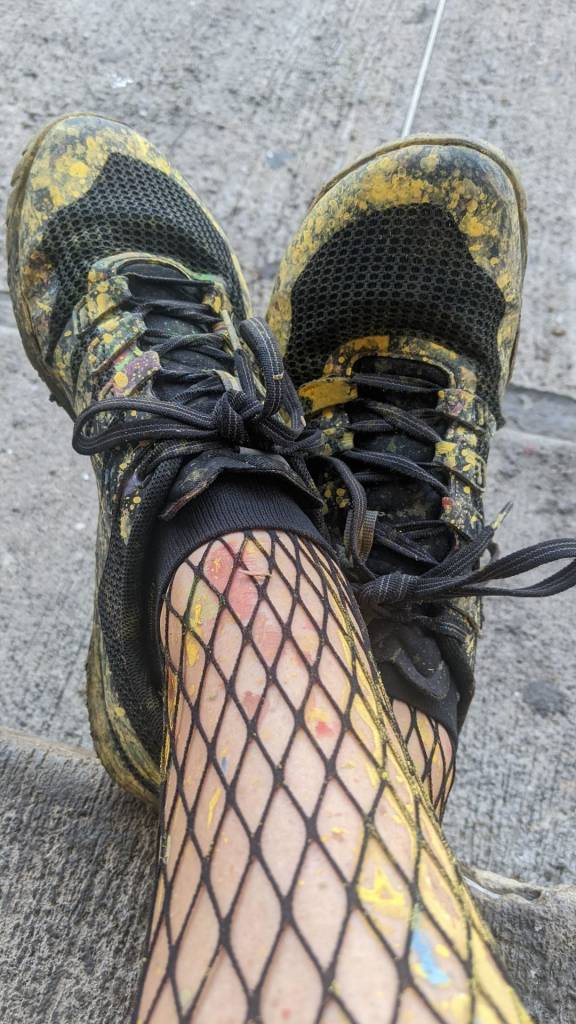
We had just gotten used to the crowds and the deafening music and the light show when the paint came out. Staff passed out plastic water bottles with sport caps full of red, blue, and yellow paint (supposedly washable, but you can’t prove it by looking at my sneakers) We shook our bottles and squeezed, spraying streamers of paint into the sky… and eventually back down onto our heads. I quickly dropped my bottle – there was plenty of paint flying from other revelers and from the trucks without my help. Capt. Mike took a more artistic approach, squirting smiley faces and polka dots on the backs of fellow JumBeez.  At a few points on the parade, colorful powder was thrown into the air to stick to the paint, and mud was splashed around our feet, but I avoided those variations as much as possible! There were even trucks with pressurized paint guns shooting paint 30 feet into the crowds.

Sunrise was subtle, but we gradually went from watching our footing in the dark to watching the crowds on the sidewalk who were out in force to see the parade. I have to tell you, there’s nothing cooler than seeing a full sized flag waving above the heads of a paint-splattered crowd in the first light of day. Back at the stadium, we “crossed the stage”. The DJs played the most energetic, jumpiest songs in soca and everyone, including the security staff, jumped up and down with hands in the air in celebration of daybreak, rebirth, and Carnival.

Do yole wanna race?

On our final Sunday in Martinique, we tagged along with Popeye and Lisa on SV Tumoltuous Uproar to watch the traditional Martinique Yole boats race in a regatta. We didn’t really know what to expect but Ooh la la! It turned out to be an exciting day.

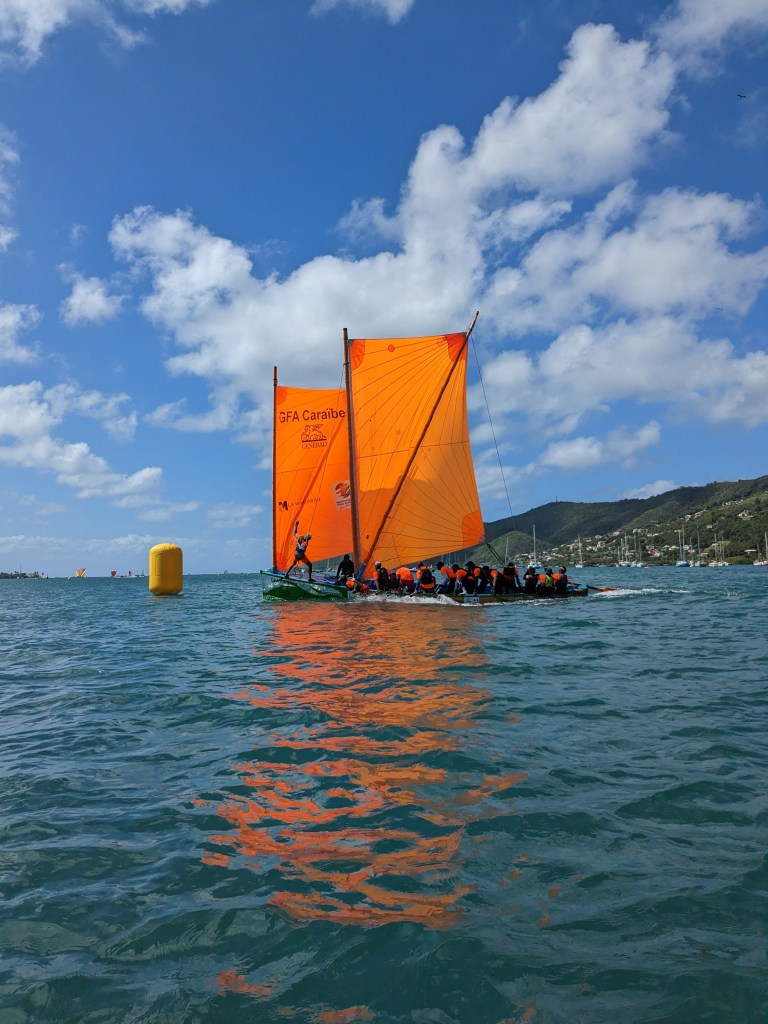
One of the best teams – look at that coordination!
At the starting line!

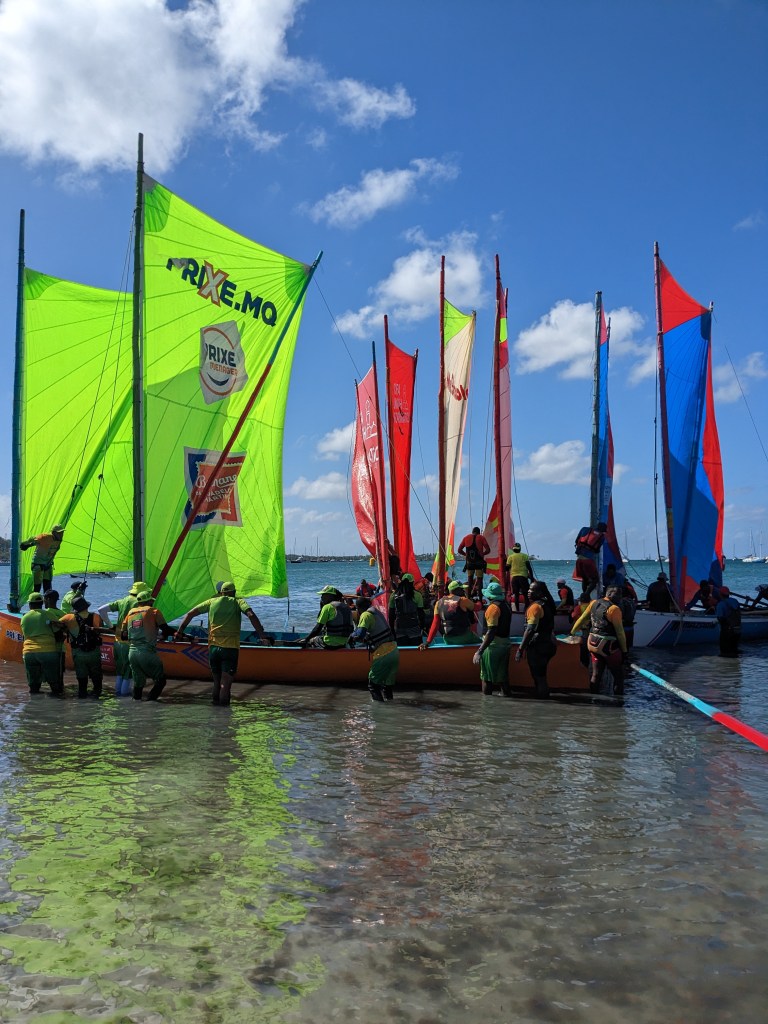
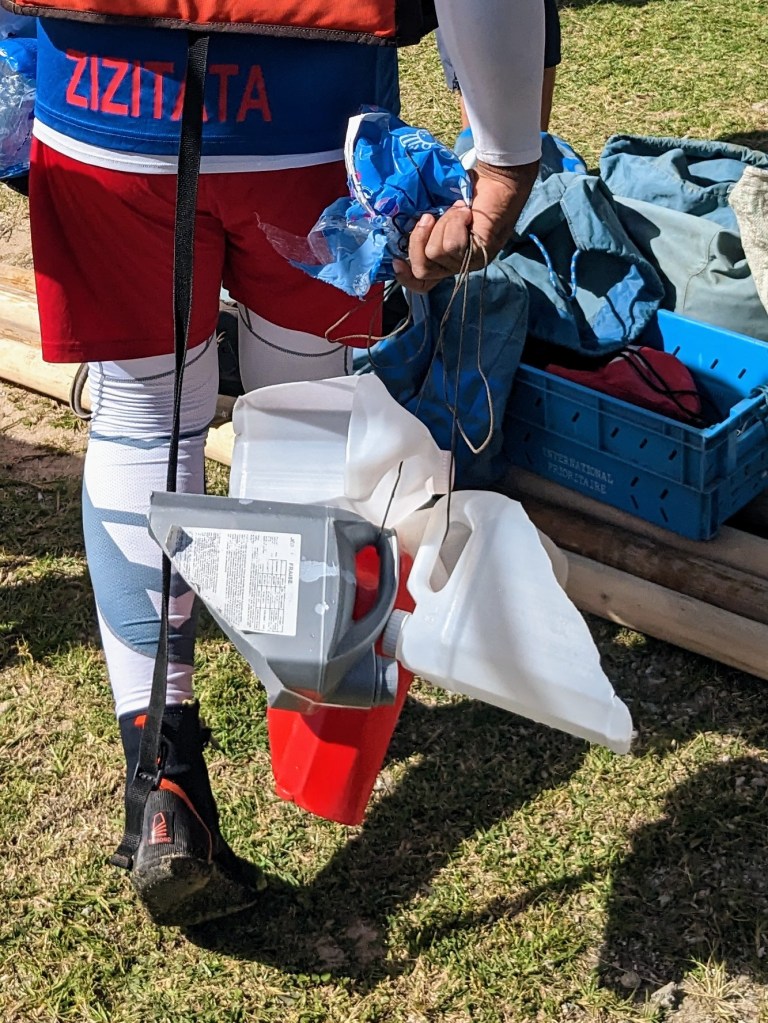
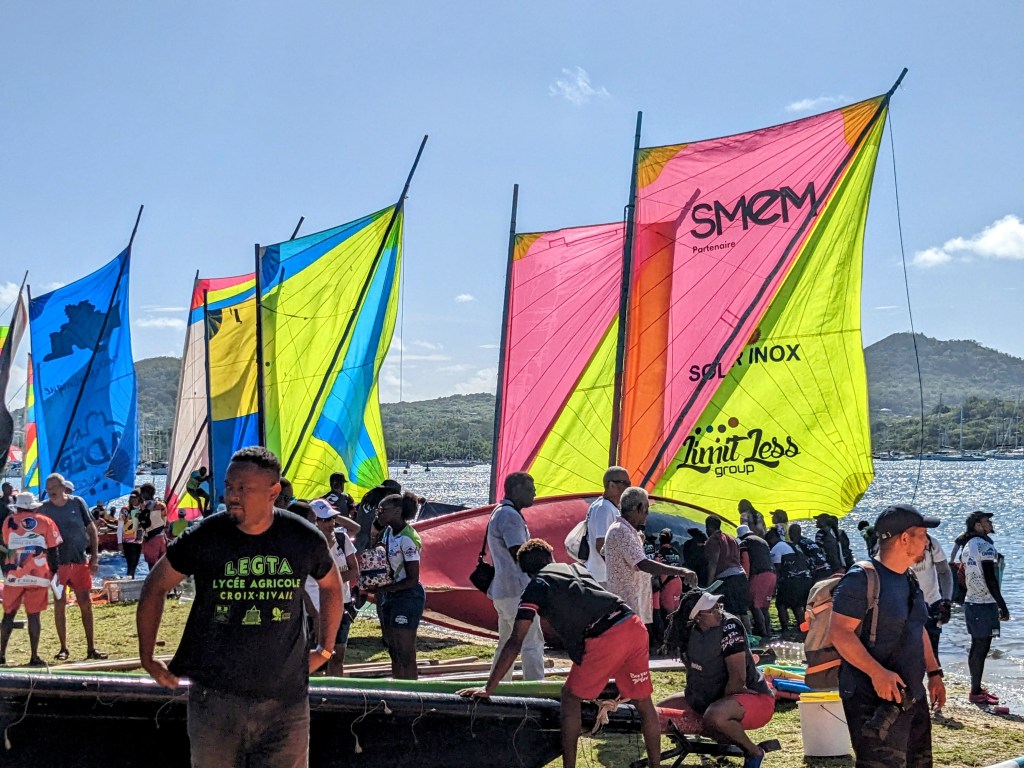
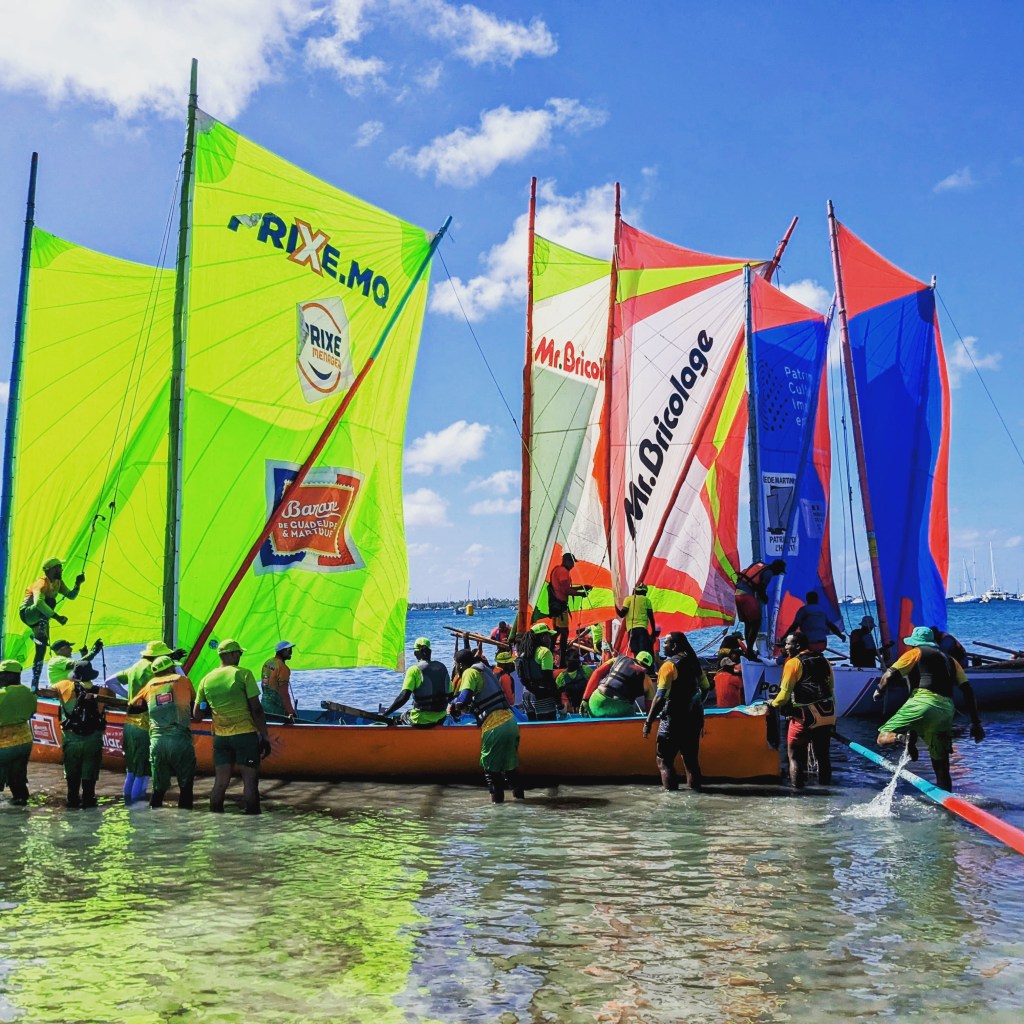
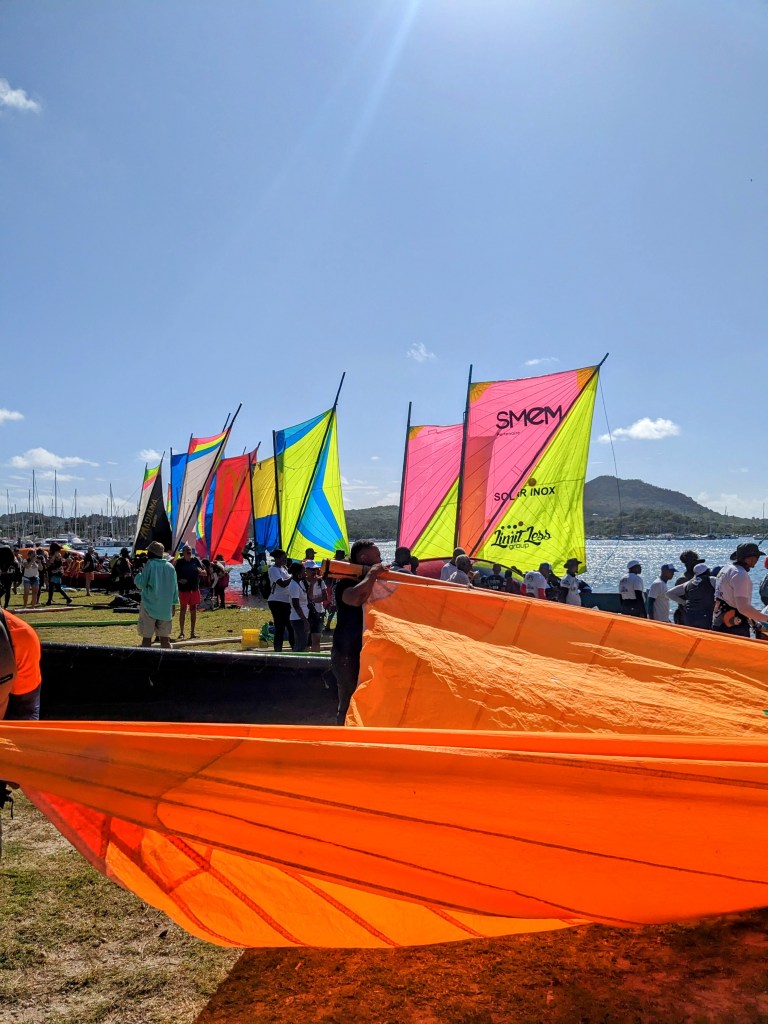
What is a yole? Well basically, they are traditional wooden sail boats, originally used by fisherman and to transport goods around the island. Each 10.5 meter yole boat is hand carved out of solid wood, without a keel or any ballast. So they are light and fast, but extremely “tippy.” The masts are made of bamboo, and instead of a rudder, a long wooden oar is used to steer the boat and to help paddle it through each turn or tack. The sails are rectangular and un-battened and extremely hard to manage. To balance the boat, a team of strong, burly, coordinated men hike way out from the boat onto sets of wooden poles, using their body weight and hopefully perfect timing to keep the boat from tipping over. Did I say “hopefully”? Several times during the race, we saw a boat heel over a tad too far, scoop up a whole bunch of seawater, and slowly sink. A race boat then had to tow them back to shore in the “tow of shame” with the boat sinking lower and lower, arriving back to the beach before it completely sank. There are actually members of the racing team whose sole job is to bail out water with plastic bottles and buckets during the race. If you can’t quite picture that strangle jumble of boat parts in action, have no fear ‘cause I took tons of pictures!

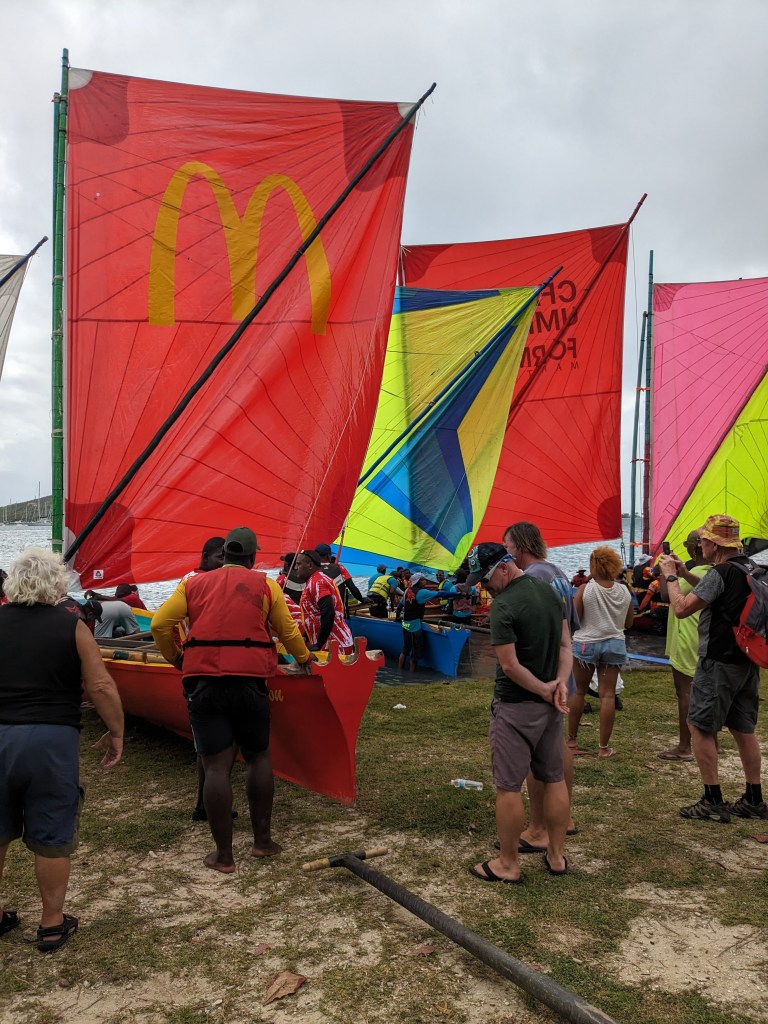
So colorful!
Capt. Mike getting ready to help launch team McDonald’s
One man’s trash is another man’s bailing bucket

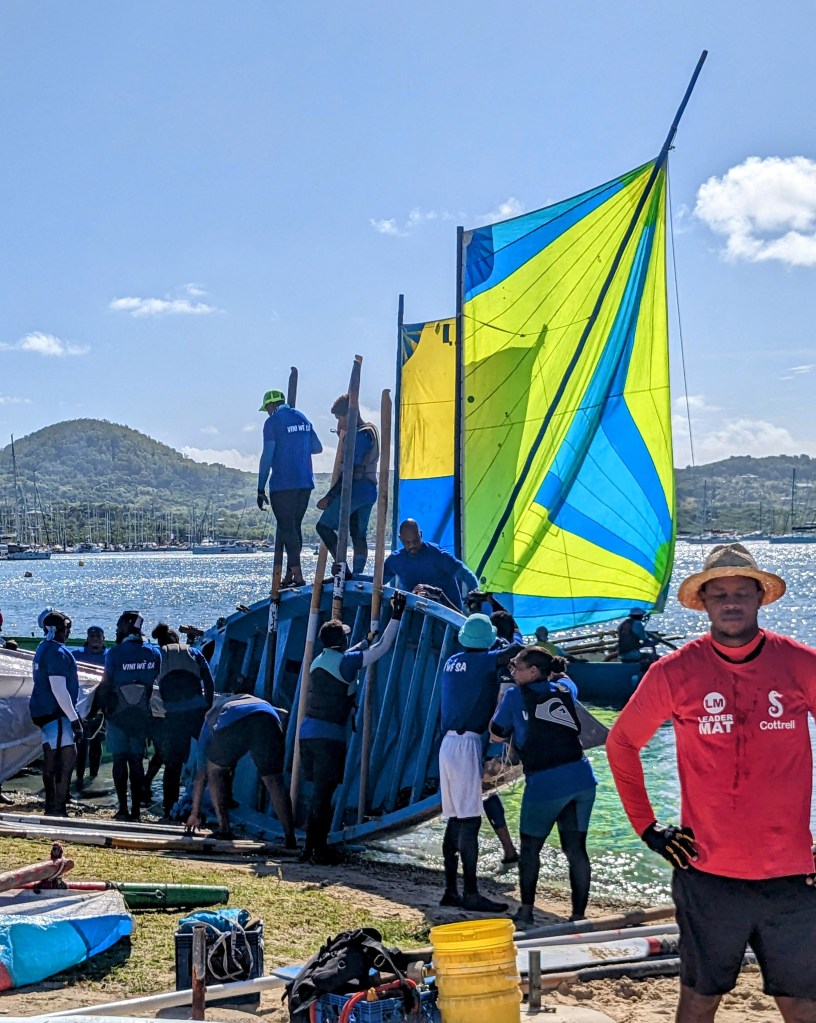
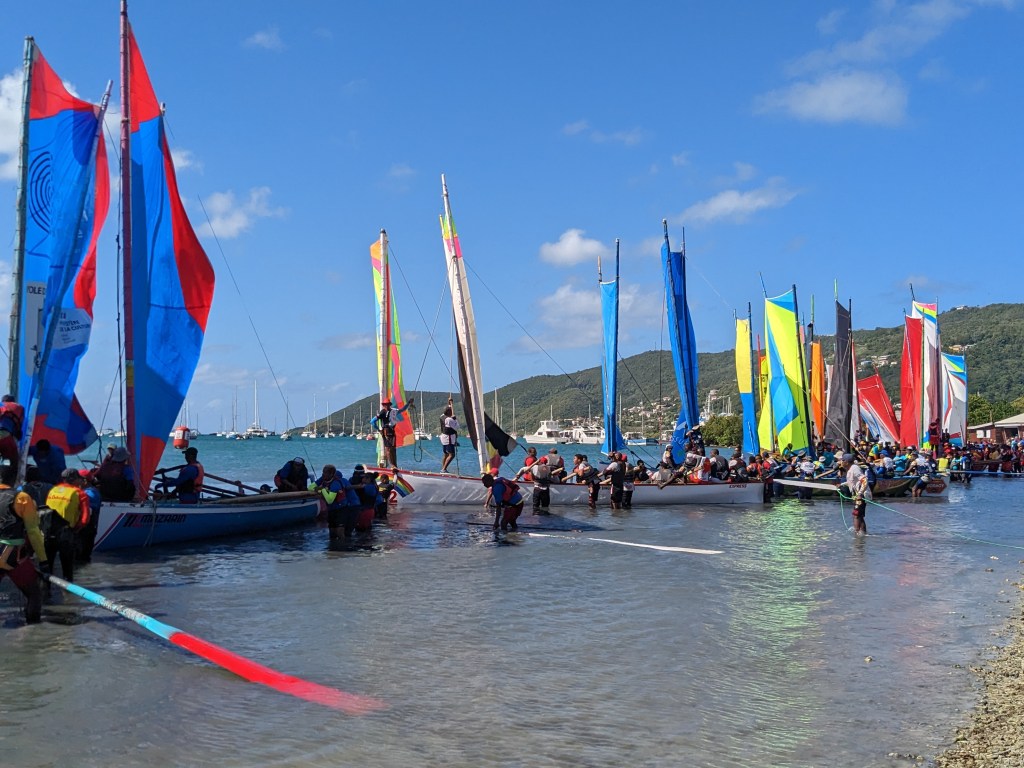
The best part of the race is the start. Each boat gets dragged down the beach to the water’s edge and turned onto its side. On land, the two masts are maneuvered into place and the team rigs the two sails by tying a whole bunch on knots while the boat is still on its side. Once all the hiking out poles are slotted into place, three or four of the heaviest guys stand up on the high side, lean their weight onto the poles, and slowly (then all of a sudden, very quickly!) they tip the boat upright, with other team mates running in at the last minute to push it into the water. It’s a blast to watch! When it goes smoothly, it’s a work of art. When it doesn’t, watch your head ‘cause it’s all going to fall back to the ground again.

Ready to launch

To start the race, crews wait for the final horn blast and then shove and push these heavy boats full of heavy guys into deep enough water for them to float and start sailing. With at least a dozen boats all starting from that same stretch of beach there’s always a lot of bumping, knocking, crashing, and shouting until they get far enough apart to settle down a bit. Mike and Popeye helped launch the McDonalds boat. Luckily, this maneuver went fairly smoothly and we did not have to experience the local health clinic.

The next best part of the race is watching the boats round a big floating race marker. We took the dingy out to watch the lead boats make the turn from up close. They come in HOT with the team captain shouting out commands. As the turn starts, everyone hikes way, way out on the poles trying to keep their legs out of the water. Not to stay dry (this is definitely not a dry sport) but to avoid slowing the boat down due to drag. The sail guy on the bow basically bear hugs the mast and the spar to force the sail to tack from one side to the other. The boat slows way down and three guys on the stern start rowing with all their might to complete the turn. If all goes well, the sails quickly grab the wind and the boat surges forward on the next leg of the race – with very little bailing required. If it doesn’t go well, the boat loses all speed, scoops up a bunch of water and starts that slow sinking process. It’s very exciting!

We all picked a team to root for and joined the rest of the crowd in cheering on our favorites. I understand just enough French to understand the announcer calling out the team in first position, followed by the second team, followed by the third. At one point, he announced that a team was “trés malade,” I asked, “Did he just say that boat is very sick?” I got my answer a few minutes later when the race boat towed in a bright red yole nearly submerged with its team members sitting in sea water up to their waists. Very sick, indeed!