We’re Back!

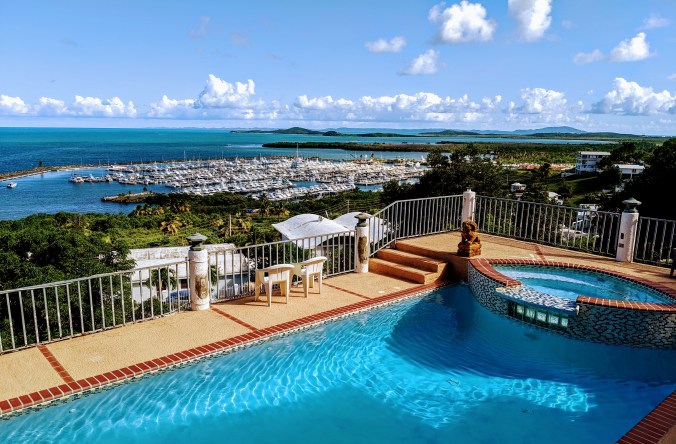
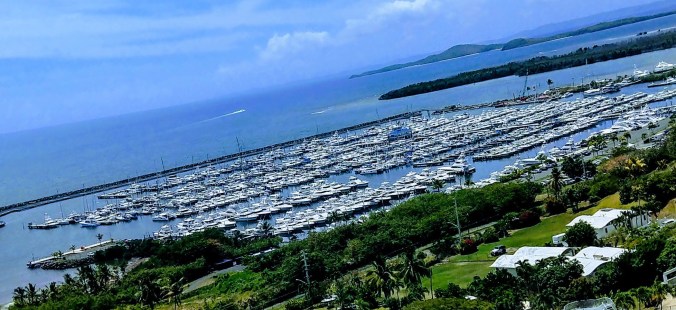
After 5 months, 4 countries, 3 states, 1400 km of hiking, and visits with countless friends and family members, summer vacation is over and we are back in Marina Puerto del Rey in Fajardo, Puerto Rico! We’re not allowed to live aboard in this boatyard, so we’ve rented an Airbnb just up the hill with a lovely view of the marina.
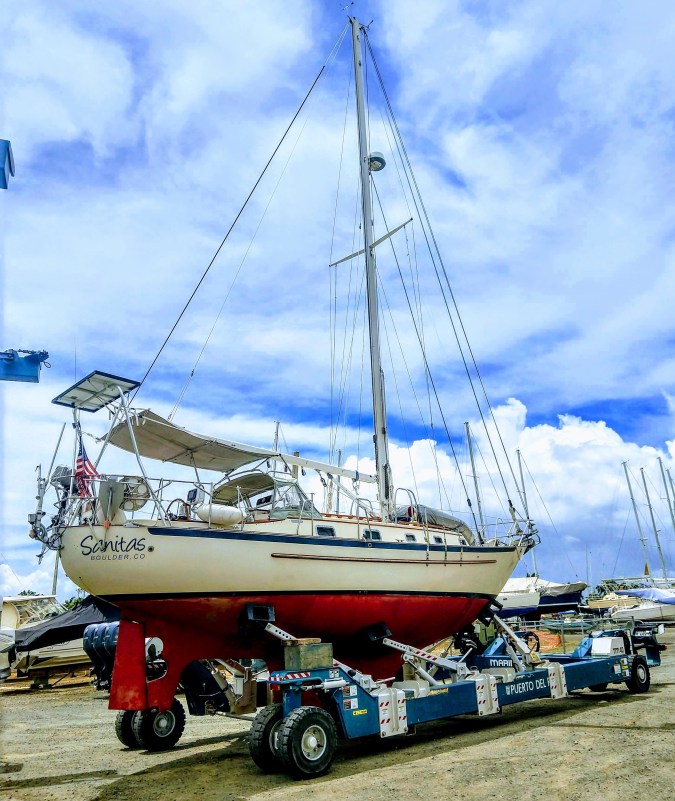
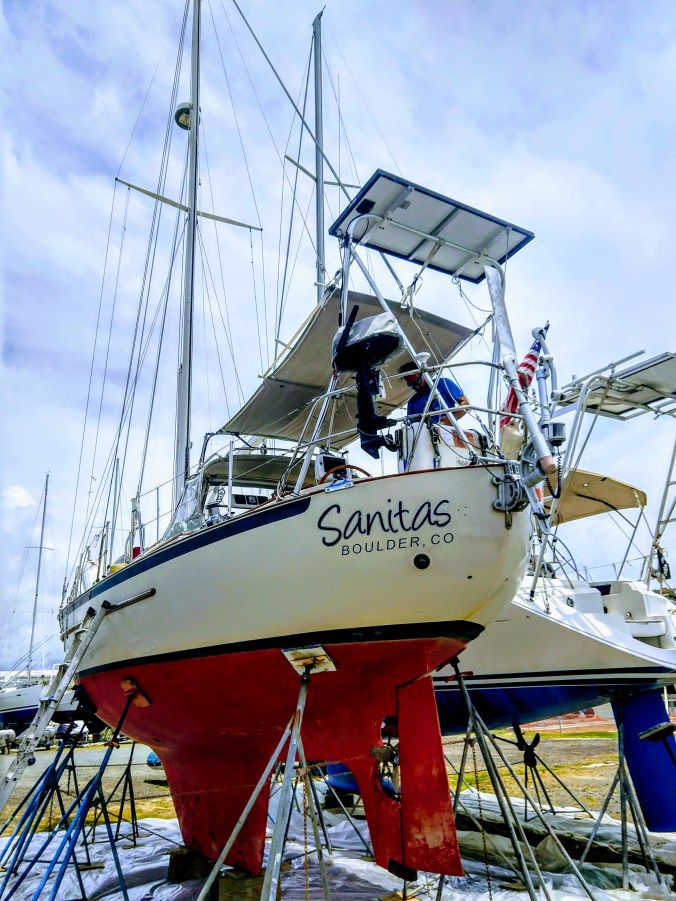
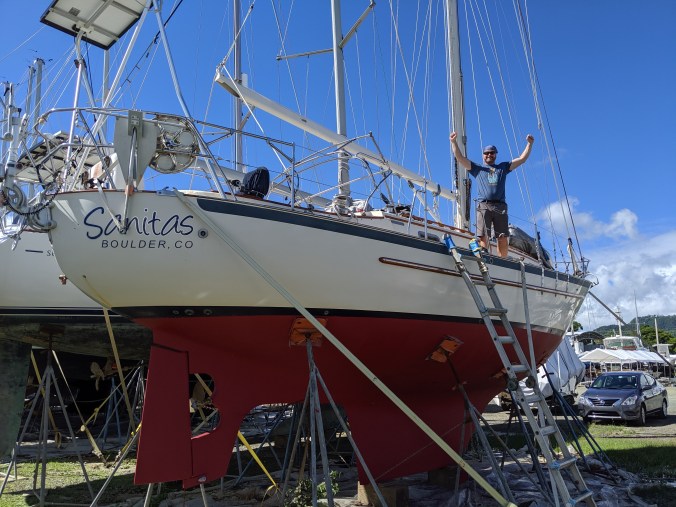
Sailing Vessel Sanitas is still on the hard in the boatyard where she has weathered hurricane season quite nicely. That’s partially thanks to our boat caretakers, Bianca and Johnny, who checked on her twice a month and performed extra storm prep during tropical storms Dorian and Karen. It’s also definitely due to the hard work Capt. Mike and I did in May to make sure everything aboard was as storm-ready as possible. We’ve done a thorough visual inspection and so far, so good – no mold or mildew, no bugs, no water in the bilge, nothing obviously broken. We’re keeping our fingers crossed that we continue to have no big surprises as we start up the systems and as we move into the water.
This month of preparation for the cruising season is the most expensive month of our year. We’re still paying boatyard fees for Sanitas and rental fees for a storage unit on land, as well as renting an apartment and car for daily use. We’re stocking up on spare parts, boat maintenance supplies, and canned and dry goods for six months. We’re paying for the only boat maintenance we don’t do ourselves; sanding and repairing the hull, applying a new coat of bottom paint, and polishing the hull. And we’re placing a new Amazon order practically every other day (did you know Amazon Prime free shipping works in Puerto Rico? Instead of 2-day shipping, it takes about 4 days, but who cares? It’s fantastic!) It makes me super anxious as we spend all this money, but I know we’ll be living at anchor and eating through those canned goods soon enough, spending practically nothing, so I try not to freak out.

This is our third time preparing for a winter in the Carribean. In fall of 2017 we had just bought Sanitas. She’d been out of the water for months while she was up for sale, so we found lots of surprises when we arrived at the boatyard in St Petersburg and set to work. The biggest, costliest project that first year was replacing the failed diesel fuel tank. In 2018, after surviving our first year of boat life, we returned to the boatyard with a massive to-do list of projects and things we needed to change to making living aboard a small sailboat more comfortable and our lives a bit happier. Each time, we spent much longer in the boatyard than we’d anticipated. But the investment of time and money up front made our cruising season go more smoothly. I’m hoping that third time’s a charm and that we know our boat well enough by now (and we’ve maintained her well enough as we go) that we can break free of the boatyard faster this time. I’d like to put in the work, and then hit the water! Let’s get to the the rewarding and fun part of cruising faster this time, ok?

Knock on wood because anyone who has ever owned a boat knows that there WILL be surprises – it’s just a matter of how serious and how costly… Ok, now back to work!
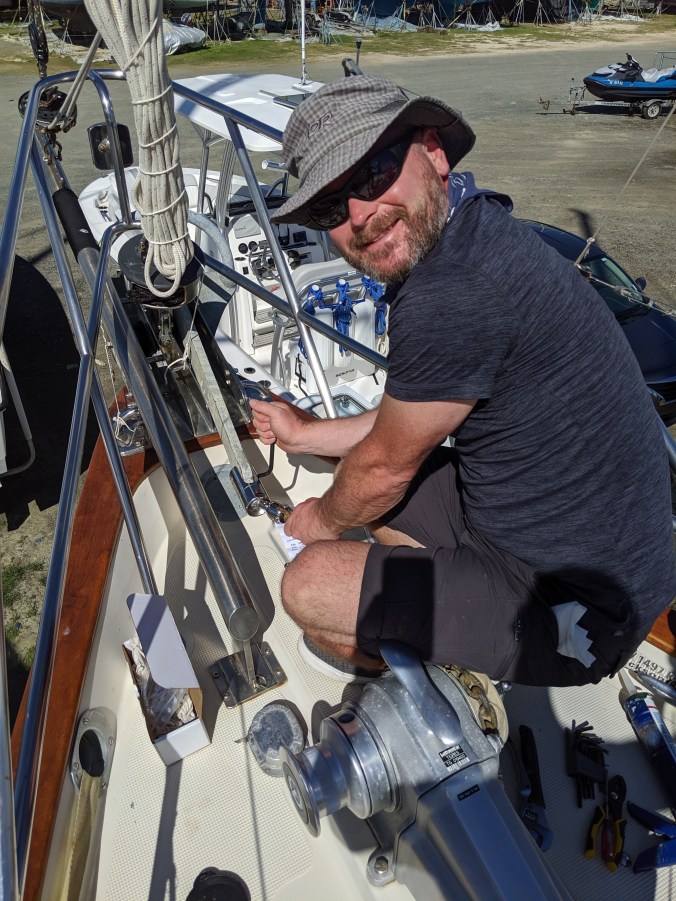
Back in the Boatyard, Baby!
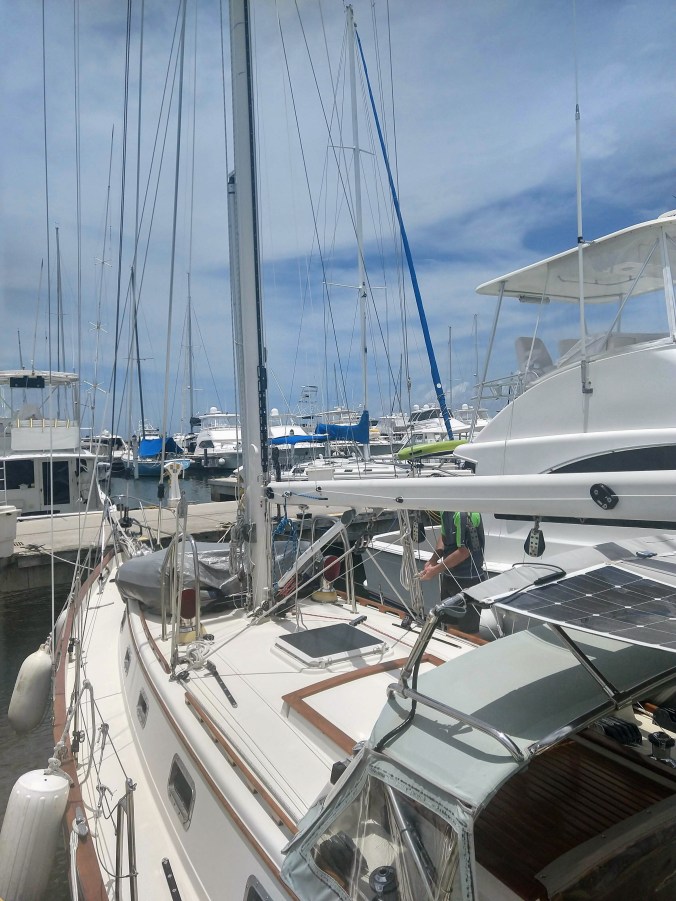
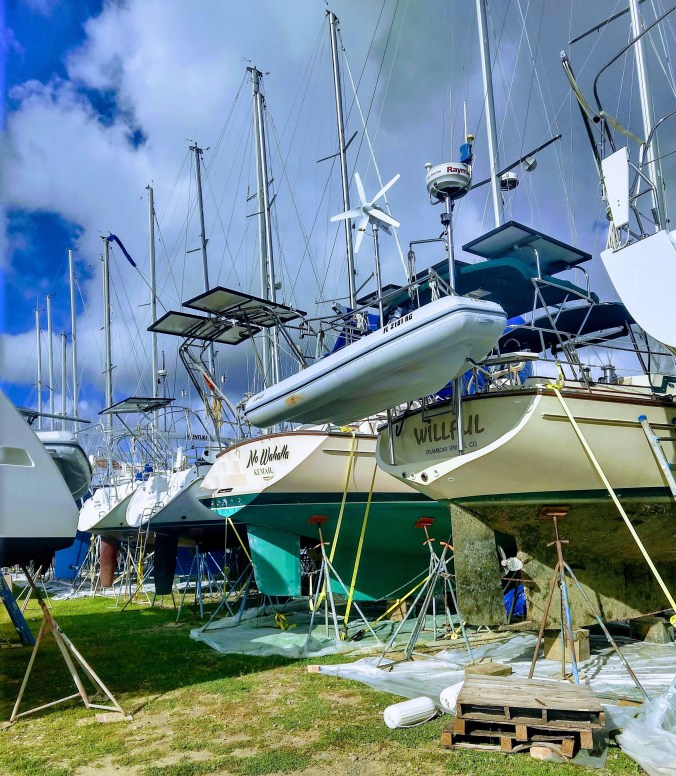
Sanitas finished the 2019 cruising season at the Puerto del Rey marina in Fajardo Puerto Rico. This marina is massive – it holds over 1000 boats in wet slips, and several hundred “on the hard” for hurricane season storage. It’s so huge, they employ a fleet of golf carts to drive you from a slip to the parking lot or the main office building because the walk can be nearly a mile! I’d often choose to walk, and I could get my daily 10,000 steps just doing laundry!

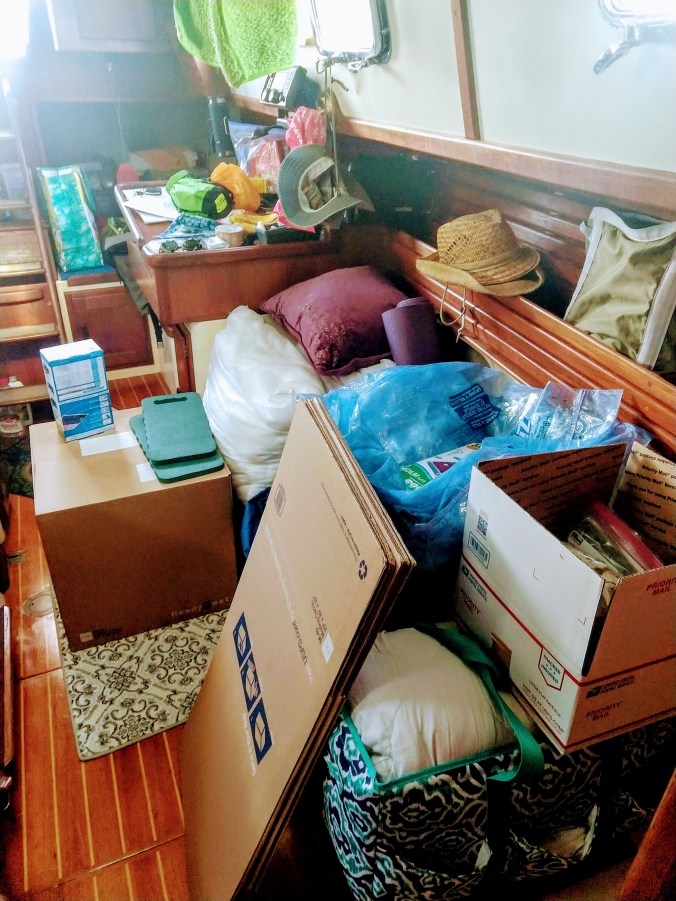
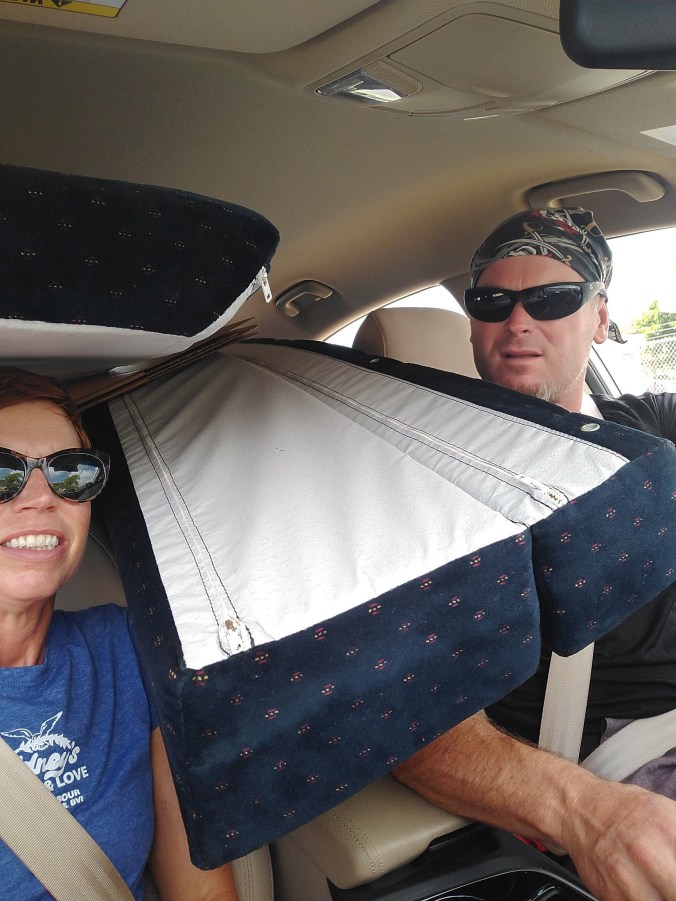
Once we pulled into our slip at PdR, the vacation was over! Now the hurricane season preparation spreadsheet comes out, and we get to work cleaning Sanitas from bow to stern and making her as safe as possible from tropical storms while we travel for the summer. Capt. Mike and I rented a storage unit on land so that we could remove as much as possible from the boat, giving us the chance to clean very thoroughly and allowing ventilation so that we don’t return to mold or mildew. But remember how far our slip is from the parking lot? Getting everything off the boat is a challenge, even with a rental car.

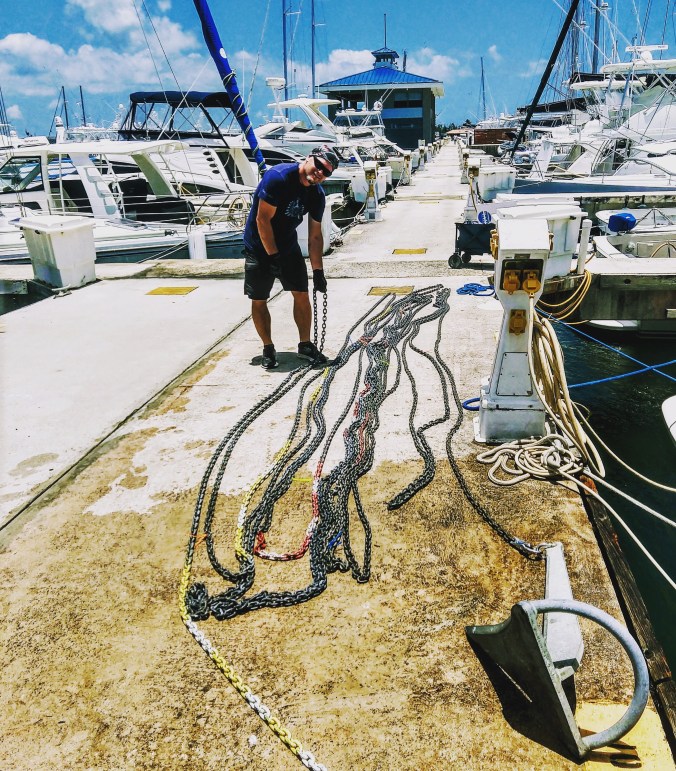
Once she’s mostly empty, we could get down to business and do some once-a-season jobs like cleaning and marking the anchor chain….

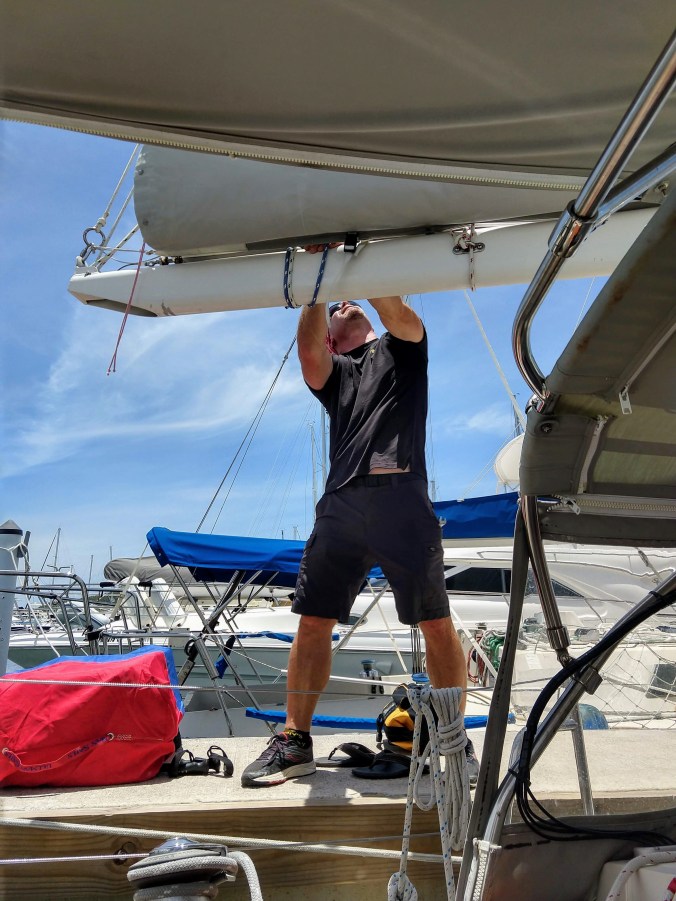
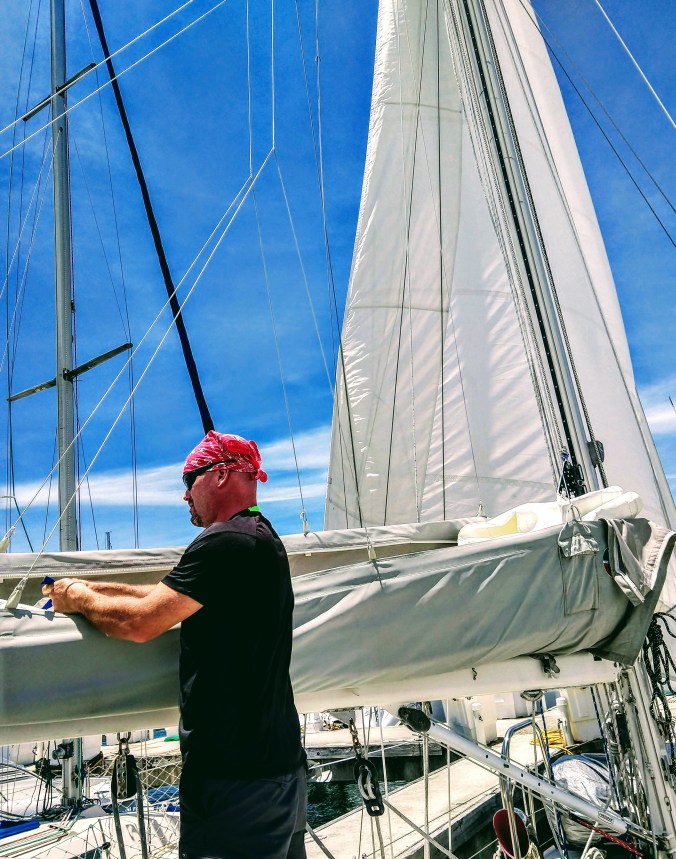
….And inspecting, cleaning, and removing the sails.

Knowing that we are inside the hurricane box, we took special care to remove anything that could be grabbed by the wind. For the first time, we removed all of the running rigging, replacing the thicker braided nylon lines with thin parachute cord “messenger lines”. I almost don’t recognize Sanitas with no canvas and no lines!

While we were in a wet slip, we had access to fresh water so that we could spray a season’s worth of dirt and salt water off everything. We also had access to electricity, which means air conditioning – hooray! We set the thermostat at 72 deg, and I think it actually got the temperature inside the boat down to around 80. Unfortunately, being in a slip so close to land and to other boats also meant LOTS of tiny little flies. I hung up fly paper and by the time of our haul-out, we’d captured hundreds.

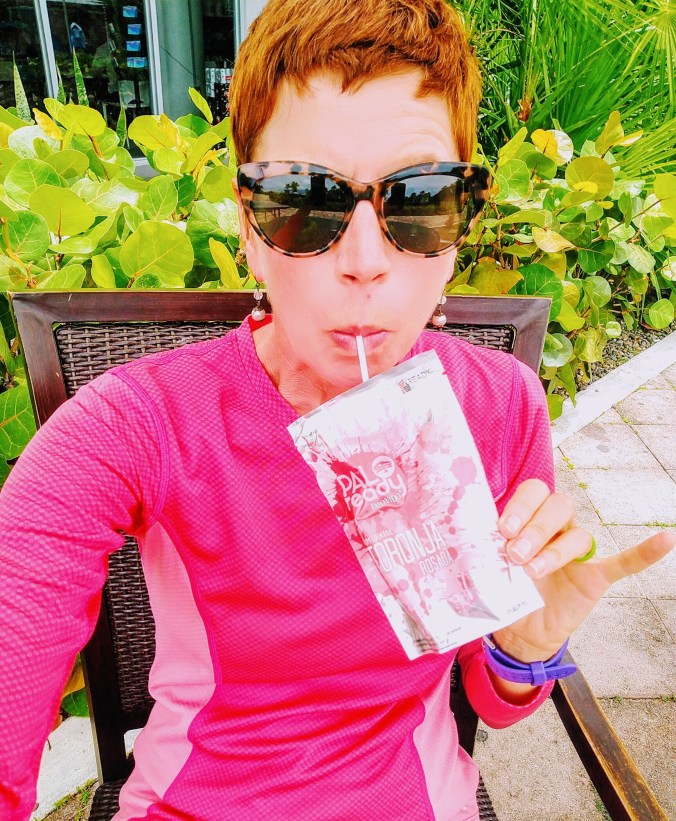
One thing that made all the heat and dirt and flies tolerable was the $1.50 rum punch pouches sold in the marina cafe. In all kinds of tropical flavors, and ice cold, it was tough to walk by without stopping for a treat.

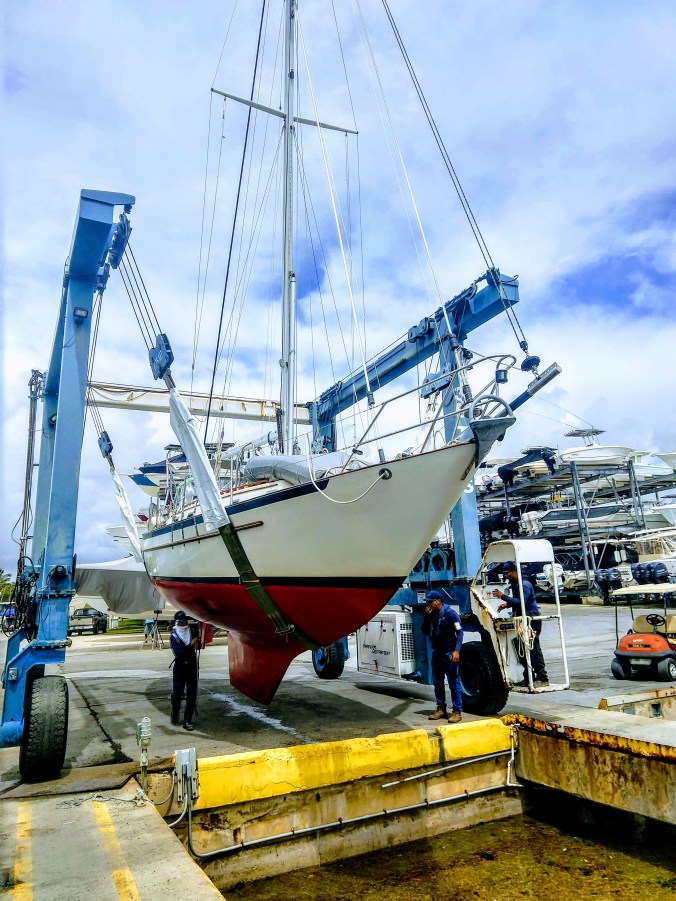
Finally, the big haul-out day arrived, and Sanitas got to go for a little ride! Capt. Mike did an excellent job backing her into the teeny little haul-out slip, and the very professional boat yard crew drove her across the parking lot, transferred her to a small hydraulic trailer, and slid her into place in the dry storage yard.

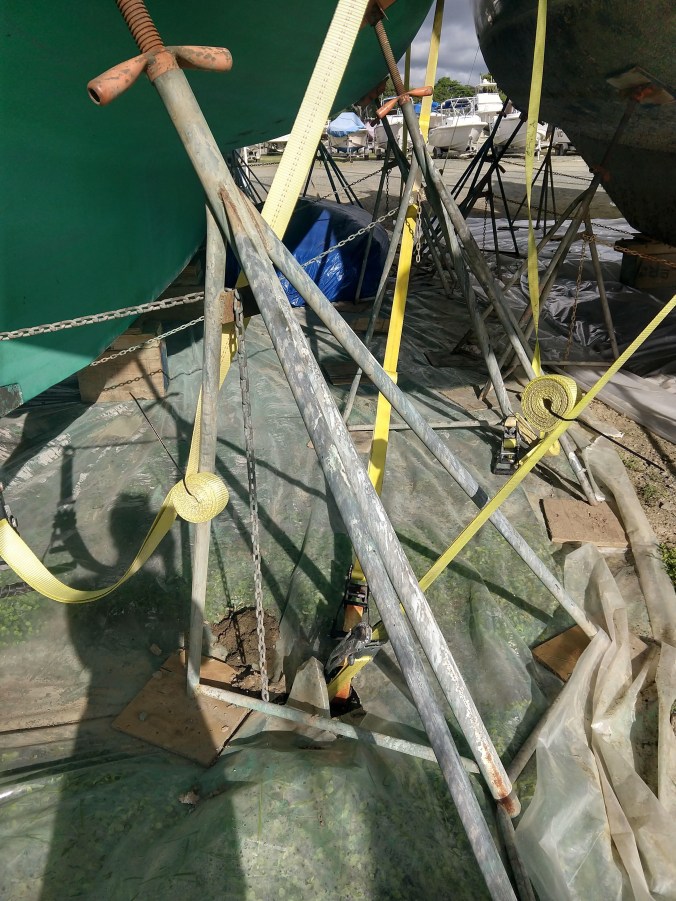
We chose Puerto del Rey for a reason – it supposedly has the most secure hurricane storage in all of the Caribbean. In the boatyard, concrete footings reinforced with rebar provide strong tie-down points. We used ratcheting tie-down straps rated at 10,000 pounds to secure Sanitas to the ground. In theory, all of the boats lined up and tied down together provide additional strength. We have our fingers crossed that it’s true, and that we’ll have no problems during the storm season! To further reduce risk, we hired a caretaker to visit and inspect Sanitas periodically, and to double check that she’s secured before every big storm.

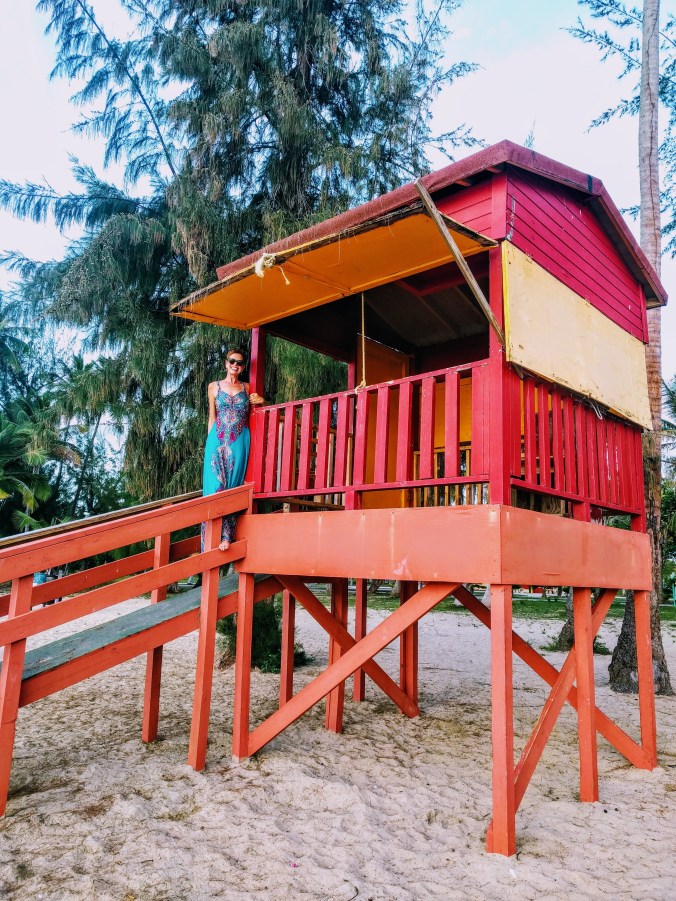
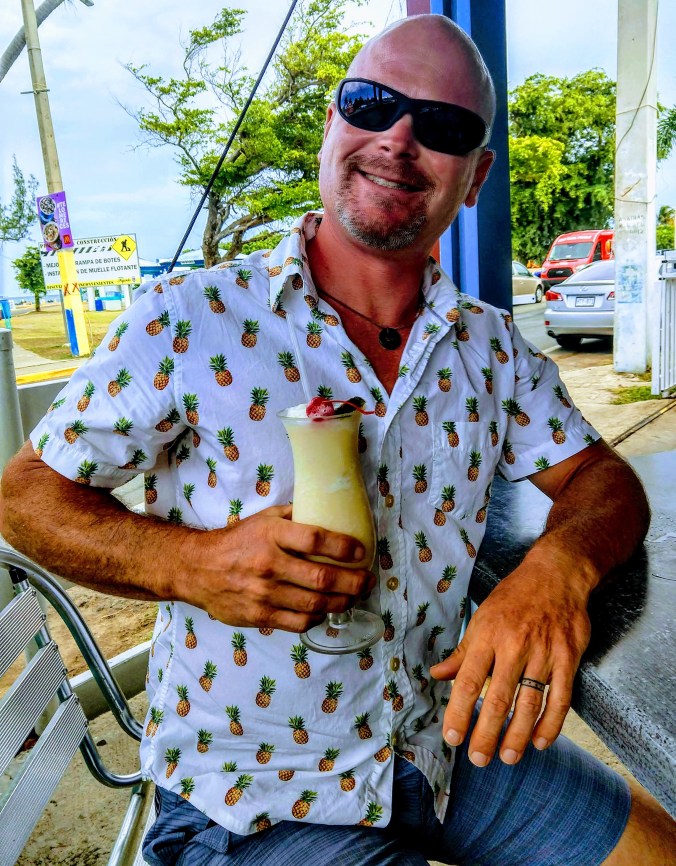
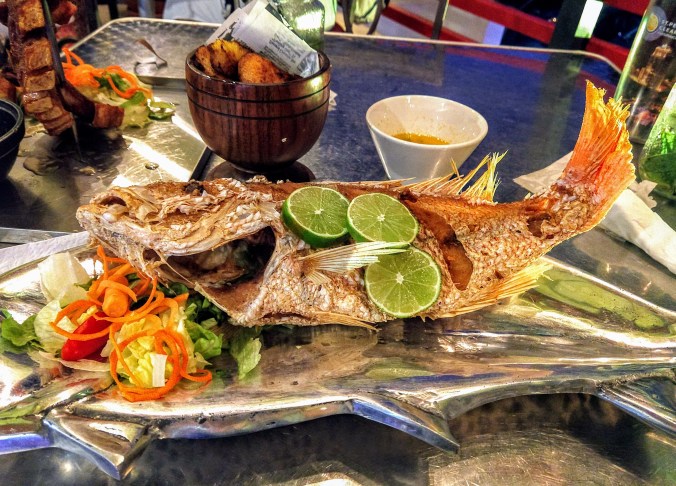
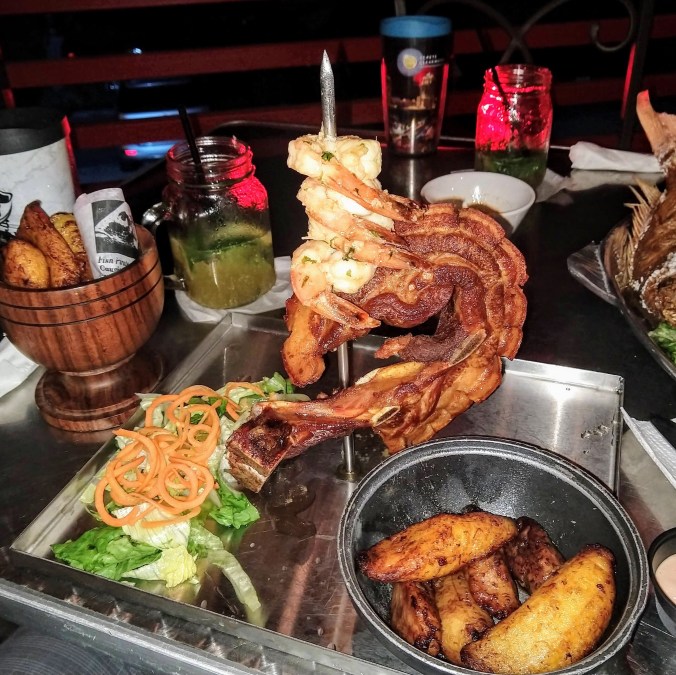
After two weeks of hard work, Sanitas was safe and secure and Capt. Mike and I could have a little fun. We explored Luquillo Beach and the kiosks that serve the tastiest food and drink we had in Puerto Rico.

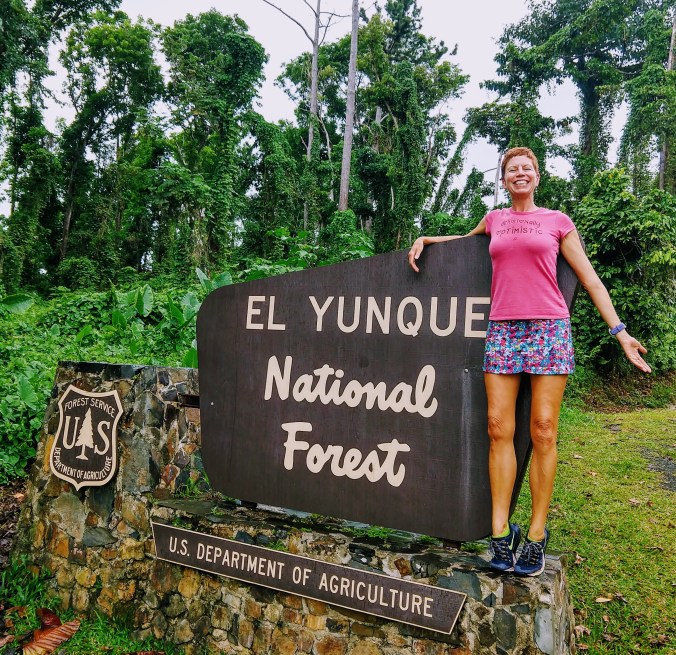
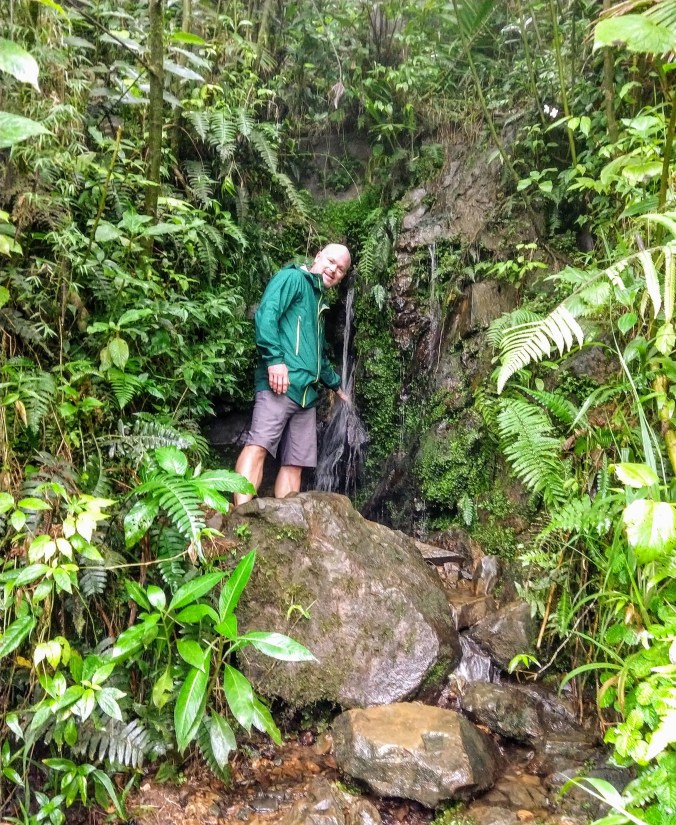
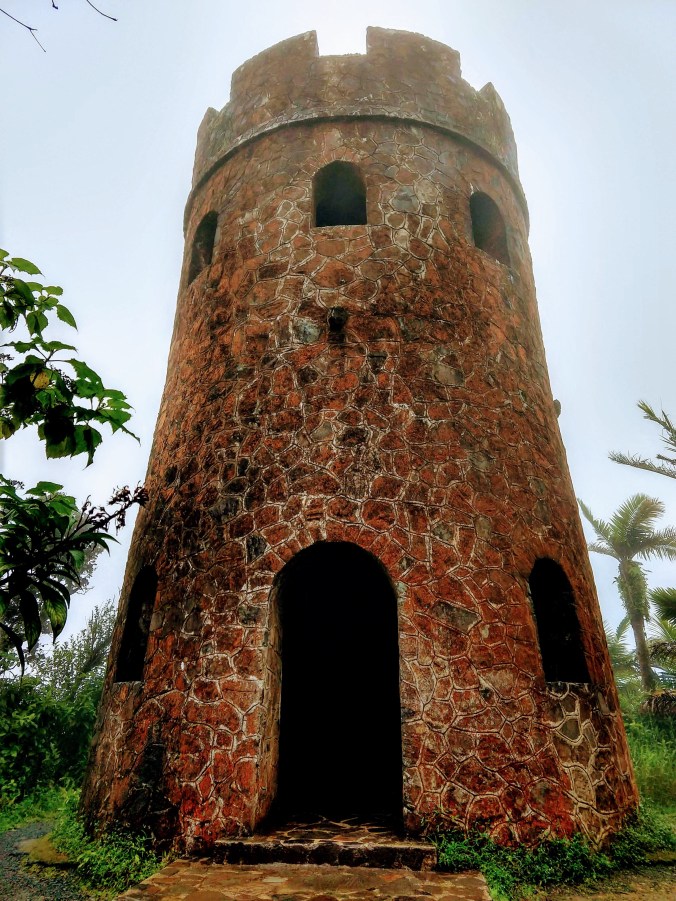
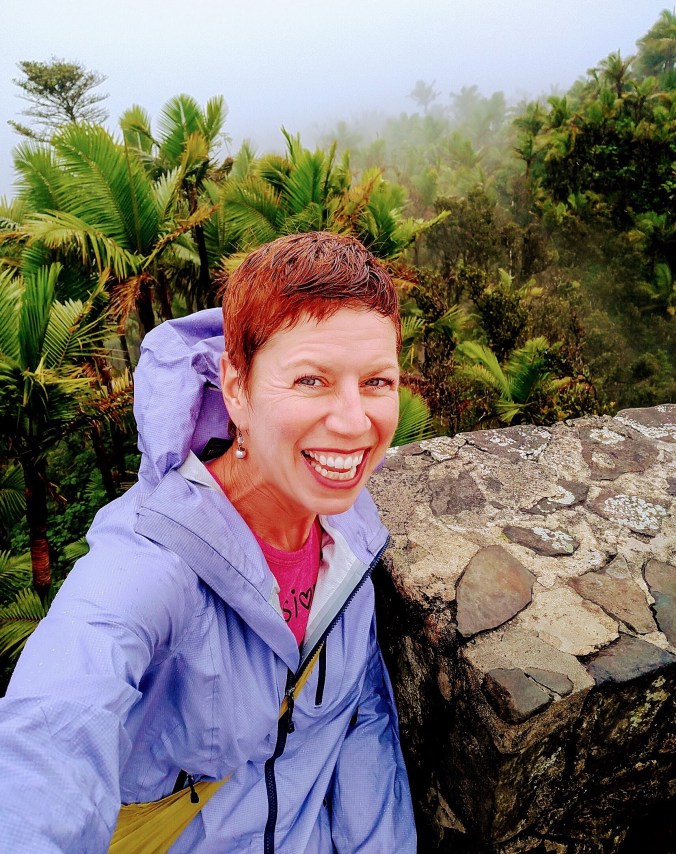
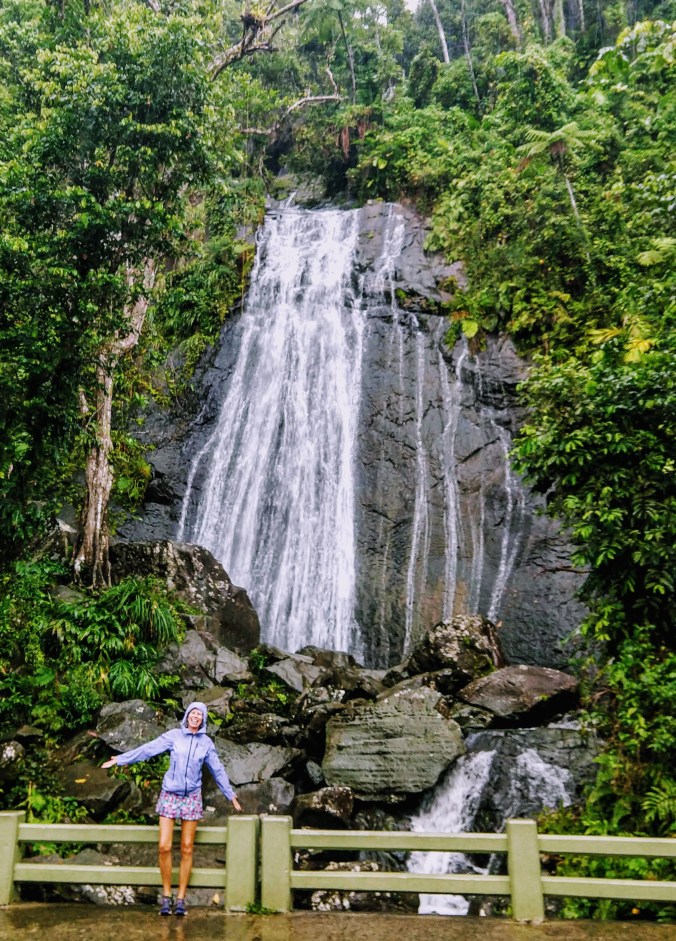
And we took a day to explore El Yunque National Forest – the only tropical rain forest in our national parks system. True to its name, it rained the whole time we hiked, so we didn’t have great views…but the vegetation and scenery and waterfalls were amazing! We worth the trip and the soggy hiking shoes!

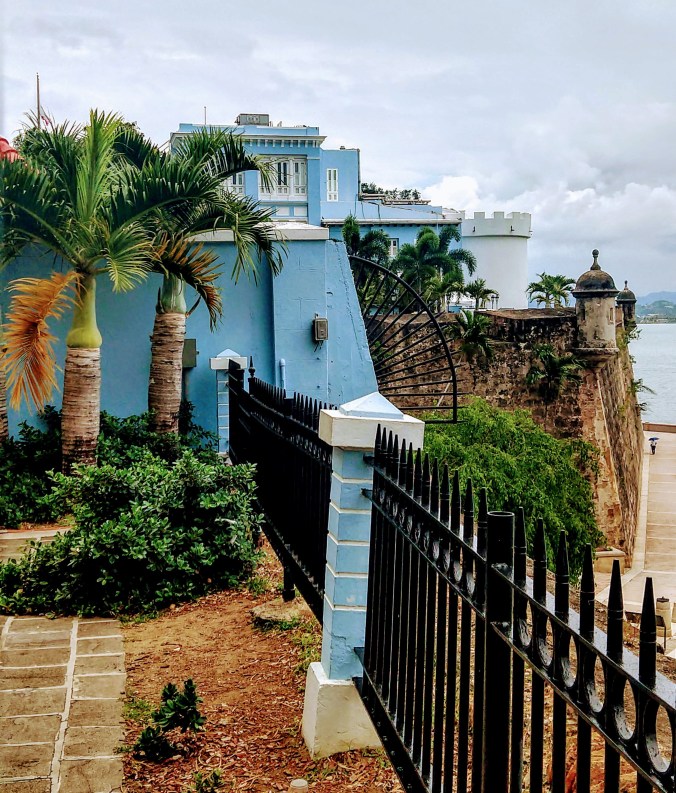
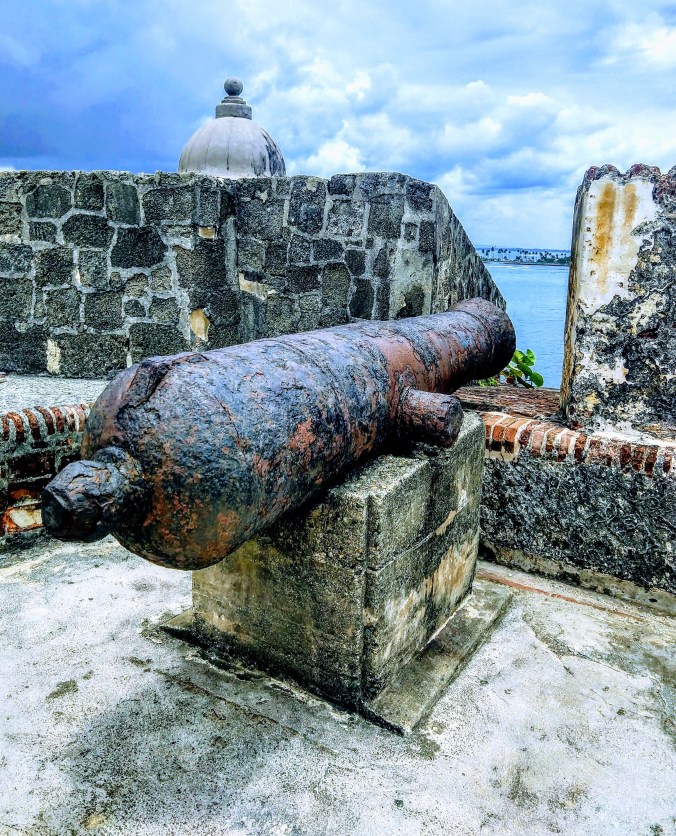
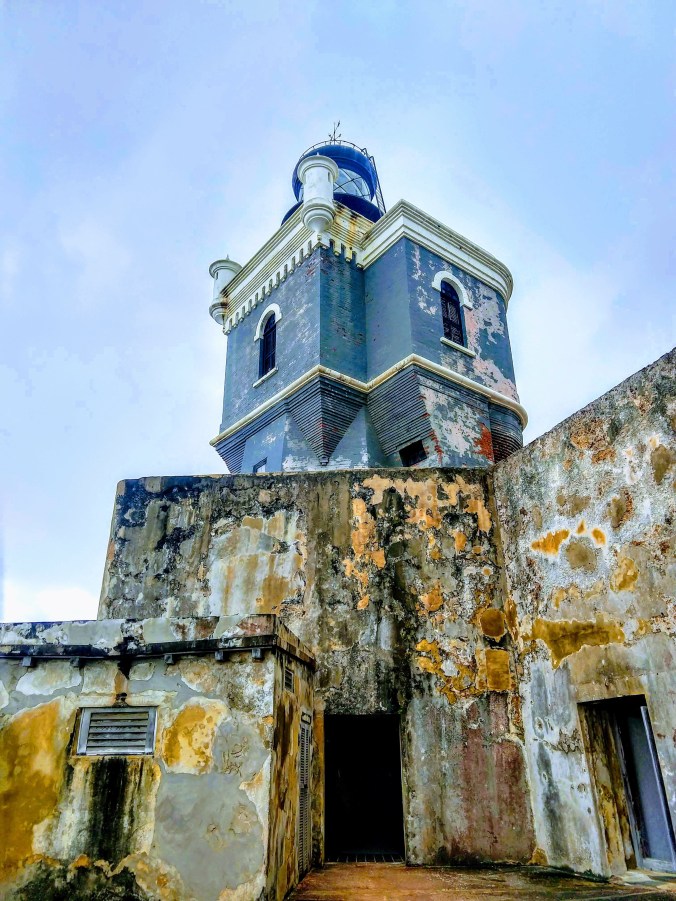
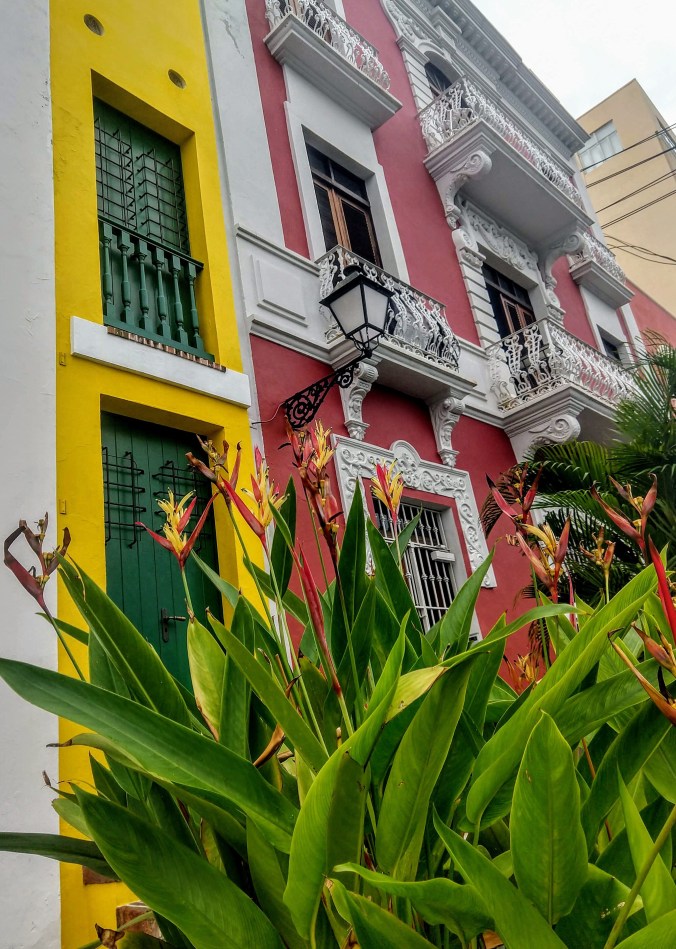
Finally, a little drama to close out our season…. on the day we were scheduled to fly from Puerto Rico to Colorado, Southwest canceled all flights to Denver because of weather. (Although how they knew at 5am east coast time there would be bad weather in Denver at 8pm mountain time, I have no idea 😡) So we were left to reschedule our flights, find a new place to stay in Puerto Rico, extend our rental car, and cancel our hotel in Denver. On the positive side, we had a day to explore Old San Juan. So we made the best of it, hiking through the Castillo San Felipe del Morro fort, and touring the governor’s residence at the Fortaleza.

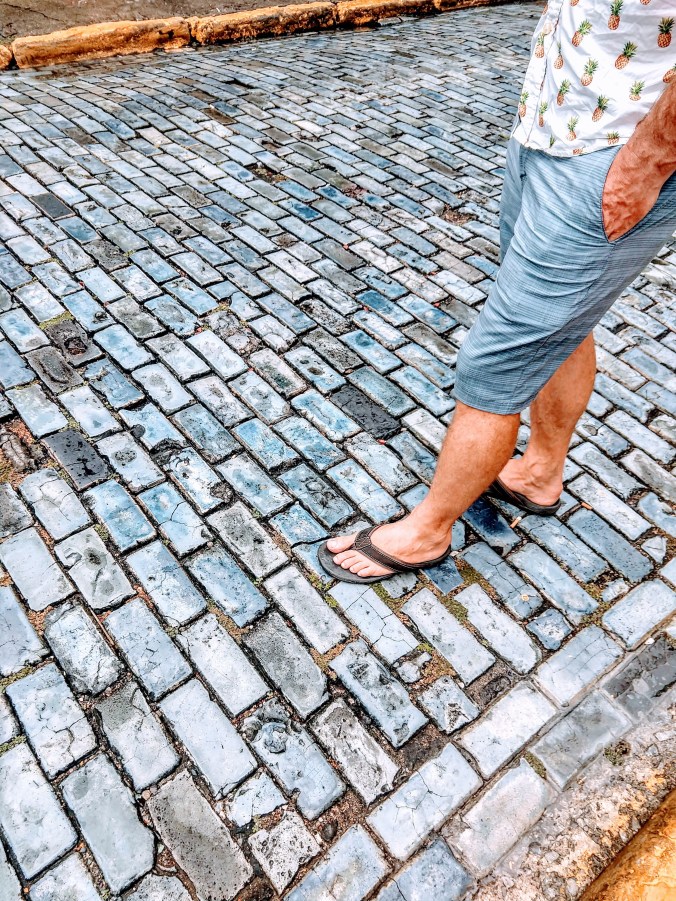
I could have spent several days just wandering the streets of Old San Juan, enjoying the people watching and sampling the tasty food! It’s the only city I’ve ever visited where the historic streets are paved with blue bricks – due to the iron content of the ingredients.

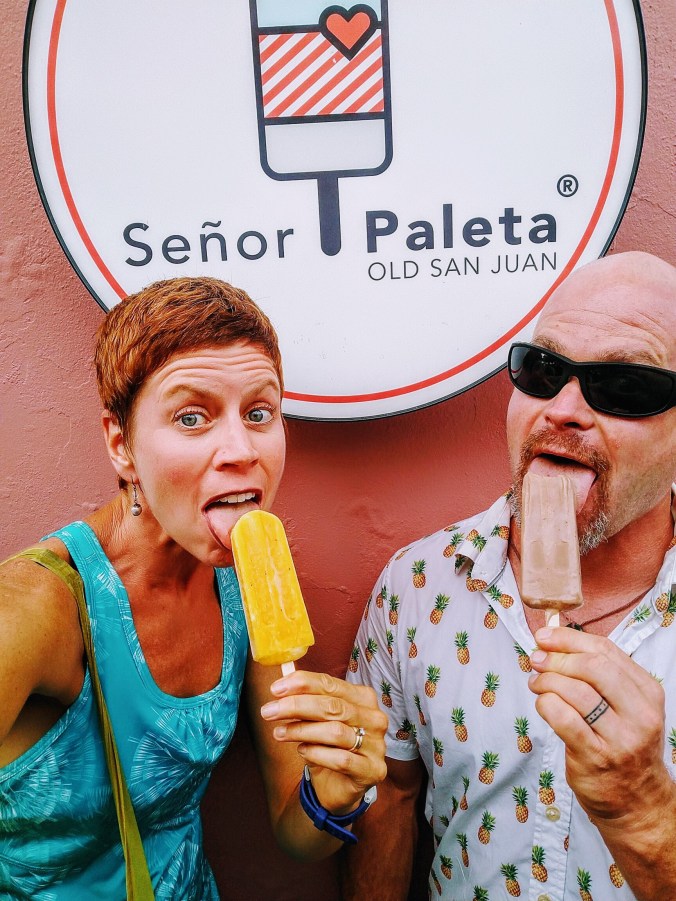
I realized that we’d been in Puerto Rico almost a month and we had yet to try paletas – the local version of popsicles, made with fresh fruit and all kinds of gourmet ingredients. Well, we certainly remedied that error on our last day!

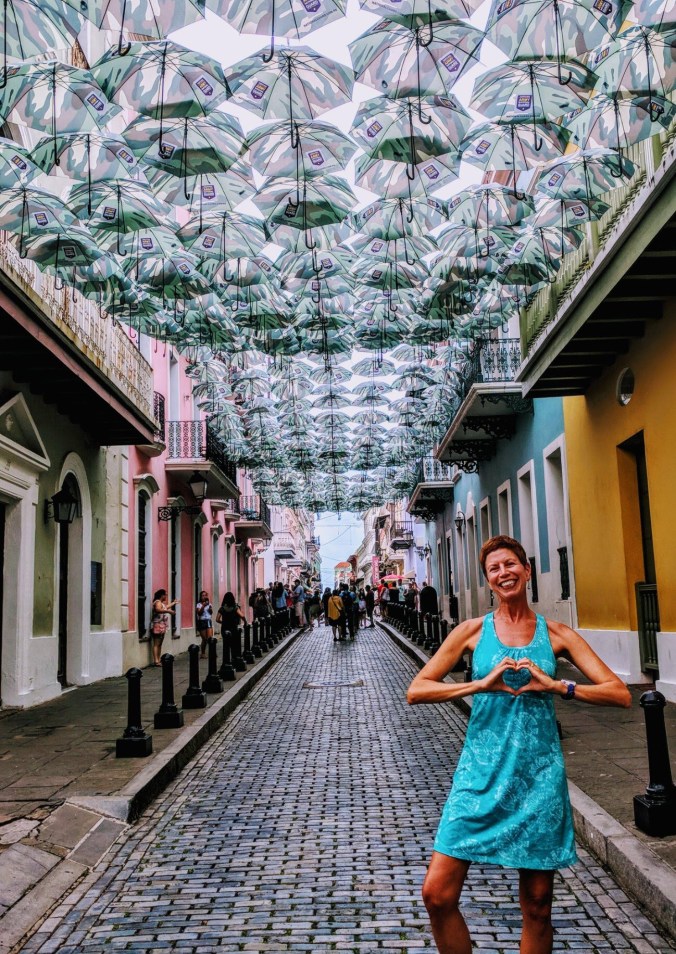
And of course, we visited the iconic Passeo de Sombrellas or the Umbrella Passage and joined the rest of the selfie-mad tourists. Instead of rainbow colored umbrellas, they were camouflage print during our visit in honor of Memorial Day and in support of the Army National Guard. I can’t wait to do more exploring when we return to Puerto Rico in the fall!

My final boat project post

I promise! You must be saying to yourself by now, “I thought I was following a blog about sailing. But she only writes about DIY projects.” Well, fair enough. But in a blatant bid to get a little credit for all the hard work we’ve done getting ready for the actual sailing part of life, here’s my last post of boat projects for 2018. Hooray!

I’ve already shared with you some of the important safety and structural projects we’ve completed. Here, I’m going to share some of the smaller, less critical projects that will hopefully make cruising life more enjoyable this year. Fingers crossed!

Cockpit Shower

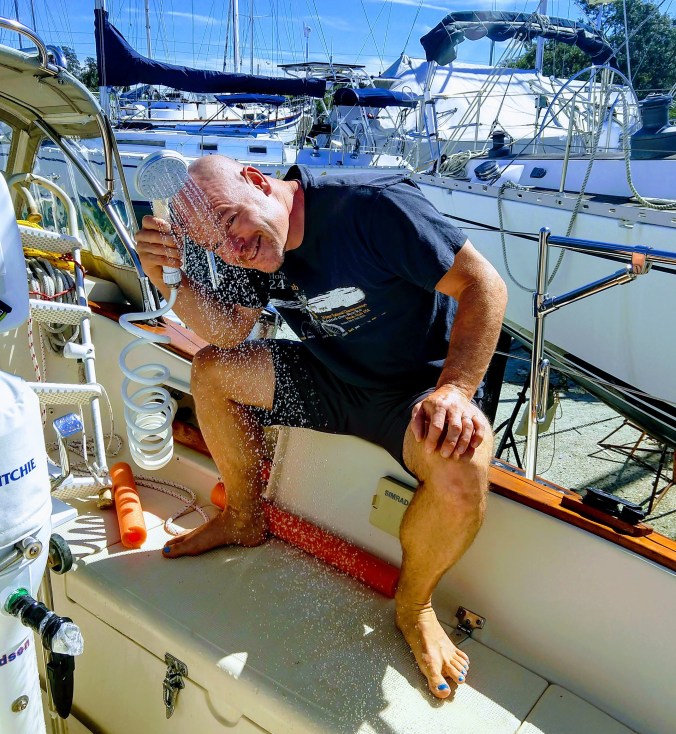
Sanitas theoretically has a shower in our head. It’s the simplest kind of shower: a spray nozzle attached to the faucet on the sink, with a pump to drain out the water that collects on the floor. However, we never use it. It’s too much of a mess getting the head all wet, and our composting toilet doesn’t handle extra moisture well. So even while anchored in paradise last year, I sometimes struggled with the lack of hygiene. We’ve made two improvements for this season; adding a spray faucet to the galley sink so that I can wash my hair, and installing a cockpit shower.

I am constantly amazed and impressed that Capt. Mike has the confidence to do things I find terrifying, like drilling a hole in the boat, or tapping into the fresh water system (that isn’t currently leaking) to add a new hose or water line. After the usual boat project problems with finding the right size fittings and hoses, we have a fantastic shower that fits into an cubby hole the the cockpit that we weren’t really using. It connects to the pressurized water system, and uses the water heater to provide warm water showers using a low-flow shower head designed for boats and RVs. Can’t wait to try it out in some gorgeous harbor in the Bahamas!

Soda Stream

I love me some fizzy water! Sometimes, I know I should drink more water in order to stay hydrated, but boring warm water just isn’t appealing. A pinch of crystal lite or Real Lemon often does the trick. But a cold seltzer water tastes so much better! Not to mention it makes an instant cocktail when mixed with the ubiquitous island rum and a squeeze of lime!

Last year, we brought a Soda Stream with us on our cruising adventures. But it has a couple of negatives: the plastic unit is pretty clunky and big and hard to store in Sanitas’ small galley. And more importantly, we couldn’t find ANYPLACE to buy the right size CO2 canister replacements. And we searched in hardware stores, propane shops, stores that sold kitchen supplies, marine supply stores; pretty much everyplace we could think of. So when we ran out of CO2, we resorted to buying club soda or La Croix cans which cost roughly the same as a can of beer! Plus, we had all those empty cans to eventually dispose of.

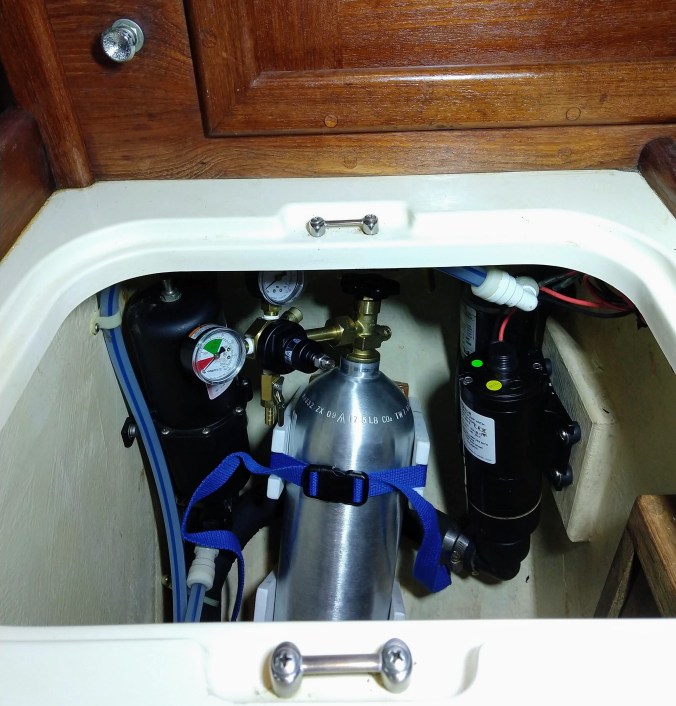
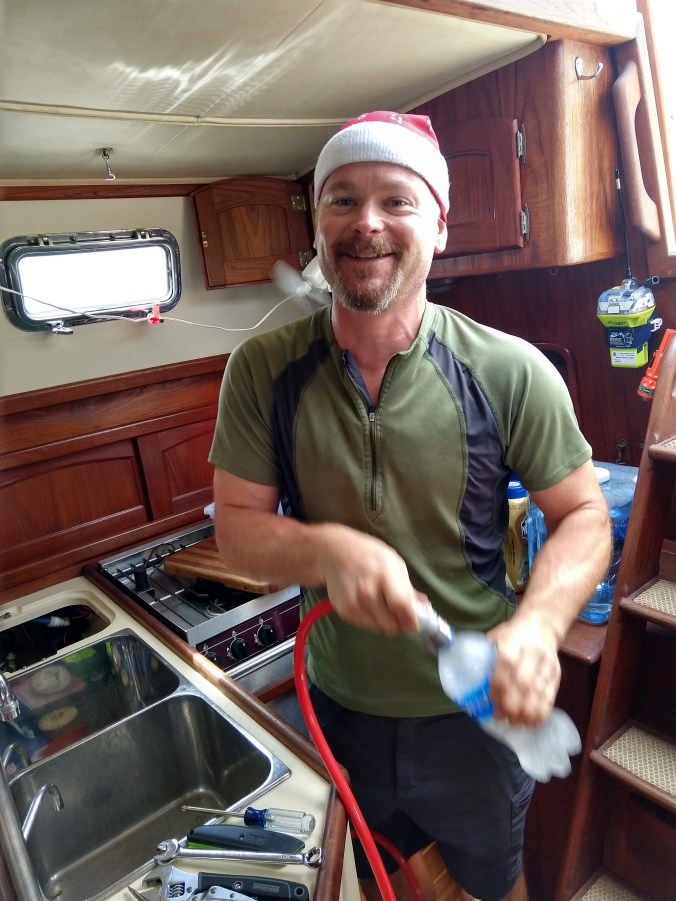
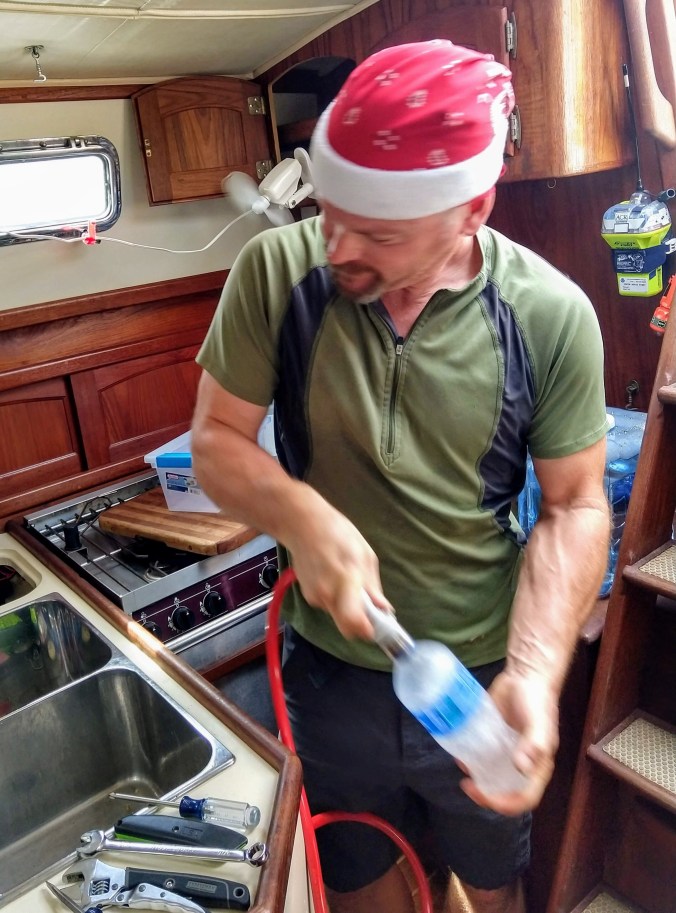
This year, Mike took a lesson from Stan on SE of Disorder, and made his own homemade soda stream. The ingenious part is that he found a little bit of unused space in the galley between the trash can and the hull of the boat to mount the CO2 canister. The hose that attaches to the water bottle comes from under the galley sink, where it is easy to access. And of course, it is a size that can be easily refilled wherever we go. Now we just need to find a buddy boat equipped with an ice maker, and we will be ready for Sundowners wherever we go!

New House Batteries

Last season, we replaced our starter battery on Marco Island once we figured out it was dead, and we were actually using our house battery bank each time we started the motor. (There’s still some important electrical stuff with the isolation switches we haven’t yet figured out, but that’s another story). By the end of the season, we found that our bank of four house batteries wouldn’t fully charge; no matter how many days of sunny weather, running the motor, or even (and this put the nail in the coffin) when we were connected to shore power overnight. Power management is a big deal to cruisers, so we bit the bullet this year and replaced our batteries. They are big. And heavy. And EXPENSIVE. But we should be good for the next five years, if we treat them nice. I did a bunch of research to find batteries that would fit in the very constrained space we have for them. Capt. Mike still had to jury rig the frame that supports the beasts. Fingers crossed that we have no more electrical issues this season!

Improving the Bed

Last year, we bought a new mattress for the V-berth. It was a definite improvement, but this princess could still feel the pea. So this year, I upgraded to a foam strip that fills in the crack where the mattress is hinged, and also added a “five zone lavender scented memory foam” extravaganza. Pretty comfy, but all these new layers barely squeeze inside the old fitted sheets.

What do you do with the extra lavender memory foam after you’ve cut the topper to fit? Why, make a hat of course! Think this will protect Capt. Mike from hitting his head on every sharp surface?

Provisioning

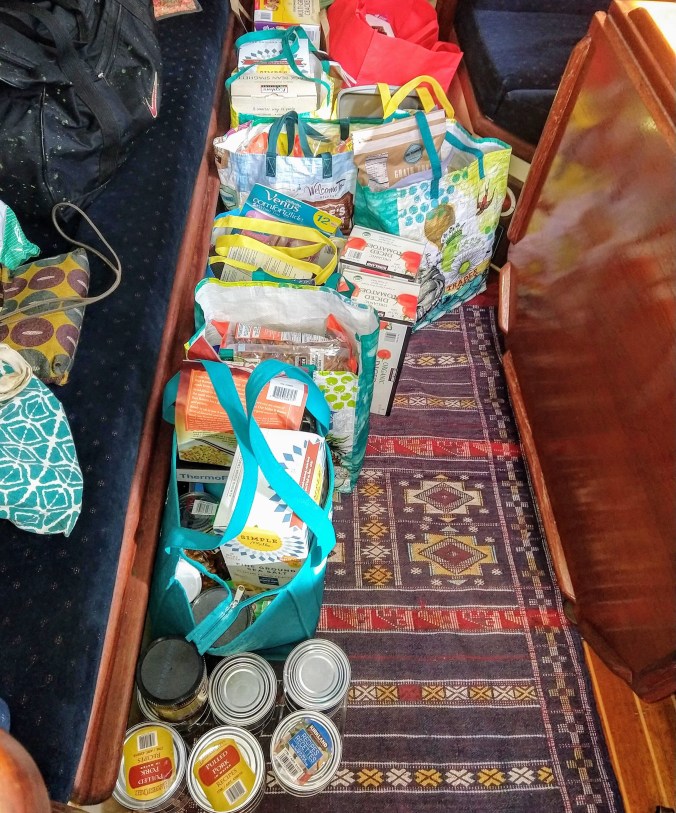
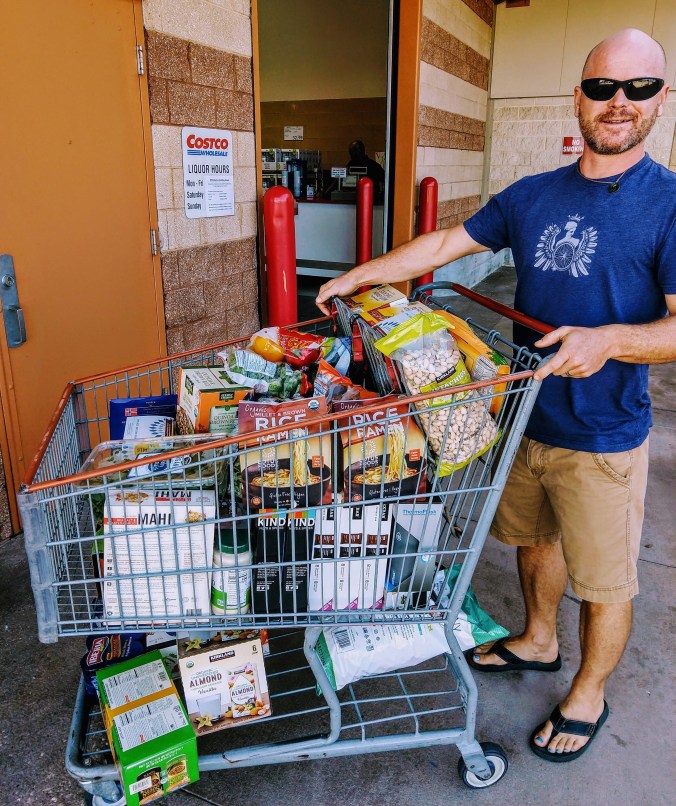
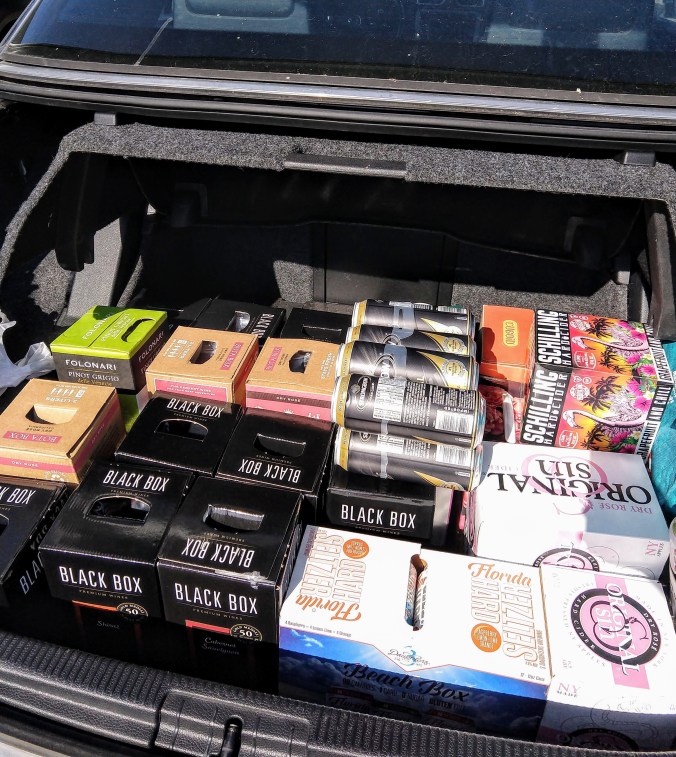
Somehow, it didn’t seem quite as intimidating to shop for months of groceries at a time as it did last year. Last year, I had a meltdown in Walmart, and called Capt. Mike saying “I can’t believe I’m doing this! I can’t believe I’m spending this much money on one trip to the grocery store!” He had to talk me down. I guess this year, I understand that this really isn’t the last time I’ll shop for food. Whatever I can buy here in St Petersburg, especially at Costco and Sam’s Club, will definitely be the cheapest I can find it. And those cans of chicken, black beans, and curry paste will form the basis of many a healthy meal over the next six months. But where ever people are, people eat. And therefore, we’ll be able to augment what I buy and stash away now with veggies, cheese, and meat if we run out along the way. We might even be able to find gluten free bread here and there. (Although if we can’t, that’s ok too. Probably healthier to skip bread all together). I did learn a few lessons last year. Canned green beans are disgusting. Even though I know I should eat my veggies, they are not worth putting in my mouth, so don’t bother buying them. We can happily eat Thai food at least once or twice a week. So might as well stock up on curry paste and pad Thai sauce at the local Asian market: even canned chicken tastes good this way! Fill whatever storage space is left over when we’re ready to cruise with tortilla chips. Why not? Everyone loves tortilla chips and they are easily twice to three times as expensive in the Bahamas. But eat the oldest ones first, because even a sealed bag can magically go stale in the hold of a sailboat!

Stainless Steel really isn’t

So this is going to be a boring post for the landlubbers out there. It’s basically just about cleaning. But you boat owners know that there are at least two boat projects that never end: varnishing the teak, and polishing the stainless.

And unlike many (many) boat maintenance projects, I actually tried to keep on top of the stainless steel hardware on Sanitas last cruising season. Especially on the bow, which is constantly covered in salt water and gets incredibly rusty incredibly fast, I spent several otherwise lovely afternoons scrubbing. But I never really got it perfectly clean, and I just assumed I was doing it wrong.

So while we were in the boatyard, and time and fresh water were plentiful, I decided to go all in. I RESEARCHED. Reading articles on Practical Sailor, YachtUnlimited, and Boatlife, and went down the rabbit hole of way too many discussion threads. I weighed the relative advantages of “Best Value” cleaning products vs highly rated cleaning products, and you always need to consider environmentally friendly options. I may have gone overboard on buying cleaning products.

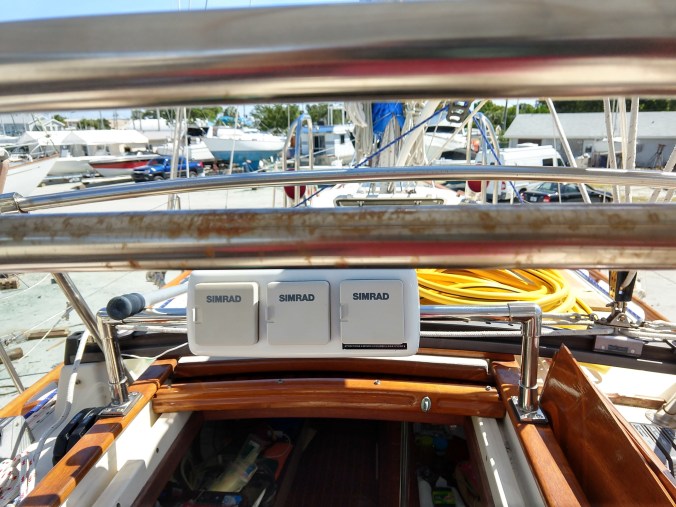
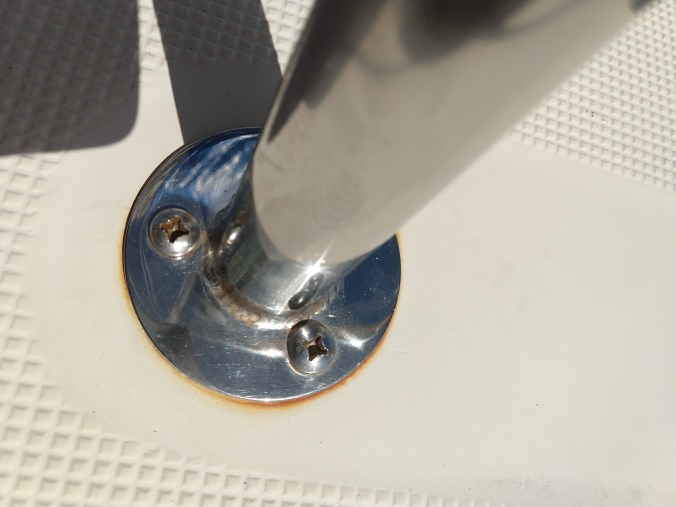
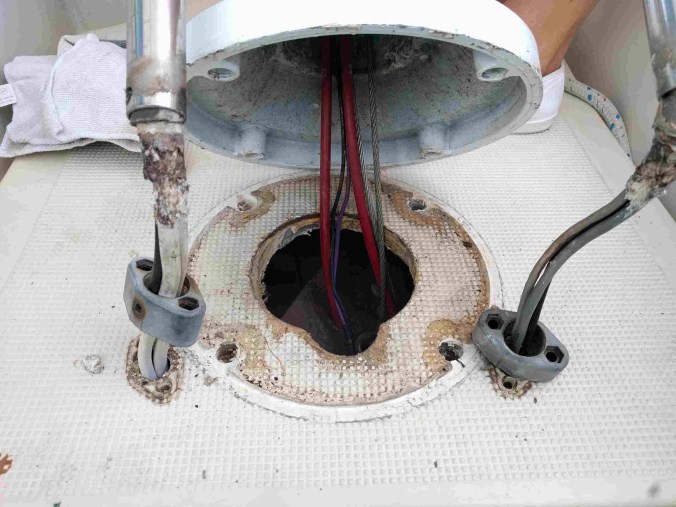
I didn’t do the greatest job of capturing the full extent of the rust problem, but here are a few examples of how terrible it looks:

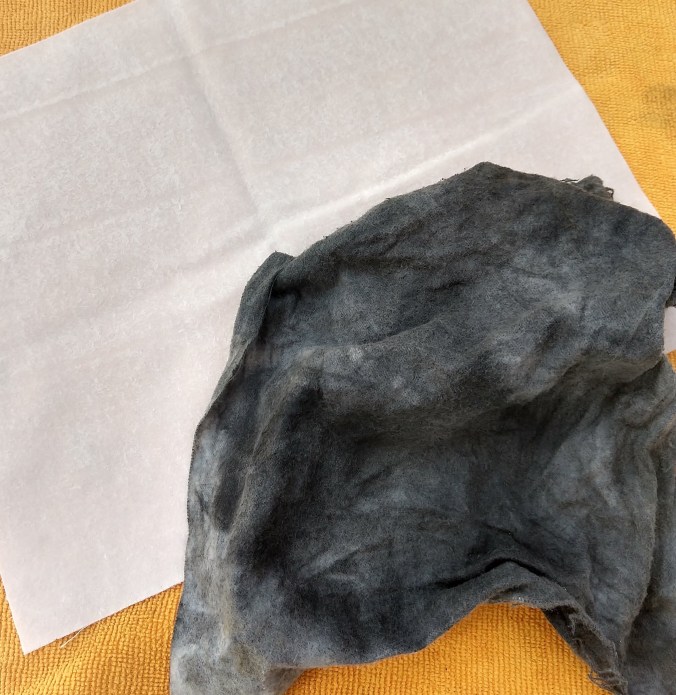
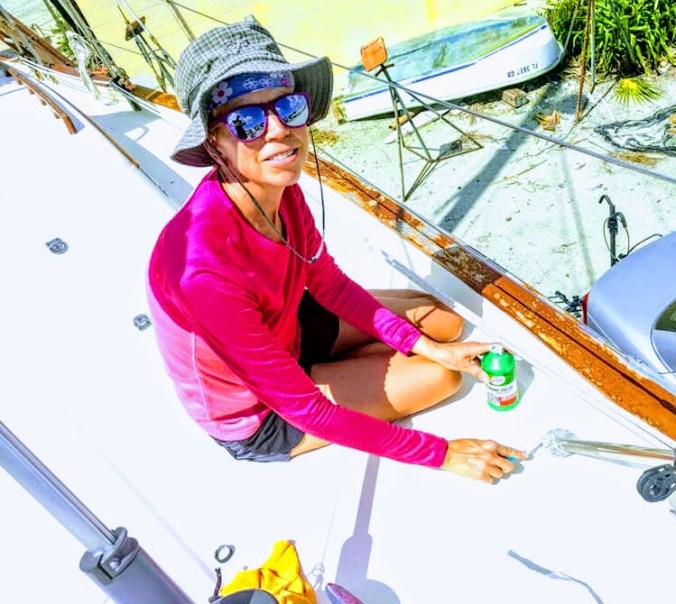
So I spent the next three days scooting around on my butt on the non-skid deck (ouch) attacking every bit of rust with a microfiber cloth or a toothbrush. Are you curious which stainless product worked the best? NOT the super expensive Flitz polish I could only find on eBay. NOT the super cheap turtle wax automotive polish I could find at Walmart. (Although it wasn’t half bad) but the Miracle Cloth is truly and totally miraculous. No waiting, no scrubbing. It even took the rust off the bow sprit. And even off the standing rigging and life lines. I’m sold. Not to mention that it is made with coconut oil that smells so…. good… every time I open the bag. Do you think if I write enough good things about it they will sponsor me and send me a lifetime supply? In theory, you can use the miracle cloth over and over again, but I may have pushed it to the limit. The white square in this picture is a new, pristine miracle cloth, and the crumpled black blog is one that I used for a few hours one afternoon. it still kind of works, but it isn’t much fun to touch.

Checkout the fashionable outfit that all the cool kids wear while polishing the stainless steel with a toothbrush! As an added bonus, you can see how bad the teak woodwork looked before I refinished it. It’s a great reminder. I’m already used to how much better the woodwork looks, and I’ve forgotten how much it needed all of those long hours of effort!

I’ve heard other boat owners describes as “she’s so meticulous at keeping her boat pristine. She’s out there every day with a toothbrush.” Huh. Maybe I have become that boat owner?

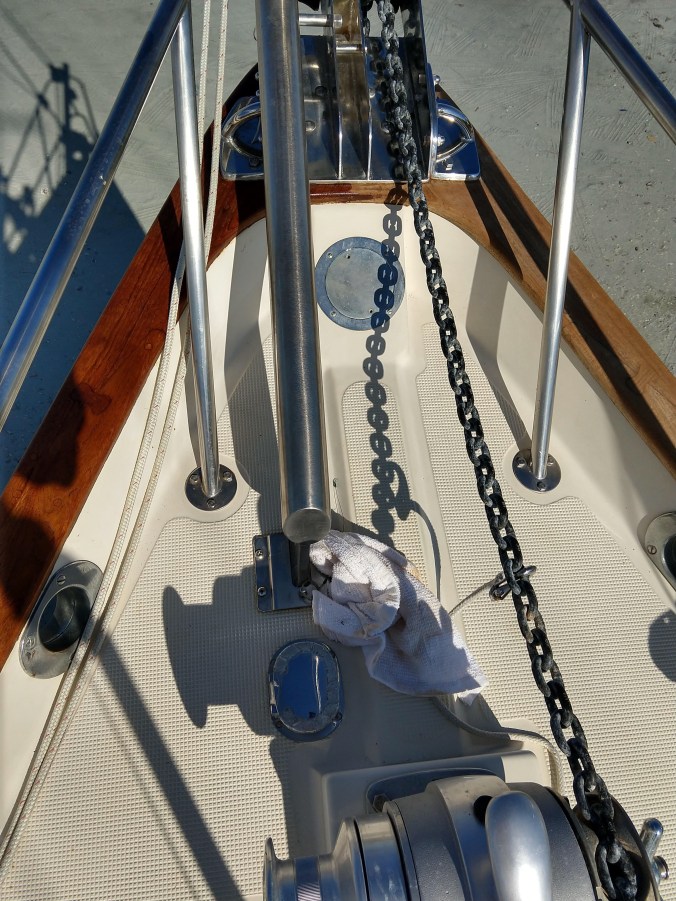
Here are a few photos on the shiny stainless post-polishing.i don’t think they do it justice. Maybe I will post a few more, just to capture the one moment in time that all of Sanitas’s stainless steel is shiny and clean, before we untie the lines, head into the waves…….and start accumulating rust once again!

Boat Project #1 – Fixing the Leaks

Jumping back in time a bit, this is the first project Capt. Mike and I took on when we returned to the boatyard after our summer vacation. We had done a pretty good job of preparing Sanitas for storage; we didn’t have any serious problems with bugs, mold, or rain water intrusion. Or at least that’s what we thought at first….

Upon closer inspection (i.e.: crawling back into the quarter berth and discovering it was squishy) we found three different leaks that needed to be addressed first thing! The simplest project was re-bedding the fresh water deck fill. Basically, the hardware that allows us to hook up a hose and fill the aft water tank was old, and no longer sealed properly. Now rain water could get around that fitting and flow into the cockpit lockers, soaking the items that we store there, and creating a rusty, slimy mess. Oh what a difference a year makes! Last year when we discovered leaky deck fittings, we agonized over how to fix them, what sort of adhesive to use, and the relative virtues of butyl tape. This year, Capt. Mike jumped right in and replaced the O-rings and fixed the seal in just a couple of hours. I think he even did it with only one trip to West Marine!

As always happens in boat projects, fixing one problem leads to finding a new problem. BECAUSE all that water had been leaking into the cockpit locker, the bulkhead that divides the storage locker from the living space inside the boat was seriously rotted, and was the cause of our squishy-slimy quarterberth. So Capt. Mike addressed Leak #2 by digging out the black, rotten wood with a screwdriver and scraper. Once he finally reached good (not rotten) wood, he used a dremel to cut out material to be patched. Now it turned into a normal boat project, because we had to put this whole effort on hold for a few days while ordering and waiting for delivery of new dremel heads – this project burned through them fast! After cutting out all the rotten wood, Capt. Mike cut a new solid piece of wood to fit the hole, epoxyed it in place, and applied fiberglass mat to seal it all. A final coat of paint to make it pretty, and this second leak was also vanquished.

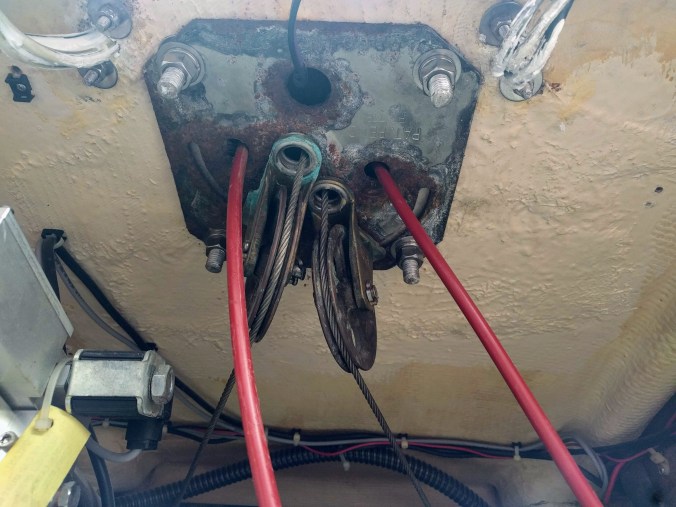
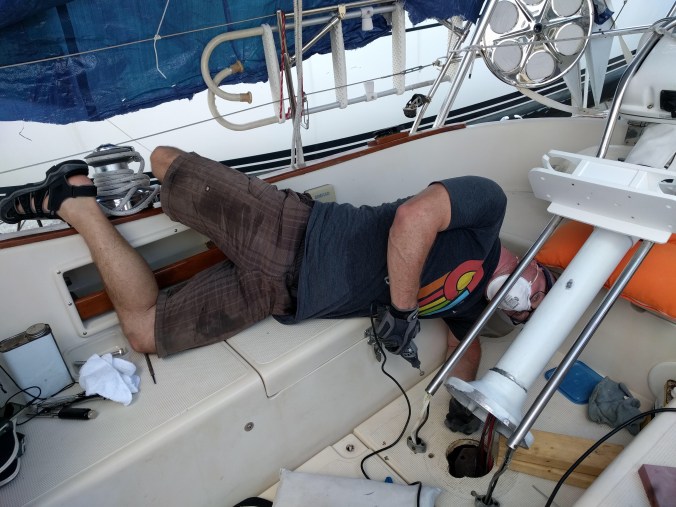
The final cockpit leak snowballed into quite a large project. During one of Capt. Mike’s frequent trips into the bowels of the boat to inspect the transmission and steering systems, he discovered that tons of water had been leaking through the base of the steering pedestal, causing lots of sensitive equipment below to rust and corrode faster than necessary. So we decided to re-bed the steering pedestal too.

But once we started looking closely at the steering pedestal, we noticed the paint had blistered and developed corrosion underneath. The quick re-bedding project turned into a week-long effort to sand down the blemishes, apply aluminum primer, and to apply four or five coats of white paint. All performed within temperature and humidity levels higher than the manufacturer’s recommendation! we had the cockpit all strung up with trip hazards and “Do not touch -wet paint” signs for over a week, even suspending the steering pedestal in mid air for much of the time to allow it to dry completely.
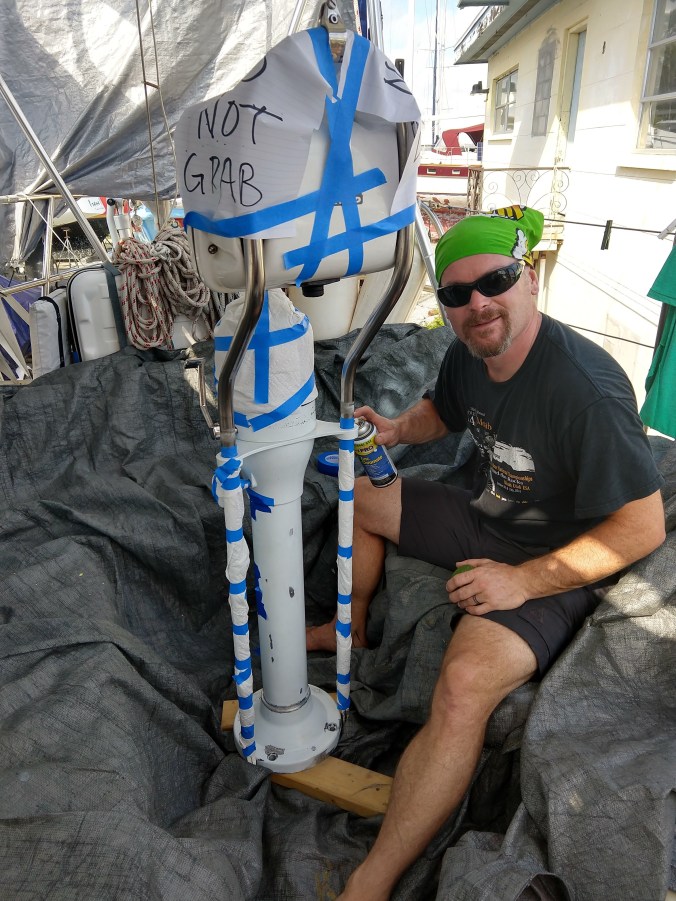
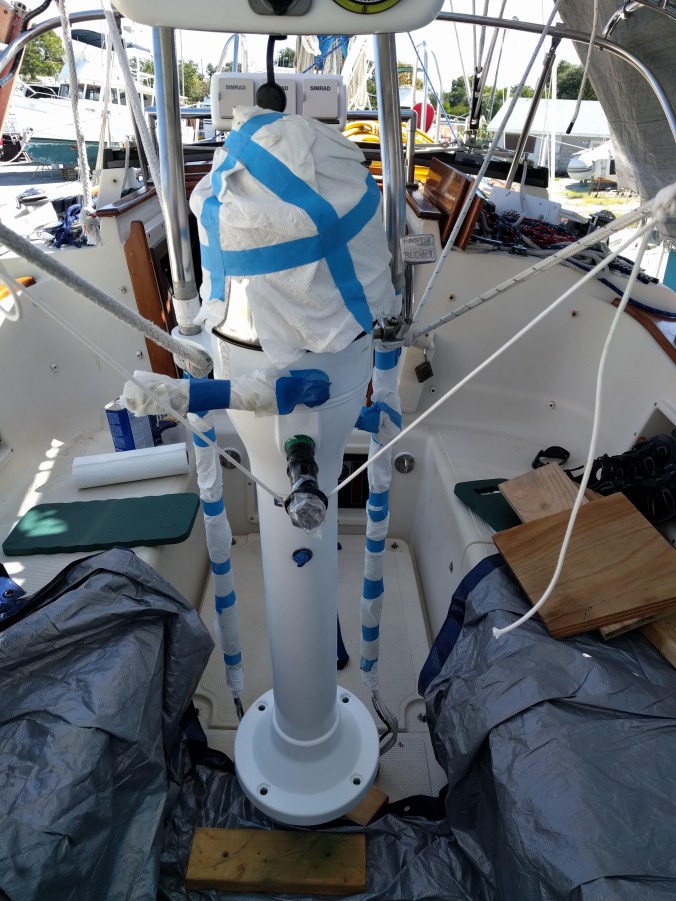
I have never claimed to have good balance, and if there’s something available to stub my toe on, I will stub it. So believe me, I was thrilled to finally complete these cockpit projects and to restore relative order to the boatyard chaos. And ….no more cockpit leaks!